
Oceans and Life
Chapter 1 | Class 9th
NCERT
Language
Choose your preferred language
Oceans and Life
🎨 Reading Colors
Background
Text Color
Table of Contents
- Ocean Relief
- Movement of Ocean Water—Waves, Tides, and Currents
- Cyclones and Tsunamis—Early Warning Systems
- Marine Resources and Their Significance
- Maritime Zones
- International Maritime Rules and Regulations
Ocean Relief
- The ocean floor has several landforms, just as land has mountains, valleys, and plains; these underwater landforms are together called submarine relief or ocean relief.
- Important submarine relief features include underwater mountains, valleys, plateaus, and trenches.
- The Mariana Trench in the Pacific Ocean is the deepest place on Earth, while the Mid-Ocean Ridge is the world’s longest mountain range, hidden beneath the ocean.
- Some underwater mountains, such as Mauna Kea in Hawai‘i, are even taller than Mount Everest.
- The continental shelf is the submerged, shallow edge of a continent that extends under the ocean; it is rich in marine life and resources such as oil and gas.
- The continental slope is the steep slope that marks the true edge of a continent.
- The abyssal plain is the vast, flat, and deep part of the ocean floor.
- Ocean trenches are the deepest parts of the ocean.
- The mid-ocean ridge is an immense underwater mountain range formed by volcanic activity.
- Seamounts are often volcanic underwater mountains, and some are flattened by wave action over millennia to form guyots.
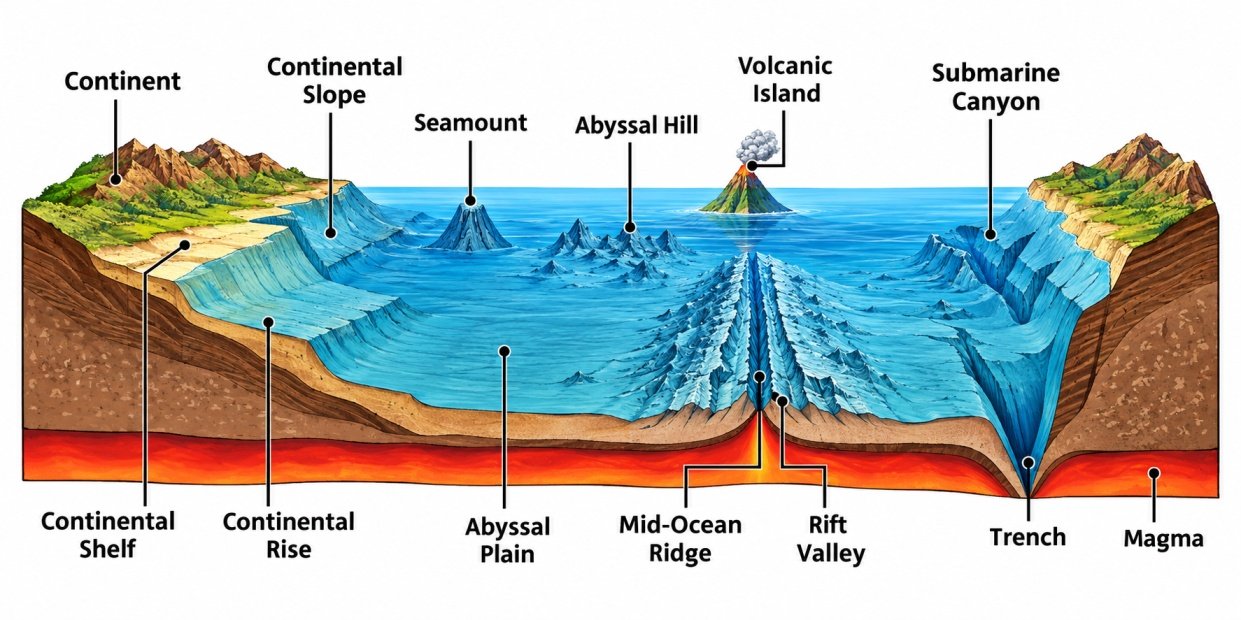
- Submarine Relief