
Subject resourcesQuick Links
Administration in Gupta Period
(Detailed Notes)
Ancient History of India
CUET PG HISTORY
Language
Choose your preferred language
Administration in Gupta Period
🎨 Reading Colors
Background
Text Color
Table of Contents
- Background
- Features
- Administrative Divisions and Governing Officers
- Provincial Administration
- District Administration
- Administrative Unit Below District Level
- Administration in Cities
- Ministers and Other Officials
- Revenue Administration
- Judicial Administration
- Military Administration
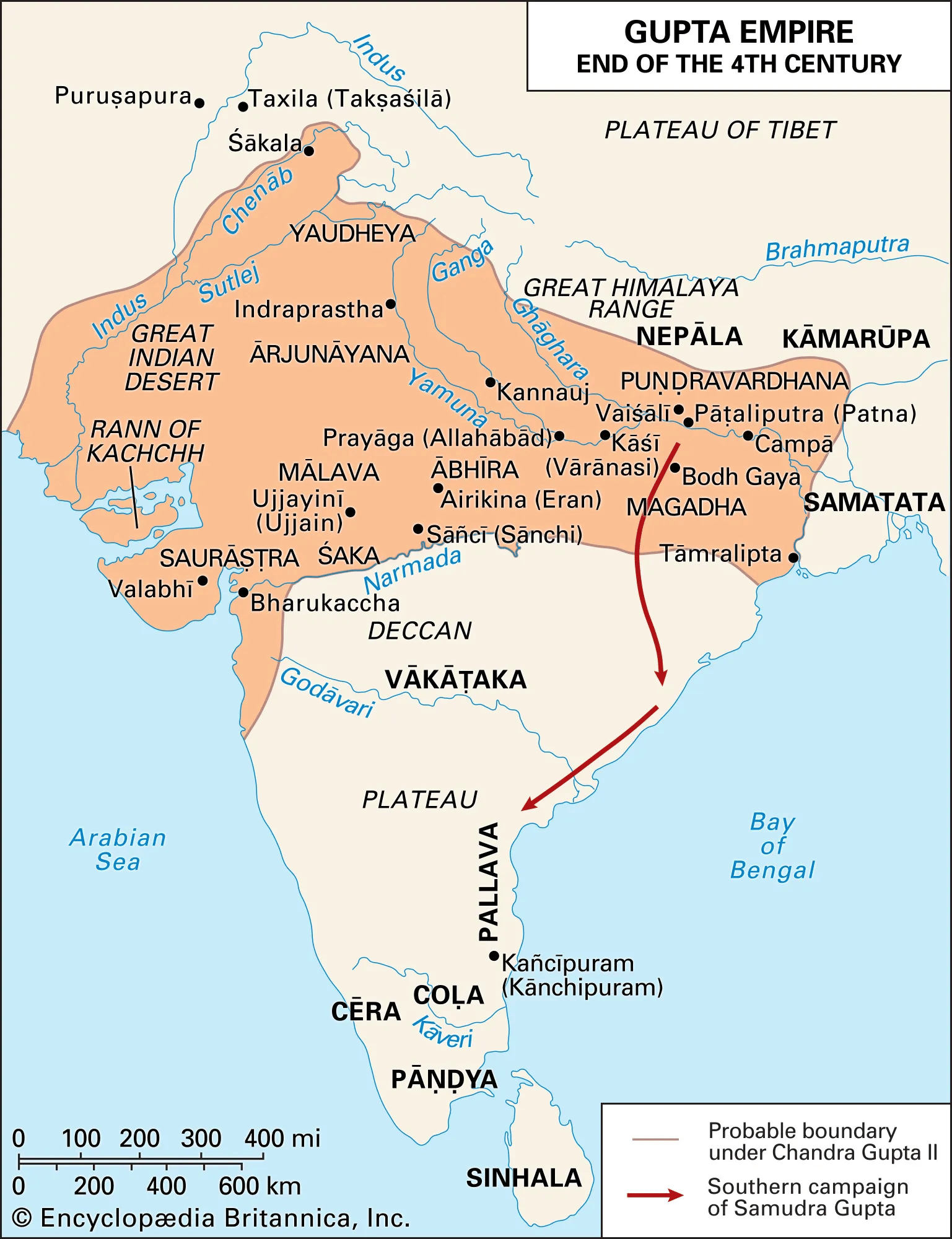
Gupta Empire covered much of the Indian subcontinent between 319 and 467 CE had top to bottom administrative hierarchy. The highest authority in the Gupta dynasty was the king, vested with political, military, and judicial powers.
Background
- The Gupta Empire, one of the most influential dynasties in ancient Indian history, thrived during the Golden Age of India from the early 4th century CE to the early 6th century CE.
- Founded by Gupta, the empire reached its zenith between 319 and 467 CE, covering a significant portion of the Indian subcontinent. The Gupta rulers, particularly Chandragupta I, Samudragupta, Chandragupta II, and Skandagupta, played pivotal roles in shaping the empire's success.
- This period is often regarded as the Golden Age due to the remarkable advancements in various fields, including art, science, literature, and philosophy.
- The Gupta Empire witnessed a flourishing of Indian culture, marked by significant achievements in literature, particularly evident in the works of the renowned Sanskrit poet Kalidasa.
- However, like many empires, the Gupta Empire eventually declined, with factors such as invasions, internal conflicts, and economic challenges playing a role in its downfall.
- Despite its eventual decline, the legacy of the Gupta Empire left an indelible mark on the cultural and intellectual heritage of ancient India.
- The empire, known by various names such as Rajya, Rashtra, Desha, Mandala, Prithvi, and Avani, exhibited a complex system of provinces and subdivisions.
- It was divided into 26 provinces, which were styled as Bhukti, Pradesha and Bhoga.
Features
King as Highest Authority:
- The highest authority in the Gupta dynasty was the king, vested with political, military, and judicial powers. (Monarchy was the dominant form).
Use of divine titles:
Claims of divine status:
|
- The authority of the king was checked by the council of ministers known as mantri parishad., who advised the king to follow Rajya Dharma.
- Mantri Parishad: Ministerial council was called Mantri Parishad. It was made up of high-ranking officials (Amatyas)such as the kumaramatya and the sandhivigrahika.
- The Gupta Empire was divided into Rajya, Rashtra, Desha, and Mandala. With these decentralized administrative divisions; the Guptas were able to command their domains efficiently. Under them, the northern territories of India were consolidated under one political entity.