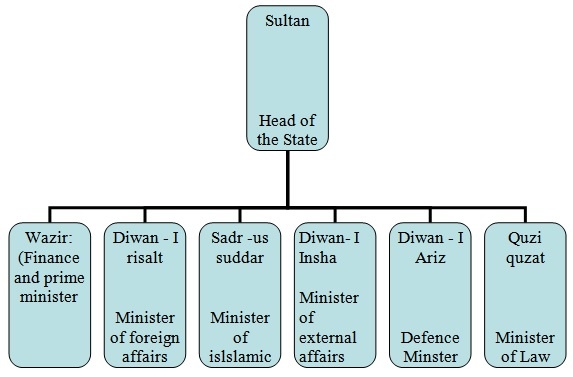
- The Delhi Sultanate period extended from 1206 CE to 1526 CE for almost 320 years. The establishment and expansion of the Delhi Sultanate led to the evolution of a powerful and efficient administrative system.
- Administration during the Delhi Sultanate was based on the laws of the Shariat or the laws of Islam. Political, legal, and military authority was vested in the Sultan. Thus military strength was the main factor in the succession of the throne.
- At its zenith, the Delhi Sultanate controlled almost the entire country as far south as Madurai. Even after its disintegration, the Delhi Sultanate and its administrative system made a powerful impact on the Indian provincial kingdoms, and later on the Mughal system of administration.
The Sultan
- The title of ‘Sultan’ was started by Turkish rulers and Mahmud of Ghazni was the first to assume the title of Sultan. The Delhi Sultanate was an Islamic state with its religion as Islam. The Sultans considered themselves as representatives of the Caliph. They included the name of the Caliph in the khutba or prayer and inscribed it on their coins. This practice was even continued by Balban, who called himself the shadow of God. Iltutmish, Muhammad bin Tughlaq, and Firoz Tughlaq obtained mansur (letter of investiture) from the Caliph.
- The office of the Sultan was the most important in the Sultanate and he was the ultimate authority for the military, legal, and political matters. The dispensation of justice was another important function performed by the Sultan and he acted as a court of appeal.
- For instance, Balban dispensed justice with extreme impartiality, not sparing even the high officers of state. Muhammad bin Tughlaq even gave harsh punishments to ulemas, who were previously exempted.
- There was no clear law of succession during this period. All the sons had equal claim to the throne. Interestingly, the idea of primogeniture was fully acceptable neither to the Muslims nor to the Hindus. Iltutmish even nominated his daughter in preference to his sons.
- But such nominations or successions were to be mostly accepted by the nobles. Sometimes, ulemas also played crucial role in getting a favourable public opinion. However, military superiority remained the main factor in matters of succession.