
Introduction
- In order to maximize the production from the available resources and prevailing climatic conditions, need-based, location specific technology needs to be generated. Delineation of agro-climatic zones based on soil, water, rainfall, temperature etc. is the first essential step for sustainable production.
- Agro-climatic regions were devised by planning commission in 1989. It was based on land survey, soil survey and agricultural survey of rural India.
- An “Agro-climatic zone” is a land unit in terms of major climates, suitable for a certain range of crops and cultivars. The planning aims at scientific management of regional resources to meet the food, fibre, fodder and fuel wood without adversely affecting the status of natural resources and environment.
- Agro-climatic conditions mainly refer to soil types, rainfall, temperature and water availability which influences the type of vegetations.
Agro-Ecological Zone
- An Agro-ecological zone is the land unit carved out of agro-climatic zone superimposed on landform which acts as modifier to climate and length of growing period.
- India is a country of great geographical diversity. The variations in its terrain, temperature, rainfall and soils have closely influenced the cropping patterns and other agricultural activities.
Delineation Of Agro-Climatic Regions
- For the planning and development of agriculture in 1989, the Planning Commission and the National Remote Sensing Agency (NRSA) have divided the country into 15 agro-climatic regions. In the delineation of these agro-climatic regions, the physical attributes of the region and socio- economic characteristics have been taken into consideration.
The main objectives of delineating agro-climatic regions are:
- To optimize agricultural production.
- To increase farm income.
- To generate more rural employment.
- To make a judicious use of the available irrigation water.
- To reduce the regional inequalities in the development of agriculture.
There are 15 agro-climatic zones in India which are:-
- Western Himalayan Region
- Eastern Himalayan Region
- Lower Gangetic Plains Region
- Middle Gangetic Plains Region
- Upper Gangetic Plains Region
- Trans – Gangetic Plains Region
- Eastern plateau and Hills Region
- Central Plateau and Hills
- Western Plateau and Hills
- Southern Plateau and Hills
- East Coast Plains and Hills
- West Coast Plains and Ghats Region
- Gujarat Plains
- Western Dry Region
- The Islands Region.
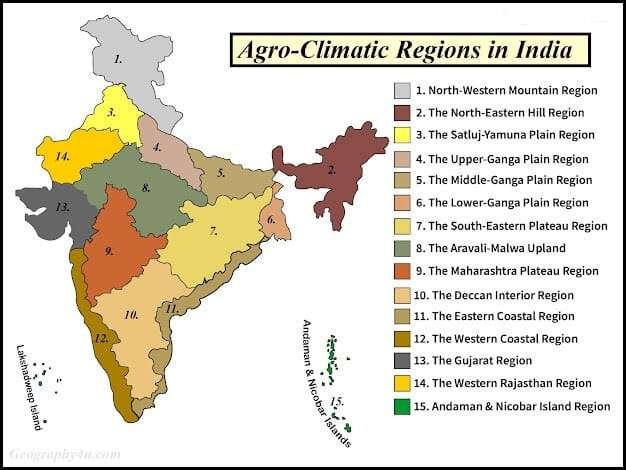
Agro Climatic Zones of India
While answering the question on Agro-climatic regions the answer must be segregated in the following divisions:
- Location and topography
- Climatic Conditions
- Agricultural information
- Socio-economic aspects and suggestions.