
Psychological testing covers several core areas, including intelligence (IQ), personality, aptitude, achievement, neuropsychological, and projective measures. These tests, often used in clinical, educational, and workplace settings, evaluate cognitive functions, emotional stability, skills, and subconscious thoughts to diagnose conditions or predict performance.
Intelligence Test Psychology
History of Assessment of Intelligence
If we look back at the history of modern intelligence testing, we find that it began in the nineteenth century with a growing interest in the care and treatment of mentally retarded individuals (now referred to as intellectual disability).
In 1838, a French physician named Esquirol observed that there are different degrees of mental retardation, ranging along a continuum from normal functioning to severe impairment. He attempted to classify these levels based on linguistic ability, as he believed that a person’s use of language was the most reliable indicator of intelligence.
Another French physician, Seguin, established the first school for the education of mentally challenged children in 1837. He used a physiological method of training, which involved exercises aimed at improving sensory discrimination and motor control. Some of the techniques he developed later became part of nonverbal intelligence tests. One of his well-known contributions is the Seguin Form Board Test, where individuals are required to place blocks of different shapes into matching spaces on a board as quickly and accurately as possible. This test is still used today.
The English biologist Sir Francis Galton (1883) believed that intelligence was closely related to a person’s ability for sensory discrimination, such as distinguishing between different stimuli. He developed several tools like the Galton bar, Galton whistle, and weighted objects to measure kinesthetic discrimination. Galton argued that these sensory tests could be used to assess intelligence.
Similarly, James McKeen Cattell supported Galton’s view and emphasized the role of sensory processes in measuring intelligence. These early efforts laid the foundation for the later development of more advanced and systematic intelligence tests.
The Binet-Simon Scale: The First Intelligence Test:
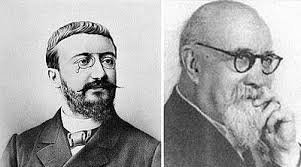
In 1904, the French Government appointed Alfred Binet to develop a method for identifying children with below average intelligence, so that they could receive special education.
With this objective, in 1905, Binet, along with Theodore Simon, developed the first intelligence test, popularly known as the Binet–Simon Scale. This was the first systematic attempt to measure intelligence scientifically.
The scale consisted of 30 problems that assessed various mental functions such as judgment, comprehension, and reasoning. Binet considered these functions to be the core components of intelligence. The items in the test were arranged in increasing order of difficulty, making it possible to assess different levels of intellectual ability.
To standardize the test, the items were administered to 50 normal children between the ages of 3 and 11 years, as well as to some mentally retarded children and adults. This helped in determining the difficulty level of each item.
However, in this early version of the test, there was no precise method for calculating a total score, which was a limitation that later revisions of intelligence tests attempted to overcome.
The Revised Scales and the Advent of IQ:
In 1908, Binet and Simon revised their earlier 1905 intelligence scale. Since the original test was mainly designed to identify children with below average intelligence, many of its items were very simple. In the revised version, several easy items were removed and new, more appropriate items were added.
The major innovation in this version was the introduction of the concept of mental level. The test was standardized on about 300 children aged between 3 and 13 years. Binet and Simon organized the test items according to age levels, placing items typically passed by children of a particular age under that age category. For example, items passed by 80–90% of 3-year-old children were placed at the 3-year level, and this pattern continued up to age 13.
The scoring system included determining a basal age, which is the highest age level at which a child could pass all items, along with additional credit for partially completed higher levels. The final score was expressed in terms of mental level, which indicated the age at which an average child performs at the same level. For instance, a 7-year-old child performing like a 9-year-old would have a higher mental level. Later, the term mental level was replaced by mental age.
Mental age was then compared with the chronological age to determine an individual’s intellectual level. For example, if an 8-year-old child has a mental age of 6 years, the child is considered to be delayed by 2 years. Conversely, if the mental age is 10 years, the child is considered advanced by 2 years.
In 1912, William Stern introduced the concept of IQ (Intelligence Quotient), defined as the ratio of mental age to chronological age.
In 1911, the Binet-Simon scale was revised again, extending it up to the age of 16 years by adding more items. Later, the American version of the test was developed by Terman and Merrill at Stanford University in 1916, known as the Stanford-Binet Intelligence Scale. Terman also proposed multiplying the IQ ratio by 100 to eliminate fractions and make the score easier to interpret.
IQ= (Mental Age / Chronological Age) x 100
In fact, intelligence testing is considered one of the major achievements of psychology in the twentieth century. After the success of the Binet–Simon scale, many other intelligence tests were developed and refined over time, improving both their accuracy and usefulness.
These tests can be broadly classified into different categories based on their method of administration and the nature of test items. One important classification is into individual tests and group tests, depending on whether the test is administered to a single person or to a group of individuals at the same time.
Another classification is based on the type of content used in the test, such as verbal tests and non-verbal tests. Verbal tests rely on language skills like reading and understanding words, while non-verbal tests use symbols, figures, or patterns and are less dependent on language.
A third category includes performance tests, which assess abilities through tasks involving manipulation of objects, visual perception, or motor skills rather than verbal responses.
Thus, intelligence tests can be categorized in multiple ways depending on their administration and the type of abilities measured, providing a comprehensive approach to understanding human intelligence.
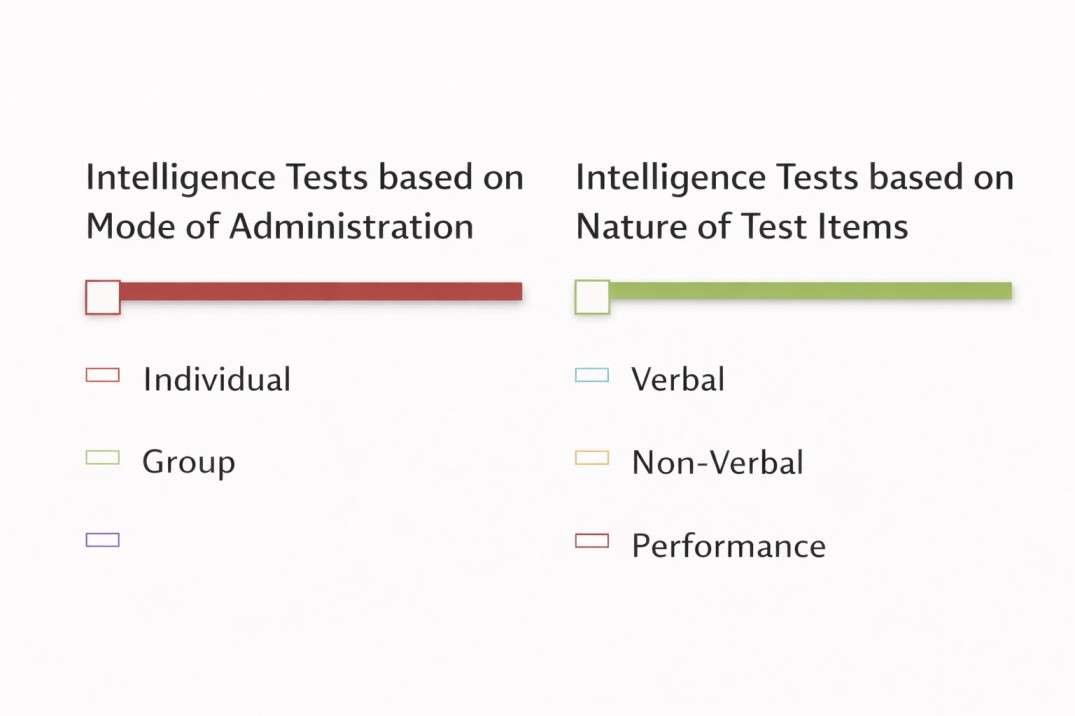
Types of Intelligence Tests
Intelligence tests are used in a variety of situations due to their usefulness in assessing an individual’s abilities and potential:
The most common use is in the educational setting. Because intelligence tests show a strong correlation with academic achievement, they are often used as measures of scholastic aptitude, helping in decisions related to student placement and progress.
These tests are also used with adolescents and adults for educational and occupational counseling, as well as in personnel selection. They help individuals choose suitable careers and assist organizations in selecting appropriate candidates.
In a clinical setting, intelligence tests are used for the identification and classification of individuals with intellectual disability, aiding in diagnosis and planning of appropriate interventions.
When using intelligence tests for educational, career, or clinical purposes, it is important to consider certain essential qualities. These are known as the characteristics or properties of a good test, which determine how effective and reliable the test is in measuring what it is intended to assess.
Properties of a Good Test:
While selecting a test for a particular purpose, it is important to consider its psychometric properties. The three main properties of a good test are standardization, reliability, and validity.
An essential feature of any test is standardization, which includes two important aspects. First, there must be uniformity in the administration and scoring procedures, ensuring that every individual is tested under the same conditions. Second, standardization involves the establishment of norms, which represent the average or typical performance of a defined group. Before using a test, it is important to examine the characteristics of the standardization sample on which these norms are based.
Another key property is reliability, which refers to the consistency of scores. A test is considered reliable if it produces similar results when the same person is tested again, whether using the same test, an equivalent form, or when administered by different examiners.
The third property is validity, which indicates whether the test actually measures what it is intended to measure. A valid test ensures that the results accurately reflect the ability or trait being assessed.
Thus, it is essential to use intelligence tests that possess strong psychometric properties, as this ensures accurate and meaningful results. If a test lacks these qualities, it may lead to incorrect conclusions, mislabeling, and even stigma for the individual being assessed.
Individual Tests
Stanford-Binet Scale of Intelligence:
You have already read about the Binet–Simon scale (1905, 1908, 1911) in the earlier section. This test was later translated and adapted by Terman (1916) along with his associates at Stanford University. This American version of the test introduced a number of new items and also revised several of the existing ones to make them more suitable for the target population. Furthermore, the entire scale underwent re-standardization based on an American sample consisting of 1000 children and 400 adults, which improved its reliability and applicability. Over time, the test continued to evolve, and its fifth version, known as the Stanford–Binet scale (SB5), was officially released in 2003, reflecting modern developments in intelligence testing.
Major Developments in the Binet-Simon and Stanford-Binet Scale
| Year | Test/Authors | Comments/ Developments |
|---|---|---|
| 1905 | Binet and Simon | Simple 30 item test |
| 1908 | Binet and Simon | Introduced the mental age concept |
| 1911 | Binet and Simon | Expanded to include adults |
| 1916 | Stanford-Binet (Terman and Merrill) | Used the concept of IQ |
| 1937 | Stanford-Binet-2 (Terman and Merrill) | First use of parallel forms (L and M) |
| 1960 | Stanford-Binet-3 (Terman and Merrill) | Modern item analysis method used |
| 1972 | Stanford-Binet-3 (Thorndike) | SB-3 re-standardized on 2100 persons |
| 1986 | Stanford-Binet-4 (Thorndike, Hagen, and Sattler) | Content coverage was broadened by 15 subtests |
| 2003 | Stanford-Binet – 5 (Roid) | Five factors of intelligence |
The SB5 Model of Intelligence:
The Stanford–Binet Fifth Edition (SB5) model of intelligence consists of 10 subtests designed to assess a wide range of intellectual and cognitive abilities. It evaluates five major cognitive factors: Fluid Reasoning, Knowledge, Quantitative Reasoning, Visual-Spatial Processing, and Working Memory. Each of these cognitive factors is measured through two subtests, ensuring a balanced and comprehensive assessment.
In earlier versions of the Stanford–Binet, the test mainly produced a composite IQ score. However, the SB5 provides a more detailed evaluation by offering three IQ scores—namely Full Scale IQ, Verbal IQ, and Nonverbal IQ—along with five factor scores corresponding to the cognitive domains. The mean and standard deviation (SD) for all these scores (both IQ and factor scores) are set at 100 and 15, respectively, which allows for standardized interpretation.
The SB5 is suitable for individuals ranging from 2 years to 85 years of age, making it applicable across a broad lifespan. The test was standardized on a large sample of 4800 individuals in the United States, carefully stratified according to gender, ethnicity, region, and educational level, based on data from the 2000 census.
In terms of psychometric properties, the SB5 demonstrates strong reliability and validity. The reliability coefficients for the three IQ scores are in the .90s, indicating a high level of consistency, while the reliability of the subtests ranges from .70 to .85, which is considered acceptable to good in psychological testing.