
Atmosphere and Climate
Chapter 3 | Class 9th
NCERT
Language
Choose your preferred language
Atmosphere and Climate
🎨 Reading Colors
Background
Text Color
Table of Contents
- Composition and Structure of the Atmosphere
- Weather and Climate
- Seasons in India
- Climate Change
- The atmosphere is a blanket of air surrounding the Earth, which makes us see floating clouds, sunshine, and feel the breeze; it is pulled down around the Earth by gravity and is a mixture of gases in various proportions, vital for the survival of all living beings on the Earth.
- The atmosphere shields us from harmful radiation coming from the Sun, including ultraviolet radiation, and regulates the Earth’s temperature by trapping some of the Sun’s energy and preventing it from escaping back into space.
- The atmosphere is a key component of the Earth’s weather and climate systems, influencing factors such as temperature, humidity, and air pressure.
Composition and Structure of the Atmosphere
Composition of the Atmosphere:
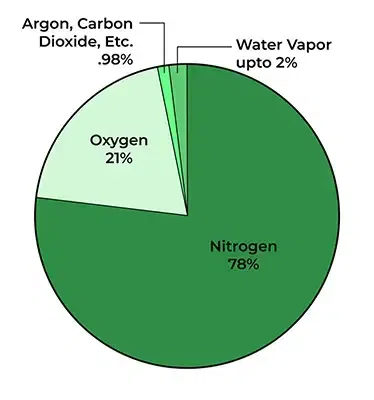
- The Earth’s atmosphere is composed of a mixture of various gases, in which nitrogen and oxygen are the two primary and most abundant gases essential to life on the Earth, while carbon dioxide, argon, helium, neon, krypton, xenon, ozone, and hydrogen are other gases present in lesser quantities; besides these, the atmosphere also consists of water vapour and tiny dust particles.
- The amount of water vapour in the atmosphere varies, but it generally ranges from 0.1 per cent to 0.4 per cent, and it plays a significant role in cloud formation and precipitation; the composition of the atmosphere also varies with altitude.
Structure of the Atmosphere:
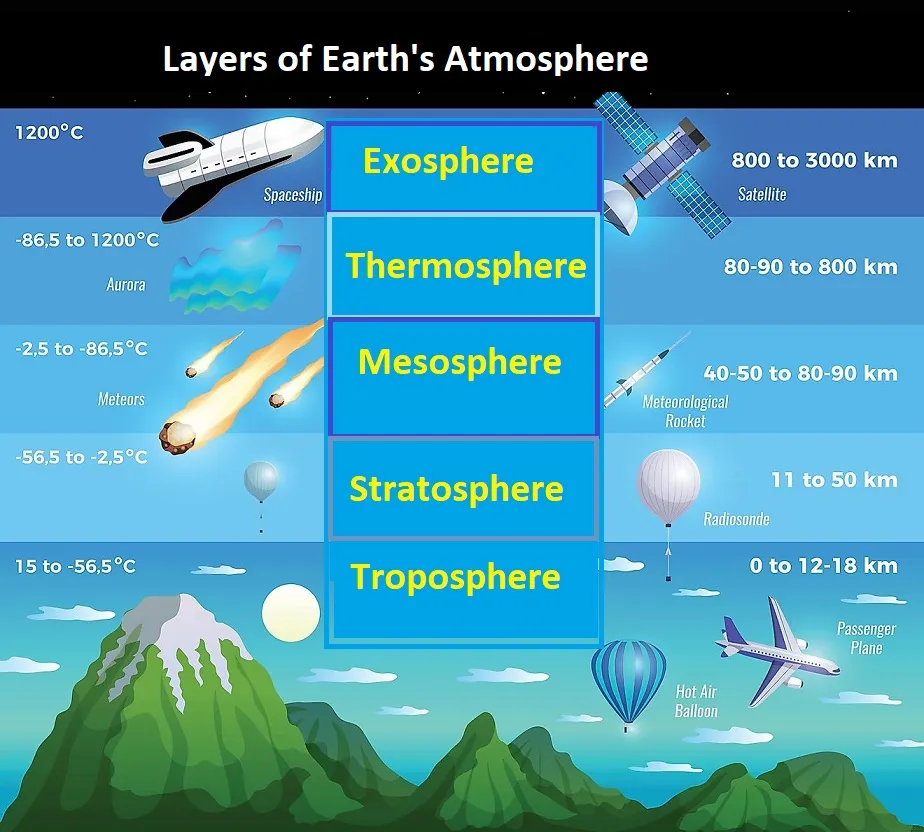
- The atmosphere has a layered structure, with layers defined on the basis of changes in temperature and density with increasing altitude; the density of air is highest near the Earth’s surface and decreases with altitude, and the major layers extend from the Earth’s surface to outer space.
- The troposphere is the most important layer of the atmosphere, with an average height of about 12 kilometres, where temperature decreases with increasing altitude; it contains the air we breathe, most of the water vapour and clouds, and nearly all weather phenomena such as rainfall, fog, and hail, and it is separated from the stratosphere by a transition zone called the tropopause.
- The stratosphere lies above the troposphere and extends up to 50 kilometres; it is ideal for flying aeroplanes because it is free of clouds and other weather disturbances, and it contains a layer of ozone gas that shields us by filtering the Sun’s harmful radiation, including ultraviolet radiation, with the stratopause marking the boundary between the stratosphere and the mesosphere.
- The mesosphere is the third layer of the atmosphere, extending up to a height of 80 kilometres, where temperature decreases with increasing altitude, and most meteorites entering from space burn up in this layer.
- The thermosphere extends from 80 to 700 km, where temperature rises very rapidly with increasing altitude because gas molecules absorb the Sun’s X-rays and short-wave ultraviolet radiation; it helps with radio transmission by reflecting radio waves transmitted from the Earth back towards it, contains the ionosphere as a part of it, and is where the northern and southern lights, called auroras, occur.
- The exosphere is the uppermost layer of the atmosphere, characterised by very thin air, from which light gases like helium and hydrogen float into space due to weak gravity; all these layers play a vital role in the Earth’s atmospheric processes and also affect its weather and climate.
| Layer | Height | Temperature | Key Features |
|---|---|---|---|
| Troposphere | Up to about 12 km | Decreases with altitude | Most important layer; contains breathable air, most water vapour and clouds; nearly all weather phenomena occur here; separated from stratosphere by the tropopause. |
| Stratosphere | Up to 50 km | — | Ideal for aeroplanes as it is free from clouds and weather disturbances; contains the ozone layer that filters harmful solar radiation, including UV radiation; separated from mesosphere by the stratopause. |
| Mesosphere | Up to 80 km | Decreases with altitude | Most meteorites burn up in this layer. |
| Thermosphere | 80 to 700 km | Rises very rapidly with altitude | Gas molecules absorb X-rays and short-wave ultraviolet radiation; helps radio transmission by reflecting radio waves; includes the ionosphere; auroras occur here. |
| Exosphere | Uppermost layer | — | Has very thin air; light gases such as helium and hydrogen escape into space due to weak gravity. |