
Introduction
Consider the following examples:
Example 1: Sheena was taking part in 100 meters marathon in her college. But as she started running, there was a cramp in her left leg. But, despite the pain and discomfort, Sheena managed to finish the race and secure the first prize. What do you think might have made Sheena continue in the race and perform to her best?
Example 2: Sania’s brother was getting married the next day and despite being preoccupied with the marriage preparations, she ensured that the report that she had to submit to her boss, was prepared and submitted as per the time given to her. What do you think promoted Sania to prepare the report and submit it in time?
In the above two brief examples, the main question that arises is why the person (Sheena and Sania) behaved in that particular way. What was the driving force behind their behaviour? In our day today life as well, you will come across such behaviours, where you may wonder why certain individuals behaved the way they did. From getting something to eat, to helping a person injured in an accident, to completing work in time, one of the significant factors that can play a role is motivation. As certain behaviours may be displayed due to motivation, it is also possible that an individual may not behave in certain ways because of lack of motivation. For example, a student may not do well in his/ her examination because he/ she never felt motivated enough, intrinsically or extrinsically or an individual may not perform to his/ her best at work due to lack of motivation.
From the above examples, it may be concluded that motivation is a key factor that determines human behaviour and thus, it is also important, as a student of psychology, that we understand this term in a better way.
Concept of Motivation
Motivation is the need within the individual to do something or to fulfill your desire. There are certain internal and external factors that are responsible for stimulating a desire and providing us with the energy to pursue our goals, needs and desires.
Motivation involves three aspects that need to be understood. First, it talks about a need state in the organism that drives him/her towards the satisfaction of the bodily need. This need could be due to internal thoughts and feelings or could be due to external factors in the environment. Secondly, this need then induces a state of arousal or an action tendency. Thirdly, the action is directed towards attaining some goal.
Nature of Motivation
The motives are responsible for propelling our action tendencies towards a desired state or goal. Motives are not visible directly, rather they are inferred from our behaviors. For example, if we observe a student working hard day and night on her/his task, we infer that she/he is motivated to score high. If we are able to make accurate inferences then we are also able to explain the behavior observed more accurately. For example, the choice of college that you take admission in, will explain if you have a need to learn or to belong to an institution to get a degree for a good job or because it is in close proximity.
The motives help us to make choices which also in a way help us to make predictions about behavior. For example, if two friends always come together for a class, we predict that they are good friends, or if one is absent from the class, we may predict the other one will also be absent. The predictions may not be accurate but we can get a fair idea about the probability of the response or behaviour.
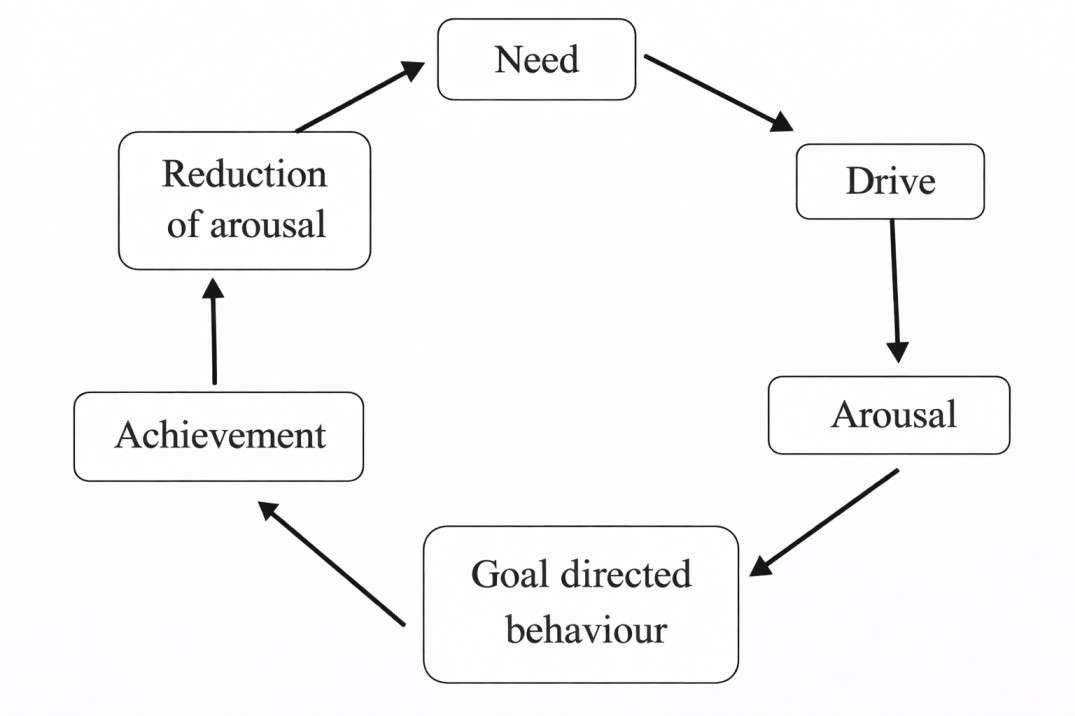
There is a motivational cycle that helps us to understand behavior (Morgan & King, 1979). This motivational cycle starts with a need, a state of lack or deficit of some necessity. The state of need leads to a driving state. Drives can be stimulated due to internal factors or external factors. Internal factors could be thoughts and memories while external factors could be the environmental factors.
This driving state arouses you and pushes you to perform some goal-directed behaviour. For example, if we are thirsty there is a need for water, this need will drive us towards attaining water and once we have consumed water, the need is satisfied and the drive is reduced or diminished. So, once the performed behaviour leads to the achievement of desired goal, it reduces the drive and organism returns to a balanced state. The motivational cycle ends here. Then it arises again after a while when the urge for water (or any other need) arises again. Figure below illustrates the motivational cycle.
Before describing further, let us discuss the four terms that are related to motivation. These four terms are needs, drives, incentives, and motives.
Needs: These are related to the biological states of cellular or bodily deficiencies that lead to drives. For example, individuals need water, food and oxygen to survive (Feist and Rosenberg, 2015).
Drives: Feist and Rosenberg (2015, pg 397) define drives as “the perceived states of tension that occur when our bodies are deficient in some need, creating an urge to relieve the tension”. This means that need leads to or compels drive. Thus, when an individual is hungry, she/he will seek food. The need leads to drive and makes individual to behave in such a way that the deficiency created is dealt with.
Incentives: This is external or is from the environment (as opposed to drive that is internal) and plays a role in motivating behaviours. It could be an object or an event. For instance, a trophy won in a game can be termed as an incentive to do well in that game.
Motives: Most often the terms motivation and motives are used interchangeably. However, they are different as motivation can be termed as a general term, whereas motive is a specific term. Motive is something that actually drives an individual to take certain action and motivation is the process within which a motive drives an individual towards certain action.
Few definitions of Motivation:
The term motivation has been derived from a Latin word ‘movere’, which means ‘to move’. There are various definitions of motivation and some of them have been mentioned as follows:
Feldman (2015, pg. 287) defined motivation as “the factors that direct and energise behaviour of humans and other organisms”.
Feist and Rosenberg (2015, pg. 397) define motivation as “the urge to move towards one’s goals, to accomplish tasks”.
Chamorro-Premuzic (2015, pg. 272) defined motivation as “an internal state, dynamic rather than static in nature, that propels action, directs behaviour and is oriented toward satisfying both instincts and cultural needs and goals”.
Quick, Nelson and Khandelwal (2013, pg. 172) defined motivation as “the process of arousing and sustaining goal-directed behaviour”.
Nolen-Hoeksema, Fredrickson, Loftus & Lutz (2009, pg. 419) describe motivation as “a condition that energizes behaviour and gives it direction”.
Types of Motivation
Biogenic Motives
Also known as biological motives, these are used as the cause to understand behaviour by earlier psychologists. When there is a departure from the balanced physiological state of the body, known as homeostasis, it arouses various biological motives to restore the balance. This balance is very important for life. There are many such motives. Some of the basic biogenic motives will be discussed in this section, like hunger, thirst and sex.
Hunger Motivation:
When there is a lack of food in the stomach, it causes hunger pangs. The stomach contracts and initiates a hunger drive. There are many reasons for hunger. Many studies have shown that after fasting, when the person uses too much of blood sugar or glucose, it causes hunger. Friedman and Stricker (1976) suggested that when there is a change in the metabolic functions of the liver, and food is less, then it initiates hunger.
There are two areas of the hypothalamus that seem to be involved in hunger. Research has shown that when lateral hypothalamus is stimulated, it initiates eating behavior. On the other hand, if this area is damaged, then it causes the animal to stop eating (Epstein, 1960). Ventro-medial hypothalamus is also involved in hunger motivation. It is known to be the inhibitory area for hunger drive. Epstein (1960) showed in his experiments that when the ventro-medial hypothalamus is damaged, then the animal does not know when to stop eating and they become overweight.
The eating behavior is also stopped by other factors. The smell of food, indigestion, and taste of food are secondary factors that may stop eating behaviour. Gibbs, Young and Smith (1973) have shown in their study that when food reaches intestine it releases a hormone in our blood known as CCK (cholecystokinin). Thus, they showed that other factors also play important role in regulating hunger, particularly satiety (the absence of hunger motivation) which signals the animal to stop eating anymore.
Hunger motivation is also believed to depend upon the levels of nutritive substances in blood. If the levels fall below a certain point, known as the set point, hunger drive is caused and food is absorbed to raise the blood levels of nutrients back to the set point. Hence, both internal and external factors are important in regulating the eating behavior.