
Introduction
The dynamic and efficient financial system plays a very pivotal role for any economy for efficient allocation of resources from surplus segment to deficit segment. The financial system consists of financial markets, financial intermediation and financial products or instruments. A thriving and vibrant economic system requires a well developed financial structure with multiple intermediaries operating in the market with different risk profiles. The financial sector in India is characterised by progressive liberal policies, vibrant equity and debt markets and prudent banking norms.
Further, a financial system helps to increase output by moving the economic system towards the existing production frontier. This is performed by transforming a given total amount of wealth into more productive forms. It induces public and investors to hold fewer saving in the form of precious metals, real estate land, consumer durables and ideal cash balances and to replace these assets by financial instruments such as bonds, shares, preference shares, units etc.
A financial system also helps to increase the volume of investments. It becomes possible for the deficit spending units to undertake more investment because it would enable them to command more capital. It encourages the investment activity by reducing the cost of finance and risk.
This is done by providing insurance services and hedging opportunities and by making financial services such as remittances, discounting, acceptance, and guarantees available. Finally, it not only increases greater investment but also raises the level of resource allocational efficiency among different investment channels.
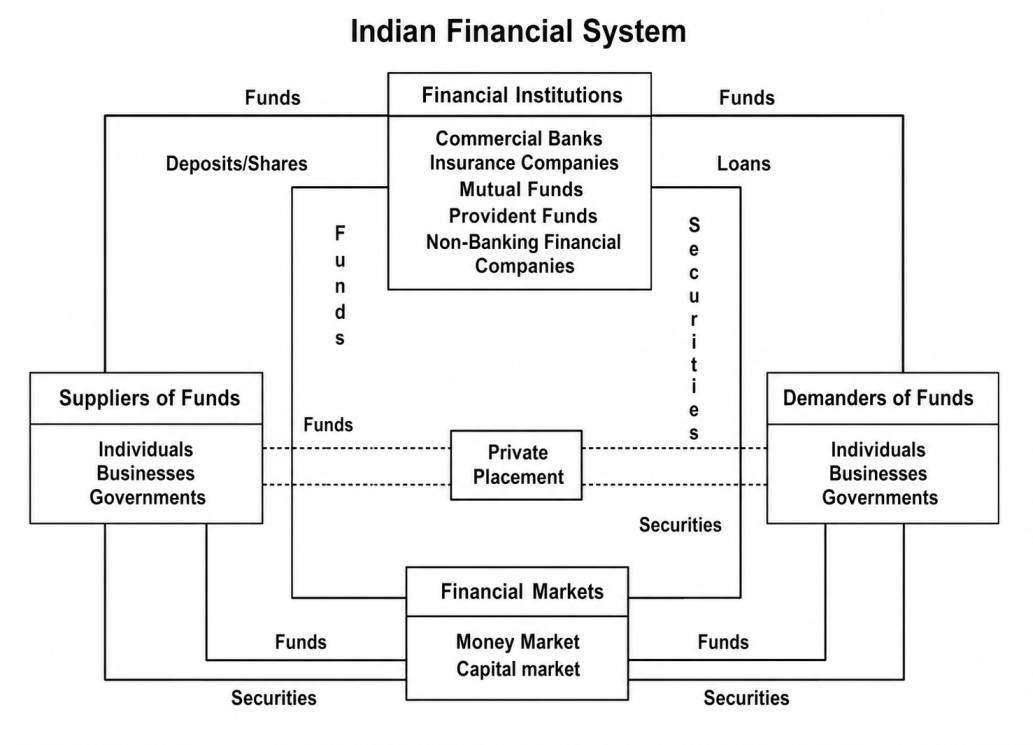
Capital market is an integral part of the financial market. The capital market is a market for financial assets which have a long or indefinite maturity. Capital market is broadly categorised into two parts such as primary market and secondary market.
In the primary market, new stock or bond issues are sold through a mechanism popularly known as underwriting.
In the secondary market, issued shares are traded through organised exchanges such as stock exchanges, over the counter etc.
The capital market consists of stock or equity market, debt market, derivative market, foreign exchange market and commodity market. These markets are providing the facilities for buying and selling of the variety of financial claims and services. The corporations, financial institutions, individuals and governments trade in financial products in these markets either directly or through brokers and dealers on organised exchanges or off exchanges.
The capital market participants on the demand and supply sides of these markets are financial institutions, agents, banks, brokers, dealers, lenders, savers and others who are interlinked by the laws, contracts, covenants and communication networks. The primal role of the capital market is to channelise investments from investors who have surplus funds to the ones who are running a deficit. Financial regulator such as Security Exchange Board of India oversees the capital markets in their designated jurisdictions to ensure that investors are protected against fraud among other duties.
Reforming and liberalising financial markets began in the wake of the country’s 1991 balance of payments crisis. The thrust of these reforms was to promote a diversified, efficient and competitive financial system, with the ultimate objective of improving the allocation of resources through operational flexibility, improved financial viability and institutional strengthening. The pace of reform was, however, slower than those in product markets, partly because the introduction of stricter prudential controls on banks revealed significant problems in asset portfolios.
Prior to the reforms, state-owned banks controlled 90 per cent of bank assets – compared with approximately 10 per cent at end-2005 – and channelled an extremely high proportion of funds to the government. Interest rates were determined administratively; credit was allocated on the basis of government policy and approval from the Reserve Bank of India (RBI) was required for individual loans above a certain threshold.
Capital markets were underdeveloped, with stock markets fragmented across the country. The major stock market acted mainly in the interest of its members, not the investing public. Derivative markets did not exist and comprehensive capital controls meant that companies were unable to bypass domestic controls by borrowing abroad.
Concerns over the 1997/98 Asian financial crisis and its contagion effects further spurred Indian authorities to strengthen the domestic financial system. Reforms were, and continue to be, based on several principles:
(i) mitigate risks in the financial system;
(ii) efficiently allocate resources to the real sector;
(iii) make the financial system competitive globally; and
(iv) open the external sector.
The goal was to promote a diversified, efficient and competitive financial system which would ultimately improve the efficiency of resource allocation through operational flexibility, enhanced financial viability and institutional strengthening.