Walter Christaller Model
The Central Place Theory attempted to explain the economic interactions between cities and smaller towns. It also aims to explain why cities are situated where they are in terms of geography and how they provide specialized goods and services to the smaller settlements nearby.
The population was assumed to be very equally distributed, with settlements roughly equal distance apart. In the traditional view, consumers and sellers have roughly equal economic and purchasing power, which has an impact on markets and service placement. A number of conclusions can be drawn based on these assumptions.
Central Place Theory
- Walter Christaller proposed the Central Place Theory in 1933, and it is one of the most widely accepted theories for explaining the spatial arrangements, hierarchy, and distribution of human settlements.
- In 1932, Christaller completed his dissertation titled “The Structure of Settlements in Southern Germany.”
- The theory seeks to understand the evolution of hierarchical patterns, the number of settlements on the basis of population, and distance from other settlements.
Features of the Central Place Theory
- Christaller’s research into settlement patterns in southern Germany led to the Central Place Theory.
- He discovered that there is some sort of relationship between distribution, size, and number of settlements.
- He named these laws ‘spatial economic geographical laws‘ or ‘the laws of the geography of settlements‘.
- His study looked at the connections between settlements of varying sizes and how their economic activity influenced the people.
- The relationship between the size, number, and geographic distribution of cities is described by the Central Place Theory.
- The major function of the central place is to deliver goods and services to the surrounding inhabitants.
- Christaller explained why the highest order settlement has very specific and distinct activities and such activities can only be provided by the highest order settlement.
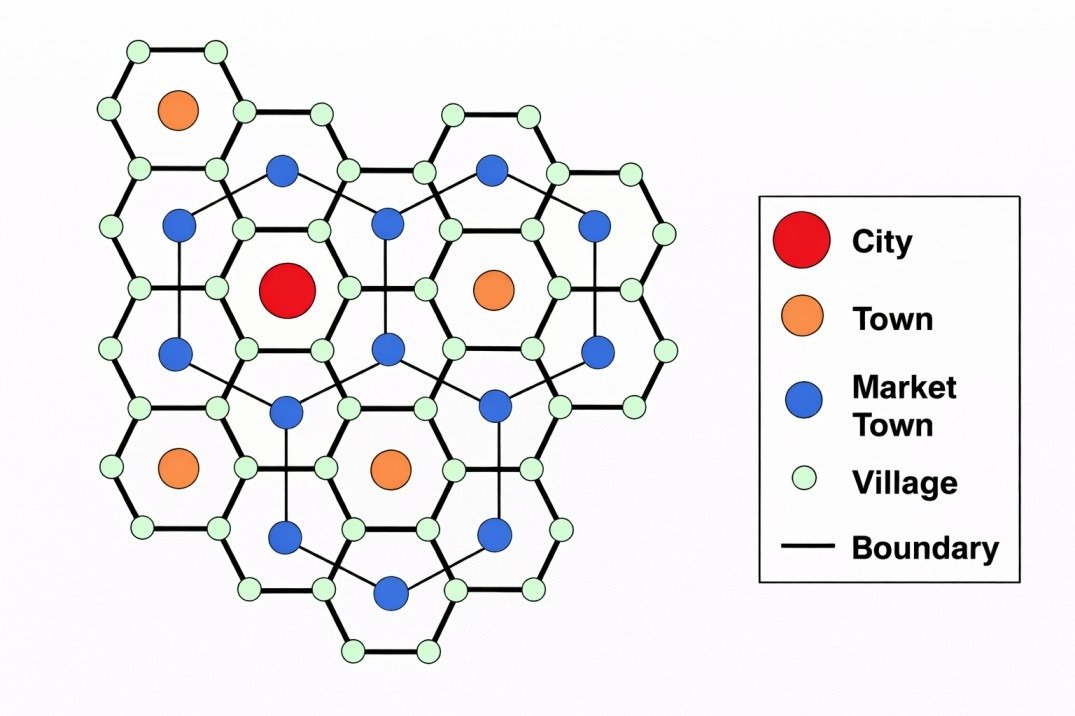
- In Christaller’s model, each settlement is situated in the center of the region that it serves. Logically, this should result in a circular complementary region.
- For example, If the threshold for customers who shop in hardware stores is fifty miles, then according to Christaller’s assumptions, it would be on a flat plane, we should be able to find hardware stores in centers located fifty miles apart.
- Even after decades, the central place theory remains important and serves as the foundation for a variety of modern urban planning theories.
Assumptions of Central Place Theory
Christaller made some assumptions to make his theory easy to understand and explain the structure of settlements, growth, and development of towns, human behavior, and fundamentals of economics. Assumptions are:
- A flat surface -A mountainous and uneven terrain makes development difficult, therefore a flat place that encourages town growth is ideal.
- The population is evenly distributed — citizens are not concentrated in one location, and there is no preference for one town over another.
- Evenly dispersed resources – no location has a resource advantage; all locations will compete under ideal market conditions.
- Evenly distributed purchasing power – wealth, like people and resources, is spread evenly. As a result, people’s purchasing power is comparable.
- People will buy things from the nearest market in order to avoid a long commute, and prices will remain consistent.
- Equal transportation cost– the cost incurred in transporting goods is equal for all and is proportional to the distance.
- Perfect competition – Price is determined by demand and supply in perfect competition. People will buy at the lowest price available on the market.
What can be concluded from Assumptions?
- When these assumptions are integrated, the result is a location that provides a variety of services.
- People enjoy the ideal market in these locations and buy from the nearby shops to save money and time.
- The population threshold influences where various services are situated.
The bare minimum of people is required to keep that service/activity running.
Main derivatives of Central Place Theory
As per Walter Christaller, Central Place Theory is based on several fundamental concepts which are
- Central Place: It is the settlement that serves other settlements of the lower hierarchy.
- Complementary area: It is the Hinterland or region served by the central place.
- Centrality: It is the surplus or the ratio between goods and services offered. Greater centrality means greater the number of services and their surplus. it is the force of attraction or the potentiality to serve.
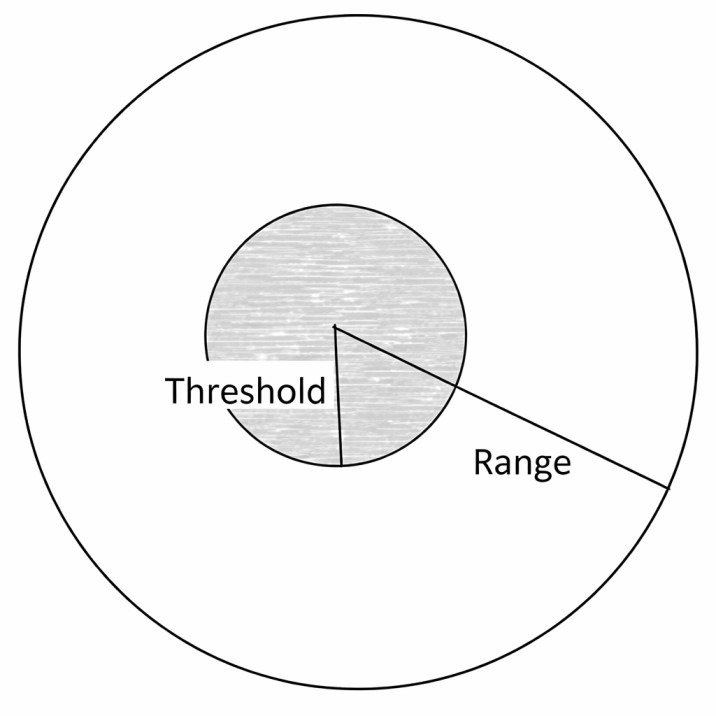
- Threshold: The minimum population required for a service to be feasible in a given location. If this threshold is not met, a specific activity will not begin or will be terminated.
- Range: This is the maximum distance a consumer will travel to buy products or receive services; consumers will not travel beyond this distance since the cost of the good/service will outweigh the value.