
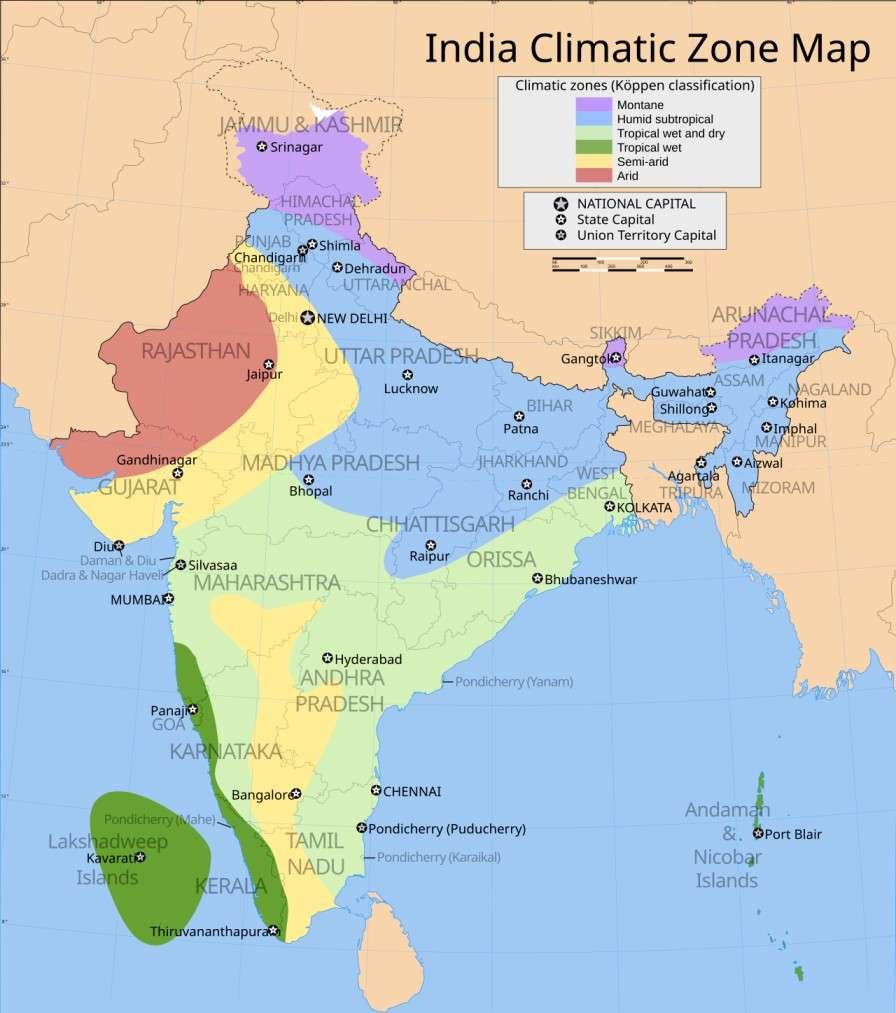
- The climate of India is described as a monsoon type. This type of climate is found in south and southeast Asia. However, there are variations in climatic conditions in the country itself. The coastal regions of India show the least amount of difference between the temperatures of night and day. In the interior regions, the difference in temperatures of day and night is huge.
Factors affecting the Climate of India
India’s climate is classified as a monsoon climate. This type of climate is mostly found in Asia’s south and southeast. Despite the overall consistency of the pattern, there are regional differences in climatic conditions within the country.
Type of Climate of India
- Although India’s northern part (north of the tropic of cancer) is located in the temperate belt, its climate is very similar to that of a tropical country.
- The Himalayan ranges separate the Indian subcontinent from the rest of Asia, blocking cold air masses moving south from Central Asia.
- As a result, the northern half of India is 3°C to 8°C warmer in the winter than other areas at similar latitudes.
- The climate in the southern parts of the country resembles an equatorial dry climate during the summer due to the sun’s position above the horizon.
- The north Indian plains are being influenced by a hot dry wind known as ‘loo’ that is blowing from the Thar, Baloch, and Iranian Deserts, raising temperatures to levels comparable to those in the country’s southern regions.
- As a result, the entire Indian subcontinent south of the Himalayas can be classified as a tropical country.
- India has a typical tropical monsoon climate due to the seasonal reversal of winds in the Arabian Sea and Bay of Bengal.
- So, rather than just being tropical or half temperate, India’s climate as said earlier is a tropical monsoon type (a distinct wet and dry) climate.
The climate of India is influenced by a variety of factors that can be divided into two categories:
- factors relating to location and relief
- factors relating to air pressure and winds
Factors Related to Location and Relief
Latitude:
- The Tropic of Cancer runs east-west through the central part of India.
- As a result, the northern part of India is in the subtropical and temperate zone, while the southern part is in the tropical zone.
- As it’s closer to the equator, the tropical zone has high temperatures all year with a small daily and annual range.
- Due to its distance from the equator, the area north of the Tropic of Cancer has an extreme climate with a wide daily and annual temperature range.
The Himalayan Mountains:
- The Himalayas and their extensions in the north act as an effective climatic divide.
- The subcontinent is protected from the cold northern winds by the towering mountain chain, which acts as an invincible shield.
- These chilly winds blowing across central and eastern Asia, originating near the Arctic Circle.
- The Himalayas also trap monsoon winds, forcing them to disperse their moisture across the Indian subcontinent.
Distribution of Land and Water:
- India is surrounded on three sides by the Indian Ocean in the south and girdled by a high and continuous mountain wall in the north.
- The water heats and cools slowly in comparison to the landmass.
- In and around the Indian subcontinent, this differential heating of land and sea creates different air pressure zones in different seasons.
- The direction of monsoon winds is reversed due to a difference in air pressure.
Distance from the Sea:
- Large coastal areas have an equable climate due to their long coastline.
- Areas in India’s interior are far removed from the sea’s moderating influence. Thus, c Climate extremes exist in these areas.
- As a result, residents of Mumbai and the Konkan coast have only a little perception of temperature extremes and seasonal weather patterns.
- Seasonal differences in weather in the interior of the country, such as Delhi, Kanpur, and Amritsar, have an impact on all aspects of life.
Altitude:
- As you get higher, the temperature drops.
- Places in the mountains are cooler than places on the plains due to thin air. Agra and Darjeeling, for example, are on the same latitude, but Agra’s January temperature is 16°C, while Darjeeling’s is only 4°C.
Relief:
- Temperature, air pressure, wind direction and speed, amount and distribution of rainfall are all affected by India’s physiography or relief.
- During June-September, the windward sides of the Western Ghats and Assam receive a lot of rain, whereas the southern plateau stays dry due to its leeward position along the Western Ghats.