
Composition of the Atmosphere
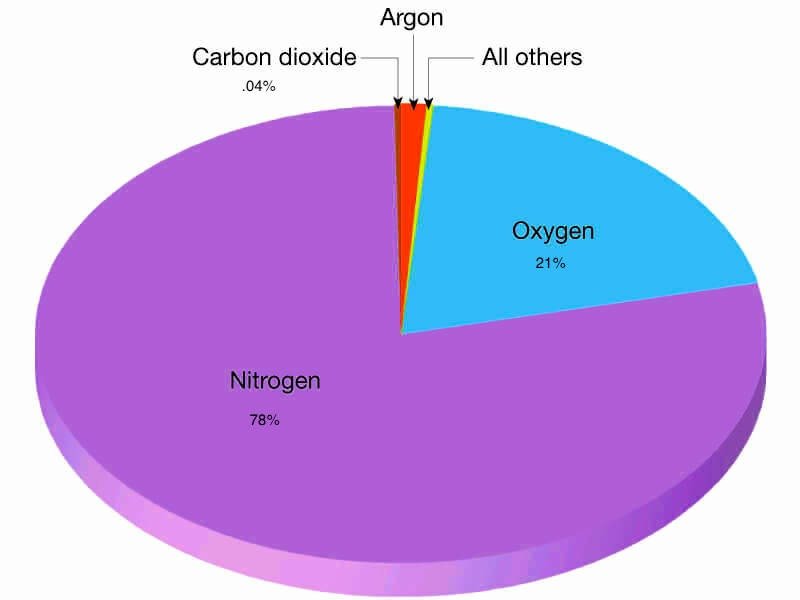
Earth’s atmosphere is composed of about 78 % nitrogen, 21 % oxygen, 0.9 % argon, and 0.1 % other gases. Trace amounts of carbon dioxide, methane, water vapour, and neon are some of the other gases that make up the remaining 0.1 %.
What is the Atmosphere?
- The atmosphere is a gaseous layer that protects all life on Earth by maintaining a constant temperature and deflecting harmful sun rays.
- The atmosphere allows the sun’s heat to be trapped instead of escaping into space.
- It shields living things from the harmful effects of the sun’s rays.
- The Earth’s water cycle is influenced by the atmosphere.
- There is no boundary between the atmosphere and outer space.
- The atmosphere gradually becomes less dense as it approaches the outer atmosphere, until it “blends” with it.
The atmosphere is composed of numerous gases. These glasses are divided into two categories i.e., constant gases and variable gases.
Constant Gases
- Nitrogen, oxygen, and argon are called the “constant gases” because their concentration has remained virtually the same for much of recent Earth history.
- Nitrogen (78%): It is a relatively inert gas produced primarily by volcanic eruptions. Most atmospheric nitrogen enters the soil by nitrogen-fixing microorganisms.
- Oxygen (21%): It is chemically very active, combining readily with other elements in the process of oxidation. Free oxygen in the atmosphere is a product of plant photosynthesis.
- Argon (0.93%): It is a colourless, odourless, relatively inert gas.
Variable Gasses
- The so-called variable gasses are those present in small and variable amounts. These include carbon dioxide, methane, ozone, water vapor, and particulates among others.
- Even though they represent a tiny portion of the atmosphere as a whole, they exert great control over our environment.
Carbon dioxide:
- CO2 makes up only 0.036% of the atmosphere by volume. Co2 is the fourth most abundant gas.
- Carbon dioxide in the atmosphere shows seasonal variation, decreasing slightly during the summer as plants leaf out and then increasing during the winter as plants go dormant and photosynthesis decreases.
- The greenhouse effect is caused when longwave radiation is absorbed by CO2 molecules in the lower atmosphere, which reradiates some of that heat back to the surface.
Methane (CH4):
- It is a greenhouse gas that contributes to about 18% of global warming and has been on the rise over the last several decades.
- Though methane makes up for less of the atmosphere (0.0002%) than carbon dioxide, it is 20 times more potent than CO2 as a greenhouse gas. Human activity has contributed to the rise of methane in our atmosphere.
- Landfills, rice paddy agriculture, natural gas systems, and livestock production appear to be significant contributors to anthropogenic sources of methane.
Ozone (O3):
- It is both beneficial and harmful to life on earth. Much of the ozone in the atmosphere is found in the stratosphere at a height of 15-50 Km from the Earth’s surface.
- Here ozone absorbs UV light from the sun preventing it from reaching the surface.
- Ozone is also found in the lowest layer of the atmosphere, the troposphere. But here ozone can act as an eye and respiratory irritant.
Water Vapor:
- It is the most variable of the atmospheric gasses and can range from 0.02% by volume in a cold, dry Antarctic climate of Antarctica to more than 4% in the humid tropics.
- Water vapor is a good absorber of the Earth’s outgoing radiation and thus is considered a greenhouse gas.
Structure of the Atmosphere
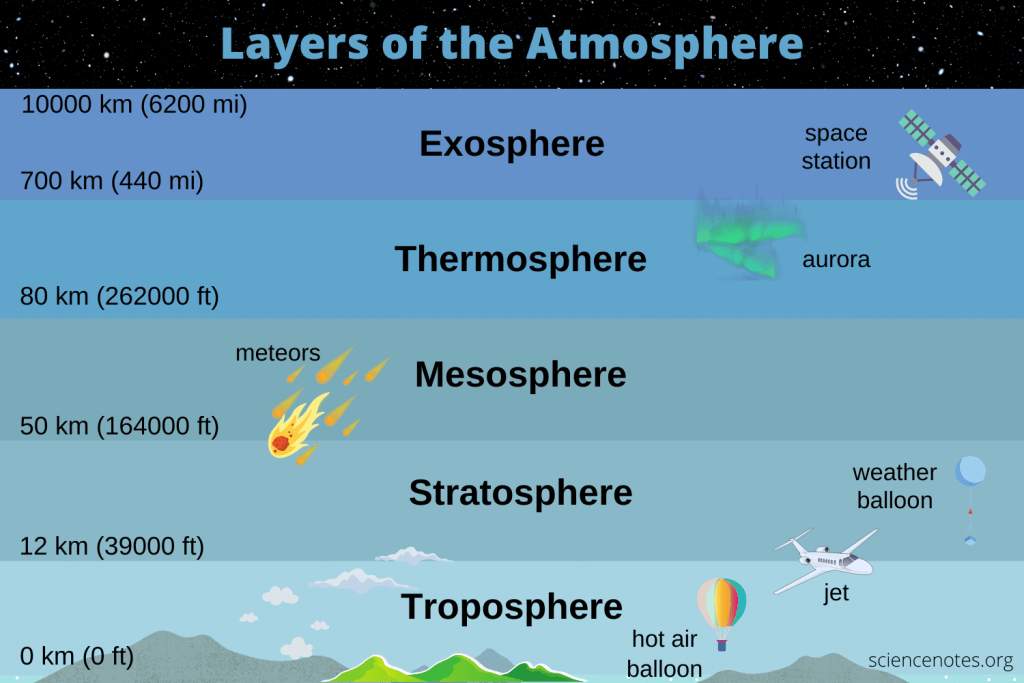
The structure of the Atmosphere is composed of a mixture of gasses that surround the planet. The present structure of the atmosphere of the earth was formed due to the degassing of the earth’s surface. It is made up of five different layers based on temperature. The effective height of the atmosphere is estimated to be between 16 and 29 thousand kilometers above sea level, with the first 800 kilometers being the most important. About half of the atmosphere is below the altitude of 5.6km, and the remaining 97 percent is confined to a height of only 29km.
Troposphere
The atmosphere consists of different layers with varying densities and temperatures. The troposphere is the lowest layer of the Earth’s atmosphere. The height of this layer is about 18 km on the equator and 8 km on the poles. The troposphere contains the majority (about 75–80%) of the atmosphere’s mass. The troposphere is where most clouds are found, and it is also where most weather is produced. By far, the wettest part of the atmosphere is the troposphere (all of the other layers contain very little moisture).
- It extends about 8-16 km above the earth. The troposphere is the lowest layer of the Earth’s atmosphere, containing around 80% of its mass and 99 % of its water vapour and aerosols.
- In addition to nitrogen and oxygen, the troposphere contains carbon dioxide, water vapour (almost all of the water vapour in the atmosphere is concentrated in the troposphere), and a variety of other particles.
- The troposphere is where the majority of our weather occurs: clouds, rain, and snow.
- The troposphere is home to nearly all of the air in the atmosphere, as well as nearly all of the water vapour (which forms clouds and rain).
- Its thickness, which tends to vary seasonally, is least at the poles and greatest at the equator.
- The water vapour and particulates of the atmosphere are concentrated in this one layer; they are rarely found in the atmosphere above the troposphere.
Tropospheres Thickness:
- The thickness of the troposphere varies across different latitudes of the earth.
- It is thickest in the equator, up to 20 km deep in the tropics, and shallower near the poles, at 7 km.
Reasons:
Temperature Differences:
- The equator receives more direct sunlight throughout the year, leading to higher temperatures. Warm air expands and rises, resulting in a thicker troposphere.
- The poles receive less sunlight, leading to cooler temperatures. Cold air is denser and contracts, resulting in a thinner troposphere.
Earth’s Rotation (Coriolis Effect):
- The rotation of the Earth affects the distribution of atmospheric pressure and temperature. The centrifugal force is greatest at the equator, causing the atmosphere to bulge outward.
- This effect is less pronounced at the poles, where the centrifugal force is minimal.
Convection Currents:
- At the equator, strong convection currents (rising warm air) contribute to a thicker troposphere as the warm air rises higher before cooling and descending.
- At the poles, weaker convection currents result in a thinner troposphere because the cold air does not rise as high.
Chemical Composition of Troposphere:
- With the significant exception of water vapour, the chemical composition of the troposphere is generally uniform.
- With increasing altitude, the volume of water vapour drops dramatically. As a result, the quantity of water vapour is generally highest at the surface and gradually drops as one rises in altitude.
Temperature of Troposphere:
- The temperature in this area of the atmosphere drops by around 6.5°C per kilometre as the distance above the earth increases. The temperature normally decreases with increased altitude.
- The average rate at which temperature within the troposphere decreases with altitude is called the normal lapse rate (or environmental lapse rate).
- The lapse rate of the environment (ELR) is roughly 0.6°C per 100 metres. With increasing altitude, the temperature drops at a nearly uniform rate.
- The reason for the lapse is that the world’s general thermal balance is maintained by maximum absorption of the sun’s energy at the bottom, which heats the lower levels of the atmosphere, and maximum radiation of heat occurs at the top of the atmosphere, cooling the earth.
Significance of Troposphere:
- The troposphere is crucial to understand because we breathe the air in this layer of the atmosphere.
- The troposphere makes up around 85% of the overall mass of the atmosphere. The water or hydrologic cycle and the greenhouse effect are examples of tropospheric processes that have a significant impact on meteorology and climate.
- The chemical makeup of the air determines its quality. Certain components, even if present in trace amounts, can be harmful to human health and the environment. As a result, it’s critical to understand how human activities affect the troposphere.