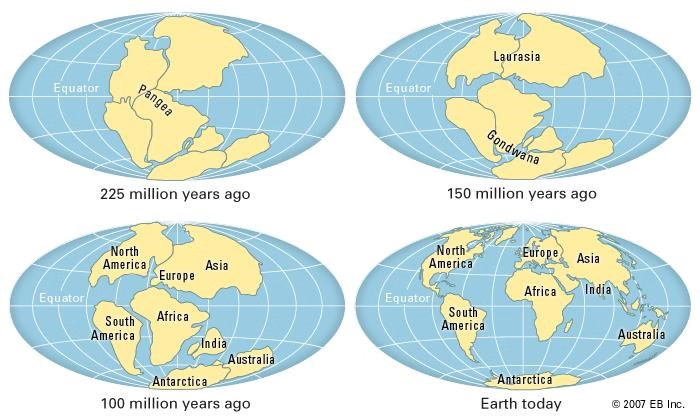
To explain the present distribution of oceans and continents, several theories were proposed over time. Among these, the Continental Drift Theory emerged as a pivotal contribution because it provided substantial evidence supporting the movement of the Earth’s crust. However, the theory could not fully explain the mechanism driving this movement.
The Continental Drift Theory by Wegener introduced the concept of shifting of continents for the first time in 1915. Until the early twentieth century, the continents were assumed to be fixed geographical masses. Wegener claimed that the Earth must have once been a single supercontinent before fragmenting into various continents.
Historical Background
For a long period, up to the early 20th century, people believed that continents were fixed landmasses. This changed in 1912 when Alfred Wegener, a German geologist and meteorologist, introduced the theory of continental drift. He expanded on this concept in his book The Origin of Continents and Oceans (1915). Although Wegener popularized the theory, similar ideas were hinted at earlier by Abraham Ortelius, a Dutch cartographer, who observed symmetry between the coastlines on both sides of the Atlantic Ocean.