
Background
- The meaning of the words. “Heritage” is a property, something that is inherited, passed down from previous generations. In the case of “cultural heritage,” the heritage doesn’t consist of money or property, but of culture, values and traditions. Cultural heritage implies a shared bond, our belonging to a community. It represents our history and our identity; our bond to the past, to our present, and the future.
- Brigid is a first generation Irish-American. Her mother is originally from Ireland, but she relocated to America after meeting and marrying Brigid’s father who is an American businessman. Brigid’s mother is a talented curator who collects artifacts from all over Europe. The walls of their home are decorated with Irish artwork. Every night before bed, Brigid’s mother tells her stories about Ireland and reads Irish fairy tales. They also say a Celtic prayer right before Brigid’s mother tucks her in. Though Brigid doesn’t know it yet, her mother is passing on her cultural heritage.
- Cultural heritage is the indicators of the ways of living that a community developed, which are inherited from previous generations. It includes artwork, buildings, books, objects, songs, folklore, and oral history. Cultural heritage provides both tangible and intangible representations of the values, beliefs, traditions and lifestyles of prior generations. Though it comes from the past, cultural heritage is preserved in the present and valued by present generations.
- Cultural Heritage is an expression of the ways of living developed by a community and passed on from generation to generation, including customs, practices, places, objects, artistic expressions and values. Cultural Heritage is often expressed as either Intangible or Tangible Cultural Heritage.
- As part of human activity Cultural Heritage produces tangible representations of the value systems, beliefs, traditions and lifestyles. As an essential part of culture as a whole, Cultural Heritage, contains these visible and tangible traces form antiquity to the recent past.
- Cultural Heritage is a wide concept. We prefer to concentrate on the similarities between the various heritage sectors, instead of on their differences.
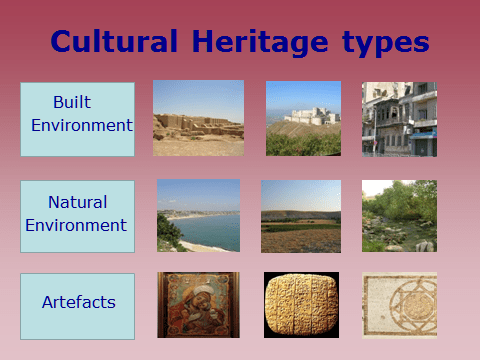
Cultural Heritage Types
Cultural Heritage can be distinguished in:
- Built Environment (Buildings, Townscapes, Archaeological remains)
- Natural Environment (Rural landscapes, Coasts and shorelines, Agricultural heritage)
- Artefacts (Books & Documents, Objects, Pictures)
Driving force behind all definitions of Cultural Heritage is: it is a human creation intended to inform.