Introduction
In the modern world, national economies are increasingly integrated, though the degree of integration varies across countries; an open economy is one that maintains not only trade relations but also financial capital flows with other economies.
Economic openness and global integration cause developments in one country to affect others; consequently, the 2007–09 financial crisis in the United States significantly impacted economies worldwide, including India, and led to a global meltdown through its effects on trade and capital flows.
Under capital flows, funds move from one country to another, creating financial linkages among economies.
Foreign trade in goods and services influences the determination of national income because net exports (exports − imports) constitute a component of aggregate demand for domestically produced output.
Capital flows in an open economy provide funds for financing domestic investment as well as government budget deficits, thereby supplementing domestic financial resources.
When the demand for funds in an economy exceeds domestic national savings, both the private sector and the government can obtain resources from abroad through:
External borrowing.
Foreign Direct Investment (FDI).
Foreign portfolio investment.
Thus, in an open economy, both foreign trade and international capital flows play a crucial role in determining economic activity, national income, and the availability of funds for investment and government expenditure.
Foreign Trade and National Income in an Open Economy
In the four-sector open economy model, the foreign trade sector is added to the three sectors—households, firms, and government—and national income is determined by including the effects of exports and imports on aggregate demand and income.
Exports (X) represent foreign demand for a country’s goods and services and generate income for domestic residents, whereas imports (M) represent domestic demand for foreign goods and generate income for foreign economies; therefore, imports reduce domestic aggregate expenditure while exports increase it.
Consequently, national income depends on net exports (NX = X – M):
Positive net exports (X > M) increase aggregate demand and national income.
Negative net exports (X < M) reduce aggregate demand and national income.
Exports and imports are influenced by the level of economic activity, output, and income; for example, rapid industrial growth increases demand for imported inputs, while higher industrial growth can also raise exports if sufficient foreign demand exists.
However, in the simple Keynesian income-determination model, exports and imports are treated as autonomous variables, determined outside the model and assumed independent of current income.
In a four-sector economy, the equilibrium condition is:
\(Y = C + I + G + (X – M)\)
where consumption is:
\(C = a + b(Y-T)\)
and:
\(NX = X – M\)
Substituting these relationships gives the equilibrium income equation:
\(Y=\frac{1}{1-b}(a-bT+I+G+NX)\)
Thus, the equilibrium level of national income equals the sum of all autonomous expenditures \((a-bT+I+G+NX)\) multiplied by the Keynesian multiplier:
\(Y=\frac{1}{1-b}(a-bT+I+G+NX)\)
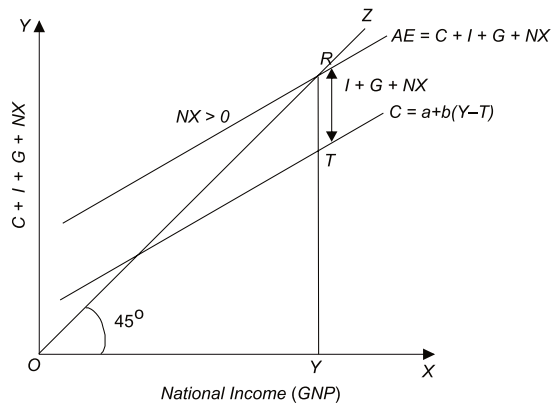
The four-sector model also implies that equilibrium national income is achieved when the saving gap between income and consumption equals the combined value of investment, government expenditure, and net exports, i.e., I + G + NX.
Graphically, when net exports are positive (NX > 0), adding I + G + NX to the consumption function shifts the aggregate expenditure curve upward to C + I + G + NX, causing it to intersect the 45° line at a higher income level, thereby increasing equilibrium national income.
Conversely, when net exports are negative (NX < 0) because imports exceed exports, the aggregate expenditure curve lies below the C + I + G curve and determines a lower equilibrium level of national income.