Introduction
The determination of the level of output and employment in an economy has been one of the central questions in macroeconomic theory. Two major schools of thought have offered contrasting explanations of how output and employment are determined in a market economy: the Classical approach and the Keynesian approach. The Classical economists, dominant until the 1930s, believed that a capitalist economy is inherently self-adjusting and always tends toward full employment. In contrast, John Maynard Keynes, writing in the aftermath of the Great Depression of the 1930s, challenged these assumptions and argued that an economy could remain stuck at an equilibrium below full employment for a prolonged period.
According to the traditional conception, the economy’s production function, labor supply, and demand all influence output and employment. Every nation aspires to produce goods and services and provide jobs for people to make a living. Output is the quantity of goods produced in a nation, and employment is the number of employed individuals. The number of workers, the equipment they use, and the way people spend their money all affect how much money a nation can earn and how many people it can employ.
The determination of output and employment forms a prime concern of macroeconomic analysis because it plays a very major role in learning about the general health of an economy. Output shows the total goods and services produced; at the same time, employment measures the number of persons involved in the labor force. There is a complex relationship between these two variables, under the influence of consumer demand, business investment, government policies, and external economic conditions.
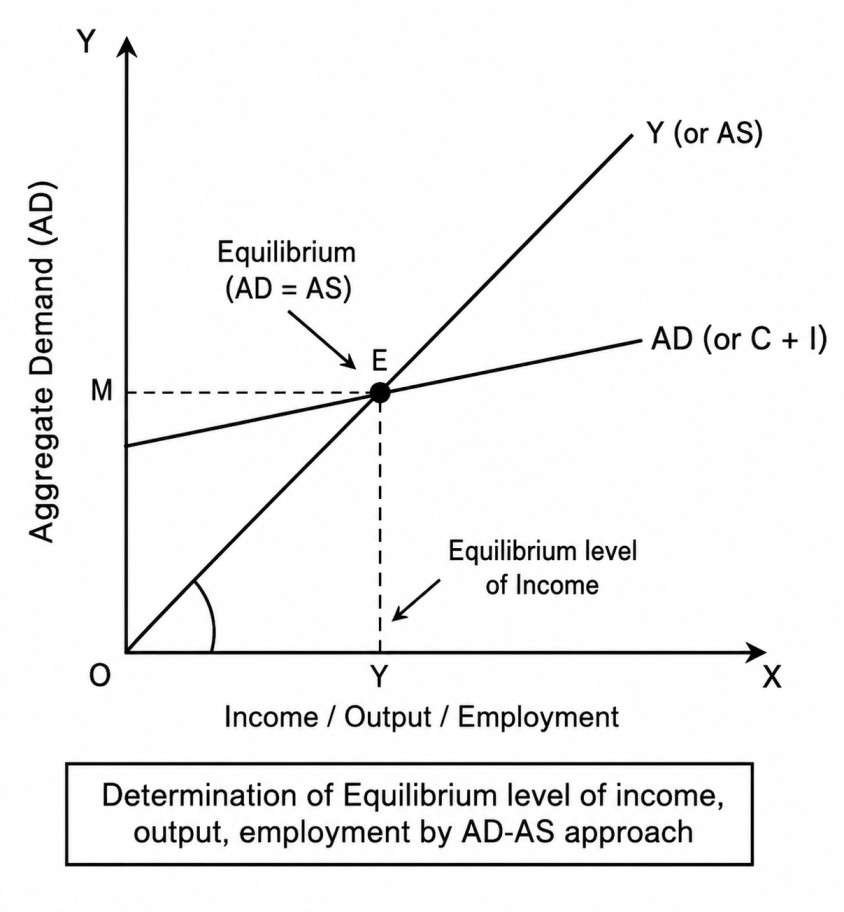
The most important among these theories is Keynesian economics, which establishes that aggregate demand plays a very significant role in the determination of levels of output and employment. This low level of demand results in underuse of available productive resources and hence lower output and higher unemployment. Other theories, such as classical economics, hold that supply-side drivers that relate to productivity and the structure of labor markets are very important in determining output and employment.
Moreover, how these fluctuations of short-run factors interact with long-term trends of growth that may influence output and employment needs serious consideration. An understanding of that interplay would help the policy designer come up with effective ways toward sustainable economic growth and full employment. How, then, is output and employment determined by illustrating the very basic functioning of modern economies?