
Dice
Dice is a cube. In cube there are 6 faces.
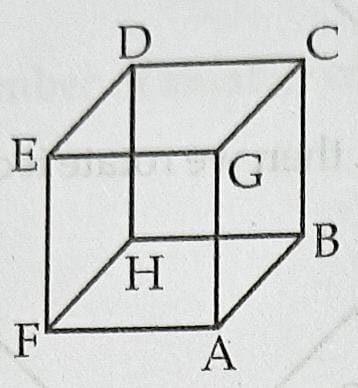
- There are 6 faces in the cube – ABCG, GCDE, DEFH, BCDH, AGEF and ABHF
- Always four faces are adjacent to one face.
- CDEG is the upper face of the cube.
- ABHF is the bottom face of the cube.
Types of Dice
1. Simple Dice: In simple dice, sum of the opposite sides are not seven. It means sum of any two adjacent sides is equal to seven.
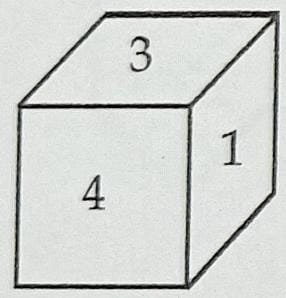
Here, 3 + 4 = 7, Sp it is simple dice
2. Standard Dice: In standard dice, the sum of two opposite sides is seven. In other words the sum of any two adjacent is not seven.
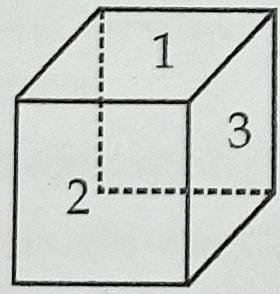
From the Figure;
1+2 = 3, 2+3 = 5, 3+1 = 4 does not have total seven. So, we can say that the opposite sides no. must be equal to be seven.
In Standard dice:
- 1 will be opposite to 6
- 2 will be opposite to 5
- 3 will be opposite to 4
Some Rules are:
1. When two different position of dice have different number then they are opposite to each other.
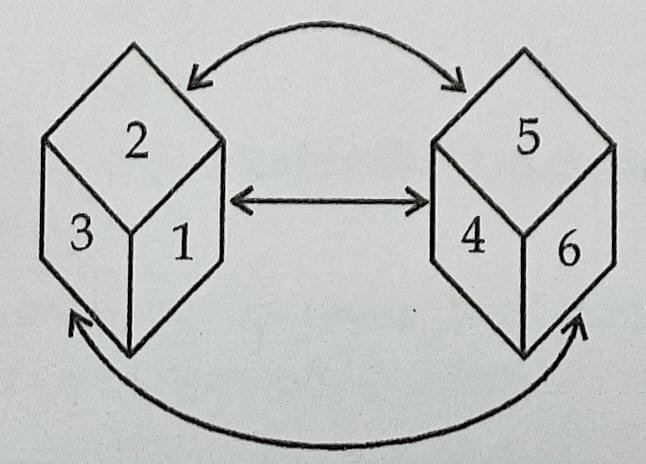
- 3 will be opposite to 4
- 1 will be opposite to 6
- 5 will be opposite to 2
2. If one side of given two dice is common in the same position then remaining are opposite to each other.
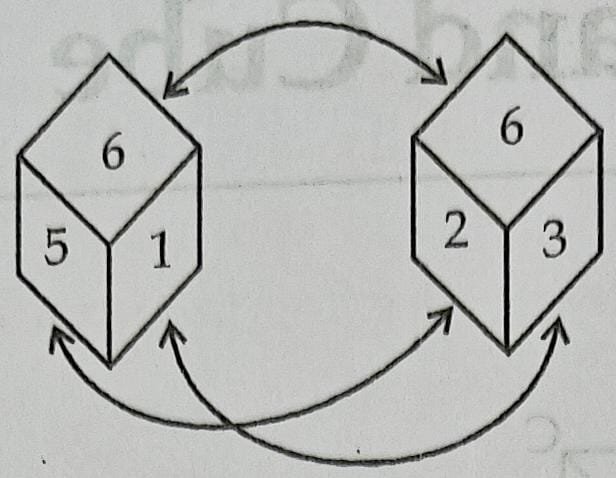
- 1 will be opposite to 3
- 5 will be opposite to 2
- 6 will be opposite to 4
If common sides are not in same position, then we rotate it clockwise or anti-clockwise to bring it into the same position.
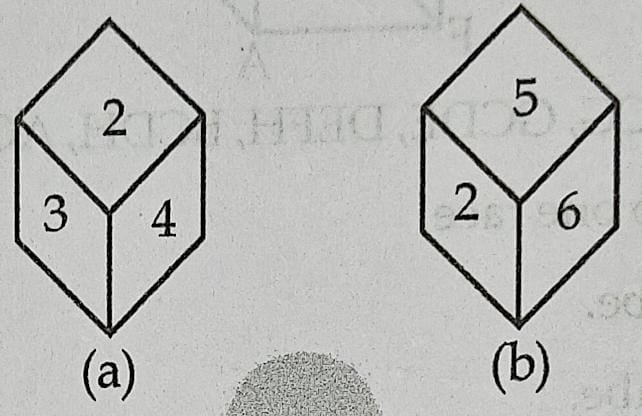
Here, common side is 2, but not in the same position, so we rotate (b) in clockwise direction.
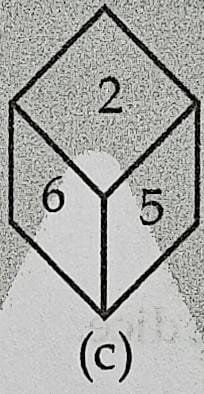
Now,
- 2 will be opposite to 1
- 4 will be opposite to 5
- 3 will be opposite to 6
- 3. If two sides of a given dice are common in the same position, then remaining is opposite to each other.
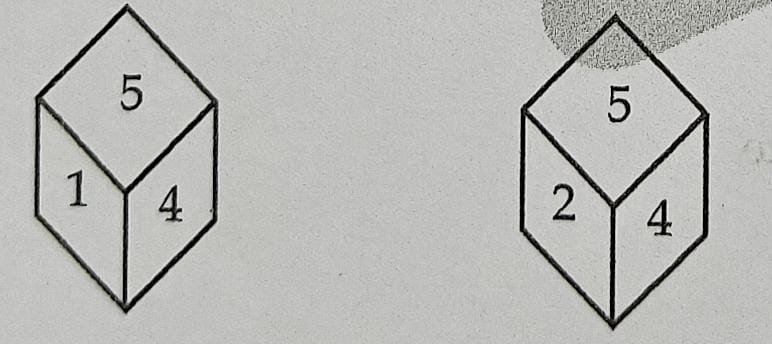
- 1 will be opposite to 2.
Expanded form of Dice:
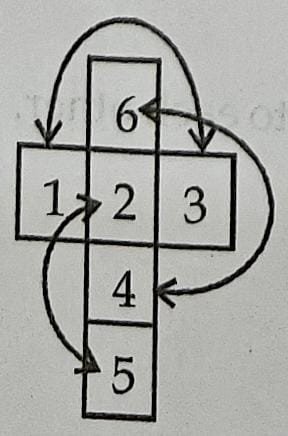
- 6 will be opposite to 4
- 1 will be opposite to 3
- 2 will be opposite to 5
Cube
Cubes are 3-dimensional objects, they also follow same property as dice rather than numbering. Cube have all side same and cuboid have different length, height and breadth. They also have 8 vertex, 6 faces and 12 edges. In exam, these topics contain cutting of both cube and cuboid and counting the number of small cubes and cuboid.
If a cube is painted on all of its surfaces and divided into smaller cubes of equal size, then after separation number of smaller cubes so obtained will be calculated as:
\(n=\;\lbrack\frac{Side\;of\;larger\;Cube}{Side\;of\;smaller\;cube}\rbrack\)
(n number of smaller cubes along each edge)
- Total number of smaller cubes = n³
- 3 faces coloured = 8
- 2 faces coloured = 12 (n-2)
- 1 face coloured = 6(n – 2)²
- No face colured = (n – 2)³
- Total number of coloured cube = n³-(n-2)³
- Number of cubes with atleast 2 face coloured = 12(n – 2) + 8
Practice Questions
1. On the basis of two figures of dice. You have to tell what number will be there on the opposite side of number 2?
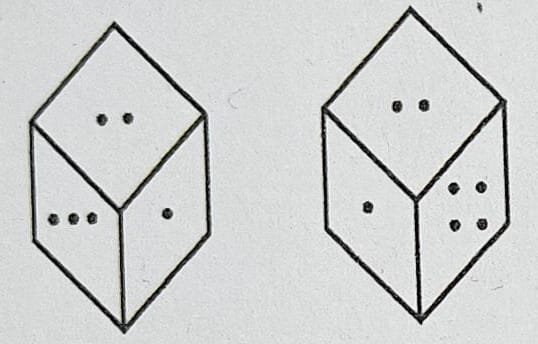
(a) 3
(b) 6 or 5
(c) 1
(d) Cannot be determined
2. On the basis of two figures of dice you have to tell what number will be there on the opposite side of number 1?
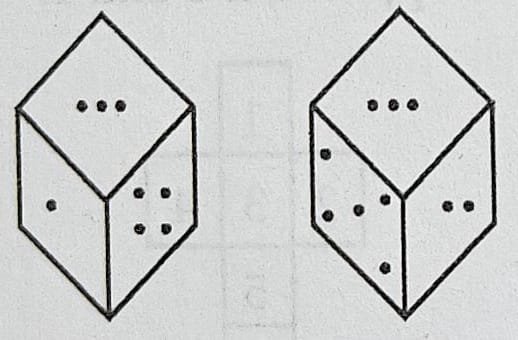
(a) 3
(b) 4
(c) 6
(d) 5
Direction (3-5): On the basis of two figures of dice. Answer the following questions.
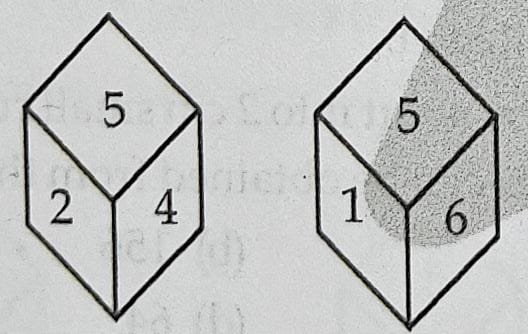
3. Which number is at the opposite of number 2?
(a) 1
(b) 2
(c) 3
(d) 5
4. Which number is at the opposite of number 4?
(a) 1
(b) 6
(c) 3
(d) 4
5. Which number is at the opposite of number 5?
(a) 2
(b) 4
(c) 3
(d) 6