
Introduction
Discrete Choice Models (DCMs) provide economists with a vital analytical framework which enables them to determine and forecast the selection behavior of people and organizations when they must pick from limited available choices. Discrete choice models handle consumption decisions by determining which specific alternative consumers decide to select instead of traditional economic models which analyze continuous quantity consumption patterns. Researchers apply discrete choice models to study authentic decision-making processes because real-world decision-making processes produce results which exist beyond quantitative measurement systems.
The foundation of Discrete Choice Models (DCMs) rests on Random Utility Theory, which explains that decision-makers will select their preferred option which brings them maximum utility while facing different limitations and incomplete information.
Discrete Choice Models (DCMs) are a research framework that enables researchers to use statistical and econometric methods to investigate how people approach decision-making when they need to select among various qualitative or categorical options. Decision-makers must decide which of their available options they will select from the predetermined options which permit only one selection.
The following selection processes exist:
Selecting between different transportation methods which include car, bus, and metro.
Identifying which brand or product to choose.
Selecting between working or non-working.
Making a choice between selecting a career path or selecting a college educational institution.
Discrete Choice Models (DCMs) establish their foundation through Random Utility Theory, which states that people will make their choice based on which option delivers them the best value according to their personal preferences and existing restrictions.
Discrete choice models function as analytical frameworks which forecast human or organizational decision patterns when people select from restricted options. The approach proves especially useful for economic research, marketing studies, transportation planning, urban development, and environmental research because it helps scholars understand how people select among various alternatives.
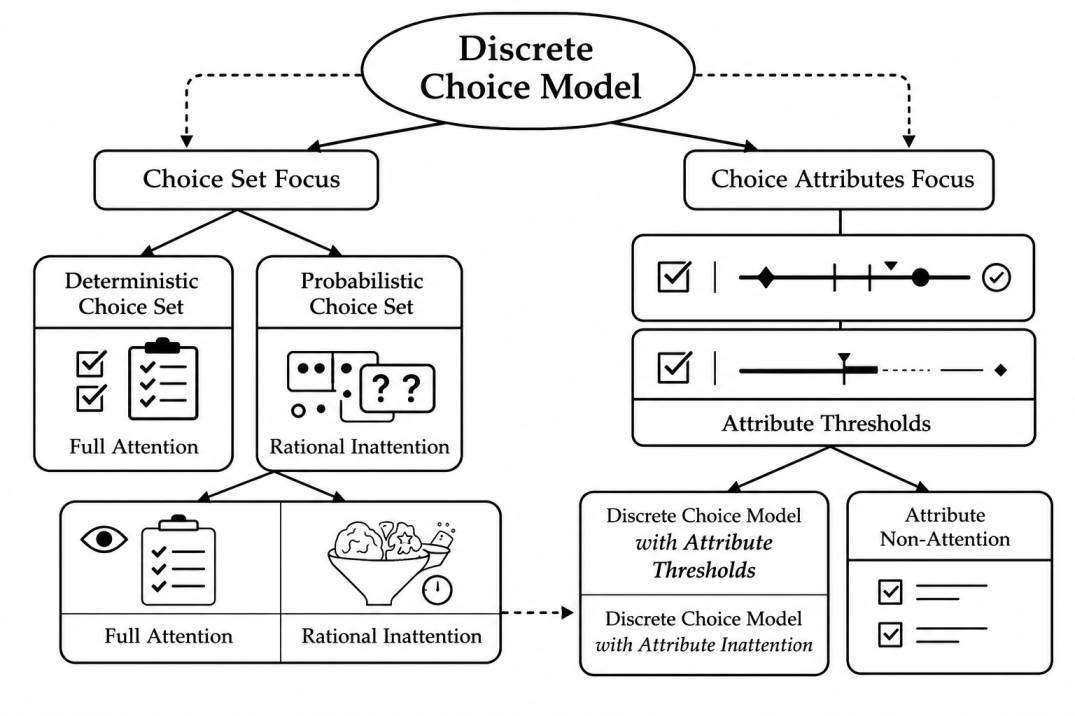
Fig: Discrete Choice Models