
Early Humans and Beginning of Civilisation
Chapter 4 | Class 9th
NCERT
Language
Choose your preferred language
Early Humans and Beginning of Civilisation
🎨 Reading Colors
Background
Text Color
Table of Contents
- Introduction
- Why Should We Study Early Human History?
- Who Were Our Human Ancestors?
- Early Human Settlements and Tools
- Palaeolithic Period
- Mesolithic Hunter–Gatherers
- Neolithic Revolution
- Neolithic Period in the Indian Subcontinent
- Sindhu–Sarasvatī Civilisation
- Bronze Age Civilisations Outside India
- Mesopotamian Civilisation
- The Sumerians
- Beginning of Writing
- Egyptian Civilisation
- Chinese Civilisation
- Common Features of Bronze Age Civilisations
Introduction
- We already studied the history of various kingdoms and empires and learned about the Sindhu–Sarasvatī civilisation, but the history of humanity goes back much further; this chapter explores who our earliest ancestors were, when and where they evolved, what food they ate, how they lived, and how they became what we are today.
- The period before the development of writing is understood mainly through archaeological evidence, as written languages emerged at different times in different parts of the world.
- One of the earliest known writing systems is associated with the Sindhu–Sarasvatī civilisation, also known as the Indus Valley Civilisation or Harappan Civilisation; writings and engravings on objects such as seals and pottery indicate that the Harappans used a pictographic script, but it has not yet been deciphered, so we still do not understand the Harappan script, also called Sindhu lipi.
- Other early writing systems include the cuneiform script of the Sumerians in Mesopotamia and the hieroglyphic script of ancient Egypt, both of which flourished around the same time as the Harappan Civilisation; unlike the Harappan script, these scripts have been deciphered and mark the beginning of the historical period, about 5000 years ago.
- From about 400 BCE, a script known as Brahmi was used in parts of southern India and in the Ganga Valley of northern India; it was later formalised by Emperor Aśhoka in the 3rd century BCE and by contemporary Iron Age people all over southern India.
Before and After the Invention of Writing
| Aspect | Before Writing | After Writing |
|---|---|---|
| Human history | More than 99 per cent of human history falls under this period, from about 3 million years ago to 5000 years ago. | Less than 1 per cent of human history falls under this period, the last 5000 years, including the present. |
| Main source for reconstruction | Tools, implements, and other material objects made by humans, called artefacts, are the major sources for reconstructing people’s ways of living. | Both material remains and written documents are sources for reconstructing the lives of people and society. |
| Lives of the people | It is generally difficult to understand the thoughts and ideas of people. | Literature or written documents provide information about names, events, and social, political, and cultural life. |
| Measurement of time | Measurement of time is approximate, as dating events and cultures is only approximate. | Dating of cultures and events becomes relatively accurate, because written documents mention specific dates of events such as coronations and wars. |
Why Should We Study Early Human History?
- The study of early human history helps us understand the long process of humankind’s biological and cultural evolution in relation to changes in climate and the environment.
- Biological evolution refers to the gradual physical and genetic changes through which our early ancestors, known as australopithecines (australis means southern and pithecus means primates), evolved into modern human beings called Homo sapiens.
- Cultural evolution explains how humans adapted to their surroundings during the Quaternary Period, which is the last 26 lakh years, including the present.
- To survive changing climatic and environmental conditions, humans developed tools, techniques, and other forms of technology to make use of natural resources.
- Over time, human ways of life changed from hunting and gathering to agriculture and food production, and the ability to produce surplus food and material goods laid the foundation for the emergence of civilisation.
- It is generally agreed that our earliest ancestors evolved and lived in Africa and began to move out of the continent around 2 million years ago.
- Homo erectus, an early human ancestor with stone tools such as hand axes and cleavers, was the first hominin to exit Africa; these tools have been found in other parts of Asia and Europe, indicating their origin in Africa and their dispersion beyond the continent between 2 and 0.5 million years ago.
- Another major wave of movement out of Africa took place around 125,000 years ago, associated with early Homo sapiens, ourselves or modern humans, who also evolved in Africa around 300,000 years ago and are now spread all over the Earth.
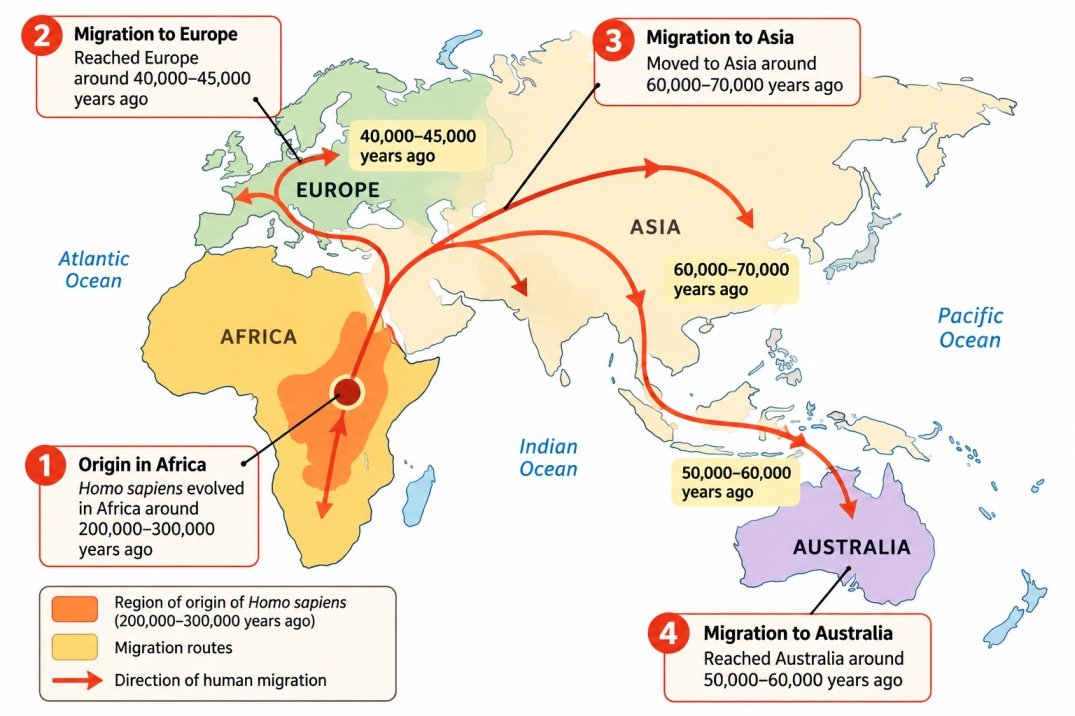
- Out of Africa Theory