
An ecological pyramid is a graphical representation of the relationship that every living creature present at different levels of the ecosystem shares with each other. Ecological Pyramids represent the different forms of bio-productivity of an ecosystem i.e. how much biomass, energy, or number of individuals each trophic level accounts for.
What is an Ecological Pyramid?
The ecological pyramid is also known as a food pyramid, trophic pyramid, or energy pyramid, and even the Eltonian pyramid as the concept of such pyramids which depict numbers was proposed by Charles Elton in the year 1927. Then came Bodenheimer in 1938 who proposed the pyramid structure for biomass and in 1942 Hutchinson and Linderman proposed the pyramid for productivity.
The pyramid is framed based on the number of individuals, energy, and biomass, and very much like the name recommends, these are shaped as a pyramid. The various kinds of ecological pyramids depend on how much energy or biomass or individuals are accessible to each trophic level.
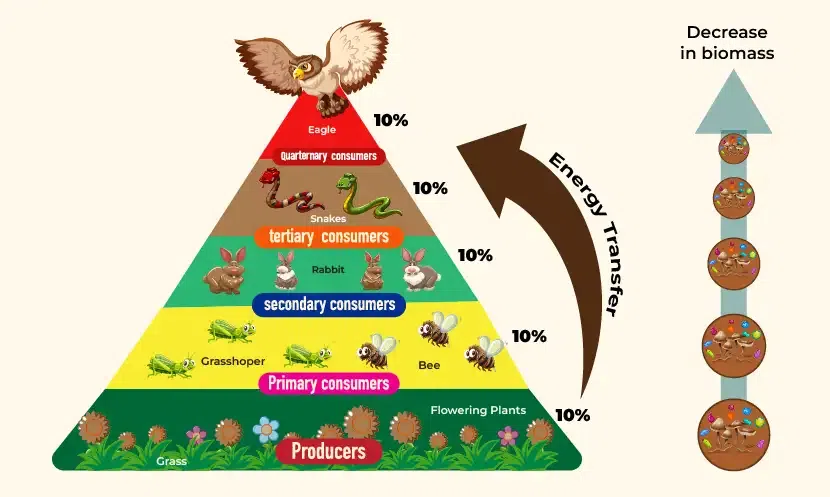
The bottom of the pyramid, usually the broadest part is occupied by the producers followed by the primary consumers at the next level, then the secondary consumers, and then tertiary consumers or the organisms placed at the top of the food chain at the topmost level. The ecological pyramid is additionally used to make sense of how different living beings in an environment are connected with each other. Also, it shows who is consumed by whom, while likewise showing the flow of the energy.
Ecological Pyramid Diagram
The diagram below depicts the ecological pyramid.
Features of the Ecological Pyramid
The following are the characteristics of an Ecological Pyramid:
- The ecological pyramid comprises two to four layers.
- Organisms that are dependent on the same type of food sources are placed at the same level.
- The producers are situated at the lowest level of an ecological pyramid with a huge population.
- The apex predators exist at the topmost level of an ecological pyramid with a relatively smaller population.
- The pointed shape of the pyramid is due to the fact that the supply of energy or biomass becomes lesser with each passing level of the pyramid.
- In the case of the pyramid of numbers, the topmost level will have a lesser number of individuals but their relative body size and volume increase.