
Pareto Optimality
Pareto optimality argues with general welfare of the society. In broader sense, the welfare of a society is measured on the basis of satisfaction levels of all the consumers. So, any changes in the economic state of the society will have better off some members of the society and worse off others.
The Italian economist Vilfredo Pareto (1848–1923) argued that it is impossible to make any one better off without making someone worse off, is called Pareto optimal or Pareto efficient.
Thus, in the Pareto optimum situation the welfare of any individual of the society cannot be increased without decreasing the welfare of another member. Before explaining the conditions of achieving Pareto optimality, we shall explain Pareto criterion of evaluating changes in social welfare because the concept of Pareto optimality or maximum social welfare is based upon Pareto criterion of welfare.
Pareto Criterion of Social Welfare
The concept of Pareto optimum or economic efficiency is based on ordinal utility instead of cardinal utility. Pareto criterion states that if any reorganization of economic resource does not worse off anyone and makes someone better off, it indicates an increase in social welfare of the economy. In other words, if any reorganization or change makes everybody better off in a society, it will, according to Pareto, increase social welfare.
According to Prof. Baumol, “any change which harms no one and which makes some people better off, this state of change must be considered to be an improvement.” Pareto criterion can be explained with the help of Edgeworth Box diagram which is based on the assumptions of ordinal utility and non-interpersonal comparison of utilities.
Suppose there are two persons A and B in a society and consume two goods X and Y. The various levels of their satisfaction by consuming various combinations of the two goods have been represented by their respective indifference curves.
In Figure 1, Oa and Ob are the origins for the utilities of two persons A and B respectively. Ia1, Ia2, Ia3, Ia4 and Ib1, Ib2, Ib3, Ib4 are their successively higher indifference curve. Suppose the initial distribution of goods X and Y between A and B is represented by point- K in the Edgeworth Box. Here K can be assumed as equilibrium point for both the persons in the initial stage.
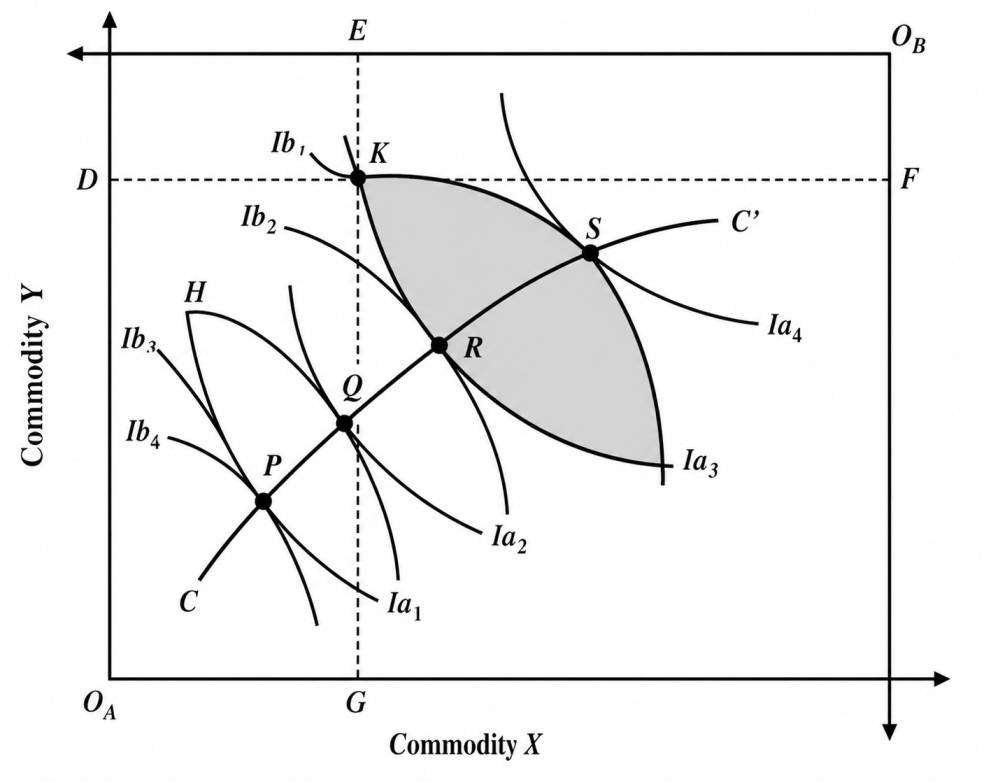
Accordingly, individual A consumes OAG quantity of X + GK quantity of Y and is at the level of satisfaction represented by indifference curve Ia3. Similarly, individual B consumes KF quantity of X + KE quantity of Y and gets the satisfaction represented by indifference curve Ib1. Thus the total given quantity of goods X and Y is distributed between A and B. In this distribution, individual A consumes relatively large quantity of good Y and individual B consumes more of good X.
Now, it can be shown with the aid of Pareto’s welfare criterion that a movement from the point K to a point such as S or R or any other point in the shaded region will increase social welfare.
As shown in the diagram any change in the distribution pattern of two goods will definitely increase the satisfaction level of at least one person. If we move from K to S through redistribution of two goods between two individuals, it increases the level of satisfaction of A without any change in the satisfaction of B. Here A has been able to increase his satisfaction by moving to a higher indifference curve Ia4, whereas B remains on the same indifference curve Ib1 because K and S lie on same indifference curve Ib1 associated to B. Thus, as a result of the movement from K to S, individual A has become better off whereas individual B is no worse off.
Similarly, the movement from K to R is also desirable from the point of view of social welfare because in this individual B becomes better off without any change-in-the satisfaction of individual A. Therefore, both the positions S and R are better than K. The tangency points of the various indifference curves of the two individuals of the society are the Pareto optimum points and the locus of these points is called ‘contract curve’.