Endogenic Processes
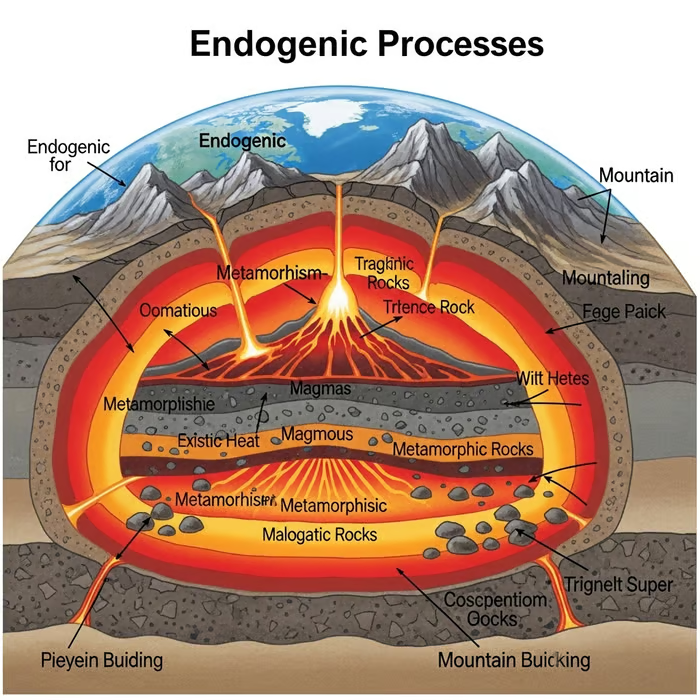
The endogenic process is an internal geomorphic process. The energy emanating from within the earth is the main force behind endogenic geomorphic processes. Volcanism, metamorphism, earthquakes, crustal warping, folding, and faulting are the major types of endogenic processes.
Endogenic Processes
Concept
- The term “endogenic process” refers to the internal processes that occur within the Earth, driven by heat and other forces originating from its interior.
- These processes play a pivotal role in shaping the Earth’s lithosphere, which includes the crust and the uppermost mantle.
- Diastrophism and Sudden Movements are the two basic forms of earth movements.
- Earth’s interior heat is the ultimate source of energy that drives endogenic movements.
- Rotational and tidal friction, radiation, and primordial heat from the earth’s origin all contribute to this energy.
- The majority of the earth’s internal heat comes from radioactive decay which accounts for 50% of it and gravitation which causes pressure gradients.
- The lithosphere experiences diastrophism and volcanism as a result of the energy released by geothermal gradients and internal heat flux.
- The action of endogenic forces is unequal due to changes in geothermal gradients and heat flow from within, strength, and crustal thickness. As a result, the original tectonically regulated crustal surface is not homogeneous.
Major Types of Endogenic Process
- Plate Tectonics: The Earth’s lithosphere is divided into several large and small tectonic plates that float on the semi-fluid asthenosphere beneath them. The movement and interaction of these plates, such as converging (coming together), diverging (moving apart), or sliding past one another, lead to various geological features and phenomena.
- Volcanic Activity: The movement of molten rock (magma) from the Earth’s mantle to its surface, resulting in volcanic eruptions. This can lead to the formation of volcanic landforms like volcanoes, lava plateaus, and geysers.
- Seismic Activity (Earthquakes): Caused by the sudden release of energy in the Earth’s crust, creating seismic waves. This release is usually due to the movement of tectonic plates or volcanic activity.
- Mountain Building (Orogenesis): The formation of mountain ranges due to the collision and compression of tectonic plates.
Forces Behind Endogenic Movements
- Temperature and pressure differences across different layers of the earth cause density variances, which cause convection currents.
- The lithospheric plates (crust and upper mantle) are driven by convection currents in the mantle, and the movement of the lithospheric plates (tectonics) is the cause of endogenic movements.
- Convection currents can be influenced by the Earth’s rotation (Coriolis effect).
- The nature and location of endogenic motions are determined by the destination of convection currents.
Classification of Endogenic Movements
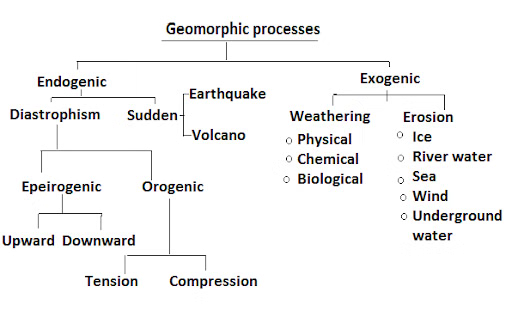
Endogenic movements are divided into Diastrophic Movements and Sudden Movements.
Endogenic Movements- Classification
Diastrophic Movements
- Diastrophism refers to all processes that move, elevate, or deform the earth’s crust due to diastrophic movements (deforming movements) such as folding, faulting, warping (bending or twisting of a large area), and fracturing.
- Diastrophic changes are slow and can last for thousands of years.
- Diastrophic movements are further classified into epeirogenic and orogenic movements.
Orogenic Processes:
- Orogenic or mountain-forming movements act tangentially to the earth’s surface, as in plate tectonics. The Himalayan-Alpine orogeny is the best instance of this case.
- These processes are further classified into Tension and Compression.
- Fissures are caused by tension i.e. when force is acting away from a point in two directions.
- The Sierra Nevada (The USA) mountain range is the best example of a mountain that is formed by tension.
- Folds appear as a result of compression i.e. when force is acting towards a point.
- The Himalayas is the best example of a mountain that is formed by compression.
Epeirogenic Processes:
- Movements that form continents are known as epeirogenic or continent-forming movements.
- They are also known as radial movements because they act along the radius of the earth.
- They can move towards (subsidence) or away from (uplift) the center.
- They create land upheavals or depressions with long-wavelength undulations (wavy surface) and little folding.
- The present-day drainage divides between Limpopo and Zambezi rivers in southern Africa is a classical example of this type.
- Epeirogenic movements are further classified into Downward and Upward.
- Subsidence occurs when movement is in a downward direction.
- It is uplifted from the center when it is away. Raised beaches, elevated wave-cut terraces, sea caves, and so on are examples of uplift.
Significance of Endogenic Processes
- Formation of Landforms:
- Mountain Ranges: Processes like orogenesis lead to the uplift and formation of mountain chains such as the Himalayas, the Andes, and the Alps.
- Ocean Basins: Divergent boundaries, where tectonic plates move apart, can give rise to ocean basins. The mid-oceanic ridges are examples of such formations.
- Island Arcs: Convergent boundaries between oceanic plates can result in volcanic island arcs like the Aleutian Islands.
- Mineral and Energy Resources:
- Many valuable mineral deposits are associated with endogenic processes, especially volcanic and tectonic activities.
- Geothermal energy, harnessed from the Earth’s internal heat, is a direct outcome of endogenic processes.
- Influencing Climate: Large volcanic eruptions can release vast amounts of ash and sulfur dioxide into the atmosphere, affecting global climates. For example, the 1815 eruption of Mount Tambora led to the “Year Without a Summer” in 1816.
- Regulating Earth’s Temperature: The heat flow from the Earth’s interior to the surface, driven by endogenic processes, plays a role in regulating the planet’s surface temperature.
- Driving the Hydrothermal Systems: The heat from the Earth’s interior can lead to hydrothermal circulations, resulting in features like geysers, hot springs, and hydrothermal vents in ocean floors.
- Role in the Carbon Cycle: Volcanic eruptions release carbon dioxide into the atmosphere, while the subduction of oceanic crust (with carbon-rich sediments) into the mantle acts as a carbon sink, playing a role in the long-term carbon cycle.
- Metamorphism of Rocks: The heat and pressure from endogenic processes can transform rocks into new types, known as metamorphic rocks.
Sudden Movements
Sudden movements is a category that falls under endogenic movements. The lithospheric plate boundaries are prone to sudden geomorphic movements. Because of the pressure caused by the pushing and pulling of magma in the mantle, the plate boundaries are extremely unstable. Earthquakes and volcanoes are two examples of sudden movements that generate significant deformation in a short period of time.

- Sudden movements, in the context of geology and geomorphology, refer to rapid and abrupt endogenic processes that lead to significant changes in the Earth’s crust over a short period of time.
- These movements can be violent and often result in natural disasters.
- The lithospheric plate boundaries are prone to sudden geomorphic movements.
- Because of the pressure caused by the pushing and pulling of magma in the mantle, the plate boundaries are extremely unstable.
- Earthquakes and volcanoes are two examples of sudden movements that generate significant deformation in a short period of time.
- While sudden movements can have destructive effects on human settlements, infrastructure, and the environment, they also play a vital role in shaping the Earth’s landscape and influencing geological processes.
Earthquakes
- An earthquake is a vibration or oscillation of the surface of the Earth caused by the elasticity or the isostatic adjustment of the rocks beneath the surface of the Earth.
- The majority of earthquakes are usually caused by sudden movements along faults.
- Earthquakes can occur at any time of the year, at any hour of the day or night. It has a jolting effect.
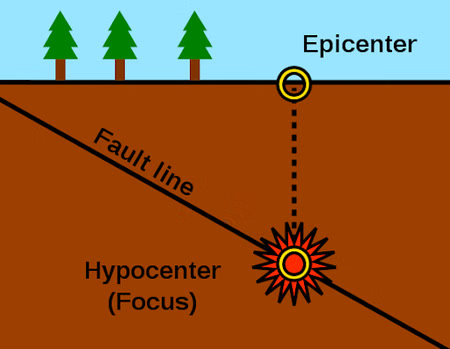
- The sub-surface area along a fault plane, where the seismic waves are initiated, is called the focus or hypocenter of an earthquake.
- The area at the surface directly above the focus is the epicenter.
- The earth’s surface vibrates as a result of a quick release of energy.
- Earthquake waves propagate outwards from the epicenter.
- These earthquake waves wreak havoc on the planet’s surface.
- Most of the damage occurs closest to the epicenter, and the severity of the earthquake weakens as it moves away from it.
- Earthquakes can lead to secondary disasters, such as tsunamis, landslides, and ground ruptures.
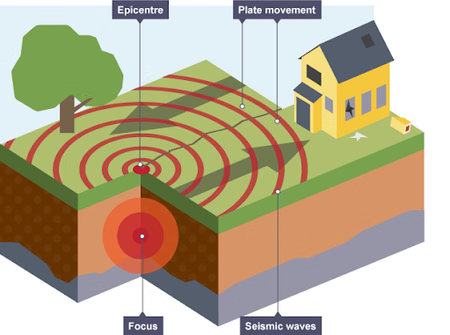
Cause and Effect of Earthquake:
- They are caused by the sudden release of accumulated stress within the Earth’s crust, leading to seismic waves that shake the ground.
- They can occur at tectonic plate boundaries (convergent, divergent, transform) or within the plates due to intraplate stresses.
- Earthquakes occur when excess stored tension in rocks in the earth’s interior owing to bending, faulting, or other physical processes is released as kinetic energy through weak zones on the surface.
- Coastal areas may experience uplift or subsidence as a result of these shifts.
- Alterations in contours, river courses, coastline changes, glacier surges, landslides, soil slips, mass wasting, and other effects may occur as a result of earthquakes.
Examples of Earthquake Caused due to Uplift and Subsidence:
- A one-meter uplift in coastal areas was produced by an earthquake in Chile in 1822.
- An earthquake in New Zealand in 1885 resulted in a 3-meter rise.
- An earthquake in Japan in 1891 caused up to 6 meters of subsidence.
Volcanoes
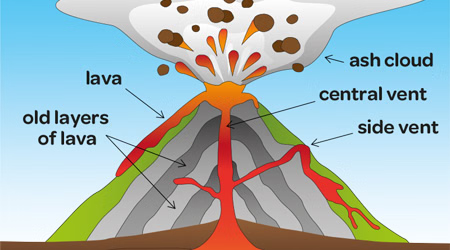
- The movement of molten rock (magma) onto or towards the earth’s surface through narrow volcanic vents or fissures is known as volcanism.
- A volcano is formed when molten magma from the earth’s interior erupts through vents and cracks in the crust, accompanied by steam, gases such as hydrogen sulfide, sulfur dioxide, hydrogen chloride, carbon dioxide, etc., and pyroclastic material (cloud of ash, lava fragments carried through the air, and vapor).
- The type and intensity of the eruption depend on the composition of the magma and the presence of dissolved gases.
- A volcano can adopt many different shapes depending on the chemical composition and viscosity of the lava.