Introduction
Any platform that facilitates sale and purchase of a good or service is known as a market. In order to produce goods and services, factors of production are required. Just like product and service markets, factors of production of an economy also have their markets. Markets are required to determine their demand, supply and market prices. The primary four factors of production are land, labour, capital and entrepreneurship. This unit explains briefly the essence, importance and operations of land, labour and capital market and the last two units of this block provide detailed explanation on labour and land markets.
To begin with, it is important to understand why there is a need for factor markets. For understanding this, there is a need to understand the importance of factors of production in an economy. As the name suggests, ‘factors’ of production are important entities in the process of production without which production cannot take place. It is not possible to produce a computer without a machine (capital), not possible to produce software without an IT professional (labour) and not possible to produce anything without some space for production (land) where capital and labour are engaged through an IT employer (entrepreneur).
All four factors of production are required in an economy for production to take place irrespective of the fact whether what is getting produced is a product or a service. However the ratios in which factors of production are used can differ as per production requirements and advancement of technology. In the era of artificial intelligence, virtual markets and robots, production process using the above technologies are likely to become more capital intensive (and less labour intensive).
Having understood the importance and dynamics of factor markets in an economy, the following sub-sections will throw light on the meaning of factor markets and theories of factor market pricing.
Meaning of Factor Markets
Factor markets are the markets where sale and purchase of factors of production like land, labour and capital takes place. These factors of production, along with entrepreneur, interact to produce goods and services in an economy. The broad characteristics and meaning of these factors of production has been outlined below:
Land: It is a physical/tangible factor of production and is a stock concept. It consists of the total physical resources that are available. Land not just includes ground, but also includes the forests, water resources, soil, minerals, mines, etc.
Labour: It is an intangible factor of production as labour services are endowed with a labourer and cannot be separated from him. The effort used by households for production purposes, whether manual or intellectual, is known as labour. Labour is a flow concept.
Capital: It is a tangible factor of production and refers to all forms of machinery, buildings, transport services, etc. that are used in the production process.
Entrepreneurship: This refers to the intangible abilities of an entrepreneur to conduct and organise the production process for producing goods and services.
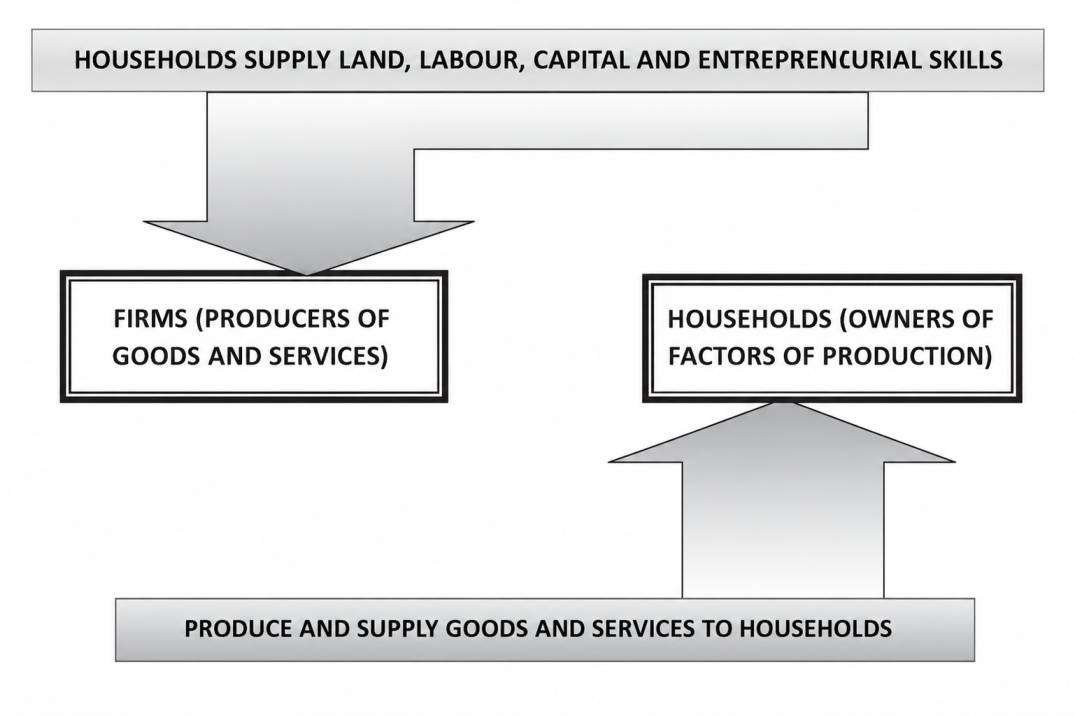
Generally, households own or control these factors of production and sell them to producers. Households provide their services as labour and earn wages in return. They also mobilise their savings for buying physical capital and also own land. Some households also have members with entrepreneurial skills and act as entrepreneurs. Households earn by selling these factors of production in the factor markets and thus contribute positively to the production process. This interaction can be shown through a circular flow of income and spending between households and firms in Fig. 1 given below.