
- The agricultural practices, cropping patterns and their productivity are closely determined by the geo-climatic, socioeconomic, and cultural-political factors. In fact, the agriculture of any region is influenced by the following factors:
- Physical factors: Terrain, topography, climate, and soil.
- Institutional Factors: Land tenure, land tenancy, size of the landholdings, size of fields, and land reforms.
- Infrastructural factors: Irrigation, electricity, roads, credit and marketing, storage, facilities, crop insurance, and research.
- Technological Factors: High-yielding varieties (new seeds) introduced in Green Revolution, chemical fertilizers, insecticides, pesticides, and farm machinery.
- These factors individually and collectively have their impact on the cropping patterns and on the level of agricultural development and yield of crops in a region.
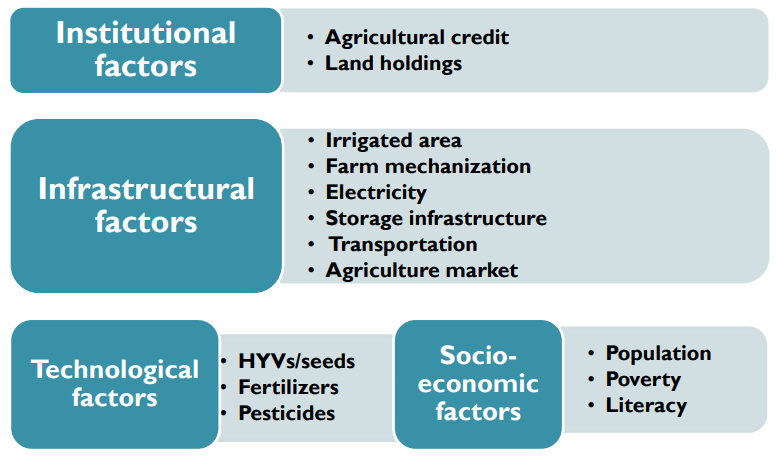
A brief account of physical factors & Institutional factors has been given below.
Physical Factors
The physical factors which affect the agriculture of any region are terrain, topography, climate, and soil which have varying influences on the agricultural productivity of a region.
It is worth mentioning that these factors do not work in isolation but the agricultural activity of a place is the product of combinations of different physical factors. The various physical factors are discussed below:
Terrain, Topography, and Altitude
- The agricultural patterns are strictly dependent on the geo-ecological conditions such as terrain, topography, slope and altitude.
- For example, while paddy cultivation requires levelled fields in order to have standing water, the tea plantations perform well in the undulating topography in which water does not remain standing, standing water damages tea plantations. Orchards of coconut, are found at low altitudes, preferably closer to sea level. While the apple orchards in the tropical and sub-tropical conditions perform well at an altitude above 1500 metres above sea level.
- However, cultivation of crops is rarely done 3500 m above sea level in the tropical and subtropical latitudes. Reason for this is the highly rarefied air, low pressure, low temperature, and shortage of oxygen at high altitudes which are serious impediments not only in the cultivation of crops but also in keeping dairy cattle.
- The soils of high mountainous tracts are generally immature. The soils at such altitude are not well developed due to the slope which induces erosion of the soil making it thin and non-conducive for agriculture.
- Topography affects agriculture as it relates to soil erosion, difficulty of tillage and poor transportation facilities.
- Mechanization of agriculture depends entirely on the topography of the land. On rough, hilly lands, the use of agricultural machinery is impossible.
- The topographical features also affect the distribution of rainfall. Normally, the windward side gets more rainfall than the leeward side. For example the windward side of Western Ghats receives 250 to 300 cm rainfall whereas the leeward side receives 75 to 100 cm rainfall.
- The amount of rainfall received in a region determines the selection of crops to be sown like we can grow jute in West Bengal but not in Rajasthan due to the variation in rainfall.
- Apart from altitude, the aspects of slope also determine the agricultural activity in a region. Aspect of slope means weather the slope is sun facing or not and how steep the slope is. The steeper the slope is, the less conducive it is for agriculture. On steep slopes terrace farming is practiced.
- The nature of the surface also affects agricultural activities. The gullied land is the least conductive for cropping. The gullied lands are highly eroded and are deficient in key nutrient resources required for agriculture. For example, the Chambal ravines in Madhya Pradesh, Rajasthan, and Uttar Pradesh have put over thousands of hectares of good arable land out of agriculture.