
Introduction
- The location of the industry at a particular place is the result of a number of decisions taken at various levels. There are certain geographical factors that facilitate this decision-making. There are other factors that fall outside the subject matter of geography. The validity or importance of a factor also changes with time and space.
- Many important geographical factors involved in the location of individual industries are of relative significance, e.g., availability of raw materials, power resources, water, labour, markets, and transport facilities.
- But besides such purely geographical factors influencing industrial location, there are factors of historical, human, political, and economic nature which are now tending to surpass the force of geographical advantages. Consequently, the factors influencing the location of the industry can be divided into two broad categories i.e.
- Geographical factors, and
- Non-geographical factors.
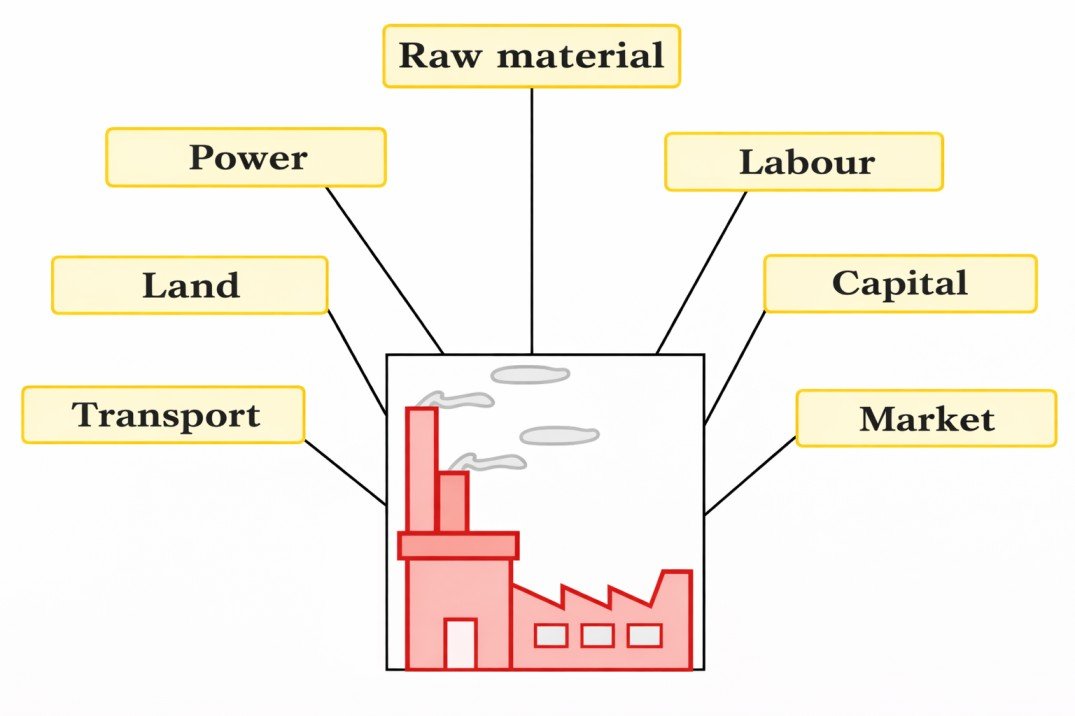
Geographical Factors
Following are the important geographical factors influencing the location of industries.
Raw Materials
- The significance of raw materials in the manufacturing industry is so fundamental that it needs no emphasizing. Indeed, the location of industrial enterprises is sometimes determined simply by the location of the raw materials. Modern industry is so complex that a wide range of raw materials is necessary for its growth.
- Further, we should bear in mind that the finished product of one industry may well be the raw material of another. For example, pig iron, produced by the smelting industry, serves as the raw material for steel making industry. Industries that use heavy and bulky raw materials in their primary stage in large quantities are usually located near the supply of the raw materials.
- It is true in the case of raw materials which lose weight in the process of manufacture or which cannot bear high transport costs or cannot be transported over long distances because of their perishable nature. This has been recognized since 1909 when Alfred Weber published his theory of location of industry.
- The jute mills in West Bengal, sugar mills in Uttar Pradesh, cotton textile mills in Maharashtra, and Gujarat are concentrated close to the sources of raw materials for this very reason. Industries like iron and steel, which use very large quantities of coal and iron ore, losing a lot of weight in the process of manufacture, are generally located near the sources of coal and iron ore.
- Some of the industries, like watch and electronics industries use a very wide range of light raw materials, and the attractive influence of each separate material diminishes. The result is that such industries are often located with no reference to raw materials and are sometimes referred to as ‘footloose industries’ because a wide range of locations is possible within an area of sufficient population density.
Power
- Regular supply of power is a prerequisite for the localization of industries. Coal, mineral oil, and hydroelectricity are the three important conventional sources of power. Most of the industries tend to concentrate on the source of power.
- The iron and steel industry which mainly depends on large quantities of coking coal as source of power are frequently tied to coal fields. Others like the electro-metallurgical and electrochemical industries, which are great users of cheap hydroelectric power, are generally found in the areas of hydropower production, for instance, the aluminum industry.
- As petroleum can be easily piped and electricity can be transmitted over long distances by wires, it is possible to disperse the industry over a larger area. Industries moved to southern states only when hydro-power could be developed in these coal-deficient areas.
- Thus, more than all other factors affecting the location of large and heavy industries, quite often they are established at a point that has the best economic advantage in obtaining power and raw materials.
- Tata Iron and Steel Plant at Jamshedpur, the new aluminum producing units at Korba (Chhattisgarh) and Renukoot (Uttar Pradesh), the copper smelting plant at Khetri (Rajasthan), and the fertilizer factory at Nangal (Punjab) are near the sources of power and raw material deposits, although other factors have also played their role.
Labour
- No one can deny that the prior existence of a labour force is attractive to industry unless there are strong reasons to the contrary. Labour supply is important in two respects
- (a) workers in large numbers are often required;
- (b) people with skill or technical expertise are needed.
- Estall and Buchanan showed in 1961 that labour costs can vary between 62 percent in clothing and related industries to 29 percent in the chemical industry; in the fabricated metal products industries they work out at 43 percent.
- In our country, modern industry still requires a large number of workers in spite of increasing mechanisation. There is no problem in securing unskilled labour by locating such industries in large urban centres. Although, the location of any industrial unit is determined after a careful balancing of all relevant factors, yet the light consumer goods and agro-based industries generally require a plentiful of labour supply.