
Introduction
The ecosystem’s organisms are linked via trophic levels or feeding mechanisms, in which one organism becomes food for another. A food chain is a series of organisms in which nutrients and energy are passed from one to the next. When one organism eats another, this occurs. Producers are at the beginning of the food chain, while apex predators are at the top. A food chain explains which organisms in the ecosystem eat which other organisms. After learning about the food chain, we can see how one organism is reliant on another for survival.
- A food chain is the sequence of events in an ecosystem in which one living organism eats another organism, which is then eaten by a larger organism.
- A food chain is the movement of nutrients and energy from one creature to another at different trophic levels.
- The feeding pattern or relationship between living species is also explained by the food chain.
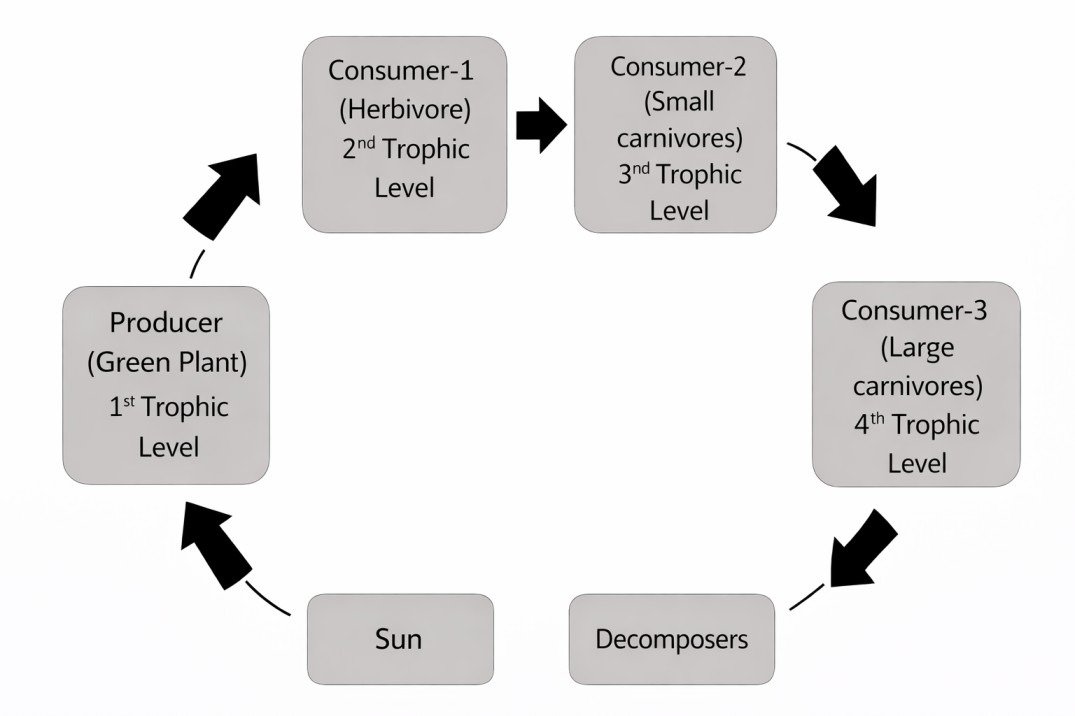
- A trophic level refers to the order in which producers, primary, secondary, and tertiary consumers appear in a food chain, starting at the bottom with producers and ending with primary, secondary, and tertiary consumers.
- A trophic level is the lowest level in a food chain.
Example of Food Chain
- Grass, for example, uses sunlight to make its own food.
- The grass is eaten by a grasshopper. The grasshopper in turn serves as prey to a frog.
- The snake is fond of consuming frogs. The hawk eats the snake.
- When a hawk dies, microbes decompose its body and return it to the soil, where it feeds nutrients to grass-growing plants.
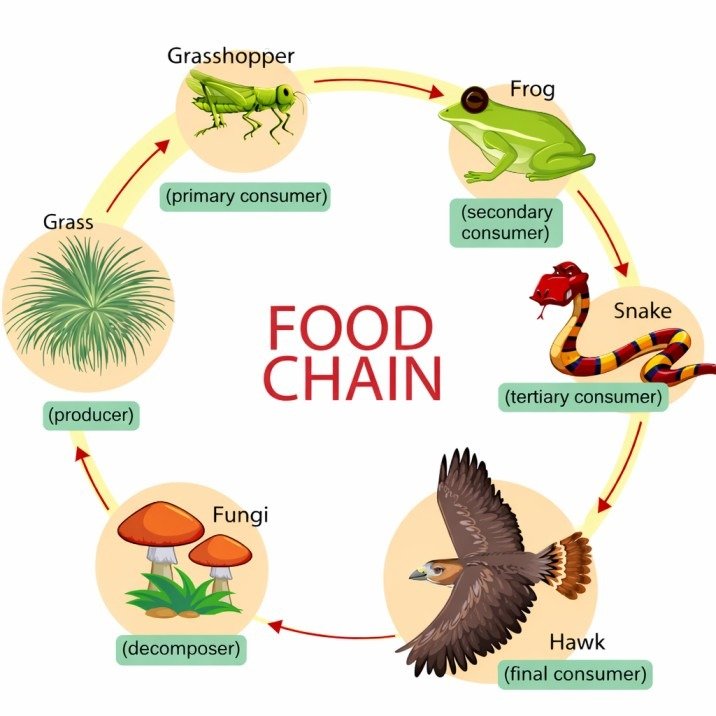
Example of a Food Chain
Definition of Food Chain
The order of living organisms in a community in which one organism consumes other and is itself consumed by another organism to transfer energy is called a food chain. Food chain is also defined as “a chain of organisms, existing in any natural community, through which energy is transferred”.
Every living being irrespective of their size and habitat, from the tiniest algae to giant blue whales, need food to survive. Food chain is structured differently for different species in different ecosystems. Each food chain is the vital pathway for energy and nutrients to follow through the ecosystem.
Food chains were first introduced by the African-Arab scientist and philosopher Al-Jahiz in the 9th century and later popularized in a book published in 1927 by Charles Elton.
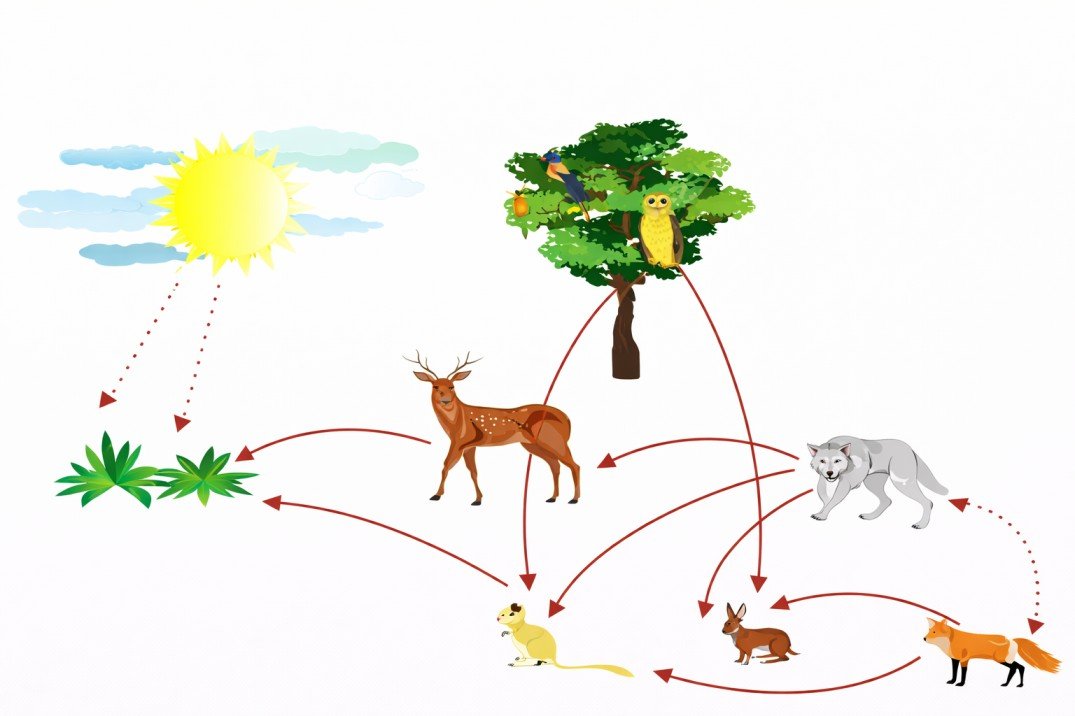
A food chain starts with a producer such as plants. Producers form the basis of the food chains. Then there are consumers of many orders. Consumers are organisms that eat other organisms. All organisms in a food chain, except the first organism, are consumers.
Plants are called producers because they produce their own food through photosynthesis. Animals are called consumers because they depend on plants or other animals for food to get energy they need.
In a certain food chain, each organism gets energy from the one at the level below. In a food chain, there is reliable energy transfer through each stage. All the energy at one stage of the chain is not absorbed by the organism at the next stage.
- Transfer of food energy from green plants (producers) through a series of organisms with repeated eating and being eaten link is called a food chain.
- E.g. Grasses → Grasshopper → Frog → Snake → Hawk/Eagle.
- Each step in the food chain is called trophic level.
- A food chain starts with producers and ends with top carnivores.
- The trophic level of an organism is the position it occupies in a food chain.
A food chain refers to the order of events in an ecosystem, where one living organism eats another organism, and later that organism is consumed by another larger organism. The flow of nutrients and energy from one organism to another at different trophic levels forms a food chain.
The food chain also explains the feeding pattern or relationship between living organisms. Trophic level refers to the sequential stages in a food chain, starting with producers at the bottom, followed by primary, secondary and tertiary consumers. Every level in a food chain is known as a trophic level.