
Introduction
- The functional attributes of the ecosystem keep the components running together. Ecosystem functions are natural processes or exchange of energy that take place in various plant and animal communities of different biomes of the world.
- For instance, green leaves prepare food and roots absorb nutrients from the soil, herbivores feed on the leaves and the roots and in turn serve as food for the carnivores.
Decomposers execute the functions of breaking down complex organic materials into simple inorganic products, which are used by the producers. - Fundamentally, ecosystem functions are exchange of energy and nutrients in the food chain. These exchanges sustain plant and animal life on the planet as well as the decomposition of organic matter and the production of biomass.
- All these functions of the ecosystem take place through delicately balanced and controlled processes.
Trophic Level
- A trophic level is the group of organisms within an ecosystem which occupy the same level in a food chain. There are five main trophic levels within a food chain, each of which differs in its nutritional relationship with the primary energy source. The primary energy source in any ecosystem is the Sun (although there are exceptions in deep sea ecosystems).
- The solar radiation from the Sun provides the input of energy which is used by primary producers, also known as autotrophs. Primary producers are usually plants and algae, which perform photosynthesis in order to manufacture their own food source. Primary producers make up the first trophic level.
- The rest of the trophic levels are made up of consumers, also known as heterotrophs; heterotrophs cannot produce their own food, so must consume other organisms in order to acquire nutrition.
- The second trophic level consists of herbivores, these organisms gain energy by eating primary producers and are called primary consumers.
- Trophic levels three, four and five consist of carnivores and omnivores. Carnivores are animals that survive only by eating other animals, whereas omnivores eat animals and plant material.
- Trophic level three consists of carnivores and omnivores which eat herbivores; these are the secondary consumers.
- Trophic level four contains carnivores and omnivores which eat secondary consumers and are known as tertiary consumers.
- Trophic level five consists of apex predators; these animals have no natural predators and are therefore at the top of the food chain.
- Decomposers or detritivores are organisms which consume dead plant and animal material, converting it into energy and nutrients that plants can use for effective growth. Although they do not fill an independent trophic level, decomposers and detritivores, such as fungi, bacteria, earthworms and flies, recycle waste material from all other trophic levels and are an important part of a functioning ecosystem.
- Due to the way that energy is utilized as it is transferred between levels, the total biomass of organisms on each trophic level decreases from the bottom-up. Only around 10% of energy consumed is converted into biomass, whereas the rest is lost as heat, as well as to movement and other biological functions. Because of this gradual loss of energy, the biomass of each trophic level is often viewed as a pyramid, called a trophic pyramid.
- It is important to note that organisms within the trophic levels of natural ecosystems do not generally form a uniform chain, and that many animals can have multiple prey and multiple predators; the non-linear interactions of trophic levels can therefore be best viewed as a food web rather than a food chain. However, disruption within one of the trophic levels, for example, the extinction of a predator, or the introduction of a new species, can have a drastic effect on either the lower or higher trophic levels.
- Decomposers occupy the last trophic level or the top of the ecological pyramid. The most common decomposers are fungi. They are the first instigators of decomposition. They have the enzymes and other compounds to break down biomolecules of deceased organism. Bacteria also have enzymes that break down organic compounds into simpler forms. After the decomposition process, the detritivores then act on the remains, scavenging for detritus or decomposing organic matter. The role of decomposers in the ecosystem is vital as they are the ones that break down the organic matter of dead d organisms where a part of them returns to earth as a geochemical component.
Trophic Structure
- A trophic structure refers to the partitioning of biomass between different trophic levels. It is controlled chiefly by the biomass of the primary producers. The primary producers affect the transfer efficiency between trophic levels as they essentially provide the energy and the nutrient inputs. Apart from them, another important factor is the top-down component. The latter includes the predators. Their consumption suppresses the lower trophic levels.
- In a way, the predators help the primary producers by controlling or limiting excessive herbivory by predation. They serve as biological control of the lower trophic levels. Another way by which the predators are able to promote primary productivity is by intraspecific competition. Both the primary producers and the predators are major factors for regulatory control.
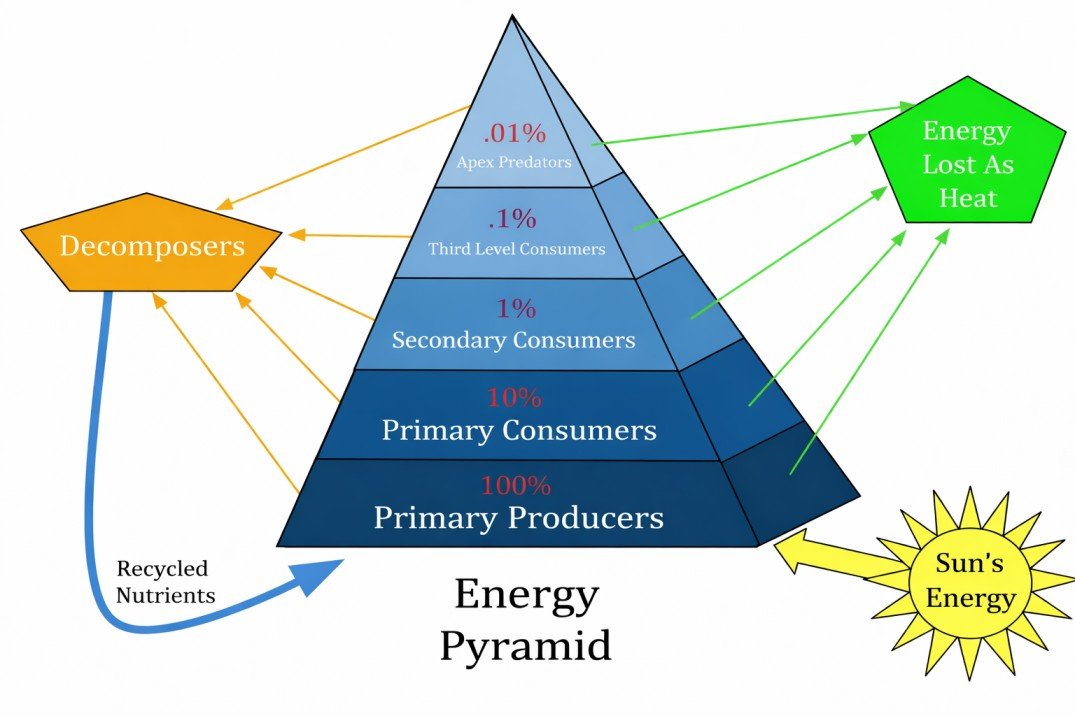
- An energy pyramid is a presentation of the trophic levels in an ecosystem. Energy from the sun is transferred through the ecosystem by passing through various trophic levels. Roughly 10% of the energy ass transferred from one trophic level to the next, thus preventing large amounts of trophic levels. There must be higher amounts of biomass at the bottom of the pyramid to support the energy and biomass requirements of the higher trophic levels.
- An ecological pyramid is often depicted as a trophic level pyramid. It is a graphical representation in the shape of a pyramid comprised of plants and animals in a certain ecosystem. The shape indicates that the bottom trophic level is comprised of organisms that can make their own food through available sources from the environment. They do not feed on other organisms to obtain their nutritional requirements. Thus, they represent the base. This portion of the pyramid is comprised of producers.
- As the trophic levels go up, it tapers towards the peak. This pyramid-shape depicts the biomass in each trophic level. Biomass is the amount of living or organic matter in an organism. The base shows the largest biomass and then diminishes in amount as it moves up to the apex. This is the most common structure in ecosystems. However, there are also instances wherein an inverted pyramid occurs. The latter results when the combined weight of producers is smaller than the combined weight of consumers.
- The ecological pyramid is also sometimes referred to as Energy Pyramid. This is because it similarly depicts the trophic levels’ energy, i.e. the energy flow through the various trophic levels. The highest energy is often found at the base that producers occupy. As the trophic structures progress to the top, the energy flow is depicted to diminish from the bottom to the top.
Different Levels of an Ecosystem
- Producers (First Trophic Level) – Producers otherwise called autotrophs prepare their food by themselves. They form the first level of every food chain. Plants and one-celled organisms, some types of bacteria, algae, etc. come under the category of Autotrophs. Virtually, almost all autotrophs use a process called photosynthesis to prepare food.
- Consumers – At the second trophic level, there are consumers who depend upon others for food.
Primary Producers
- Primary producers, or “autotrophs”, are organisms that produce biomass from inorganic compounds. In general, these are photosynthesizing organisms such as plants or algae, which convert energy from the sun, using carbon dioxide and water, into glucose. This glucose is then stored within the plant as energy, and oxygen, which is released into the atmosphere.
- In terrestrial ecosystems, almost all of the primary production comes from vascular plants such as trees, ferns, and flowering plants. In marine ecosystems, algae and seaweed fill the role of primary production.
- There are also some deep-sea primary producers that perform oxidization of chemical inorganic compounds instead of using photosynthesis; these organisms are called “chemoautotrophs”.
Primary Consumers
- Primary consumers are herbivores, that is, animals that are adapted to consuming and digesting plants and algae (autotrophs). Herbivores are generally split into two categories: grazers, such as cows, sheep and rabbits, whose diets consist at least 90% of grass, and browsers, such as deer and goats, whose diets consist at least 90% of tree leaves or twigs.
- Primary consumers may also consume other forms of plant material. Many bats, birds and monkeys eat fruit (frugivores); birds, insects, bats and arachnids (spiders) eat nectar (nectarivores); and termites and beetles eat wood (xylophages).
- In marine ecosystems, primary consumers are zooplankton, tiny crustaceans which feed off photosynthesizing algae known as phytoplankton.
Secondary Consumers
- Secondary consumers, at trophic level three, are carnivores and omnivores, which obtain at least part of their nutrients from the tissue of herbivores. This includes animals and carnivorous plants that feed on herbivorous insects (insectivores).
- Secondary consumers are usually small animals, fish and birds such as frogs, weasels, and snakes, although larger apex predators, such as lions and eagles, may consume herbivores, and can also exist within the second trophic level of an ecosystem.
- In marine ecosystems, all species that consume zooplankton are secondary consumers; this ranges from jellyfish to small fish such as sardines and larger crustaceans such as crabs and lobsters, as well as whales, which filter feed, and basking sharks.
Tertiary Consumers
- Tertiary consumers acquire energy by eating other carnivores but may be preyed upon. Owls are an example of tertiary consumers; although they feed off mice and other herbivores, they also eat secondary consumers such as stoats. In turn, owls may be hunted by eagles and hawks, and are therefore not apex predators.
Apex Predators
- Apex predators are organisms at the top of the food chain, and which do not have any natural predators. Eagles, wolves, large cats such as lions, jaguars and cheetahs, and marine animals such as sharks, tuna, killer whales and dolphins are all examples of apex predators, although there are many more.
- Apex predators often have specific adaptions, which make them highly efficient hunters, such as sharp teeth and claws, speed and agility and stealth; sometimes they work within groups, enhancing the success of their hunting abilities.
- However, not all apex predators are vicious hunters. Whale sharks are large filter feeders, consuming only small fish and plankton, although because they have no natural predators, they are apex predators in their environment.
- Apex predators play an extremely important role in an ecosystem; through predation they control populations of the lower trophic levels. If apex predators are removed from an ecosystem, organisms such as grazing herbivores can over-populate, therefore placing intense grazing and browsing pressure on the plants within a habitat.
- If there are fewer available plant resources, other organisms that depend on the plants (although are not hunted by the apex predator), such as insects and small mammals, will suffer population declines, and in turn can affect all trophic levels within an ecosystem. This disturbance is called a top-down trophic cascade, and can lead to ecosystem collapse.
Planktons
- Planktons are microscopic organisms that live on aquatic habitats. Some of them are photosynthetic and others are heterotrophs. Thus, they may be distributed to different trophic levels in the food chain or ecological pyramid. Those that are capable of photosynthesis, such as phytoplankton, are considered as producers.
- Heterotrophic planktons, such as zooplanktons may be consumers as they feed on other planktons.
Biomass Transfer Efficiency
- Biomass in an ecological pyramid is lost progressively from the bottom up. The greatest biomass amount is found at the base trophic level that includes the producers. Since the primary consumers rely on producers for sustenance, the biomass amount of the producers would, therefore, be a limiting factor to the biomass of the primary consumers.
- Likewise, the secondary consumers rely on primary consumers and consequently, their biomass would also be affected with the available biomass amount of primary consumers. Thus, in an ecosystem, it is usual to find a biomass pyramid wherein the first trophic level is widest while the topmost trophic level is narrowest.
- The distribution of biomass in an ecosystem implicates ecosystem stability. If in the case of an inverted pyramid, the ecosystem could fail when there are more consumers than primary producers.
Significance
- Monitoring the trophic levels is essential so as to gain an understanding of the interrelationships between organisms as well as the ecological processes that occur within an ecosystem. In that way, the magnitude of herbivory, predation, and decomposition processes could be used to know the status and stability of an ecosystem.