
- Meaning of Grassroot Governance
- Panchayati Raj Institution
- Development of Panchayati Raj in India
- 73rd Amendment Act 1992
- Three Tier System of Panchayati Raj
- Compulsory and Voluntary Provisions of 73rd Amendment Act
- Financing of Local Institutions
- Problems in the Panchayati Raj System in India
- Municipalities (Urban Local Government)
- 74th Amendment Act, 1992
- Types of Urban Local Bodies
- 74th Constitutional Amendment Act and Reforms
- Functions of Urban Local Bodies
- Powers of Urban Local Bodies
- Financial Resources of Urban Local Bodies
- Role and Responsibilities of Mayor in Urban Local Bodies
- Conclusion
The form of grassroot democracy and domination in India with the role of Panchayati Raj Institutions (PRIs) in the progression of rural areas is significant. Grassroot Governance is a tendency towards designing political processes that shifts as much decision making authority as practical to the lowest geographical or social level of organisation.
Meaning of Grassroot Governance
India has been a welfare state ever since after independence and the chief objective of all governmental endeavours has been the well-being of its population. Basic principles of government are elimination of poverty, ignorance of diseases and inequality of opportunities and providing a better and higher quality of life. India's democratic structure has three levels of governance which are national, state and local.
In simple terms, grassroot democracy is a people/community driven contribution in elections, governance and decision making. Grassroot democracy can be seen as a propensity towards designing political processes where as much decision making authority as practical is shifted to the lowest level of organisation. Therefore, a local government is a government at the grassroot level of administration meant for meeting peculiar grassroot needs of the people. A Appadorai (1975) was of the opinion that the local government system of government is by the popularly elected bodies charged with administrative and executive duties in matter concerning the populations of a particular district or place.
Local government was further defined by Lawal (2000) as "that tier of government closest to the people, which is vested with certain powers to exercise control over the affairs of people in its domain". Local government is a system of public administration at a local level charged with the responsibility of bringing the people at the grassroot closer to the government. Grassroots organisations can have numerous structures depending on the type of organisation and what the members want. In India, we have grassroot democracy in the form of Panchayati Raj and Municipal Corporations which are mentioned in XI and XII schedule of the Constitution.
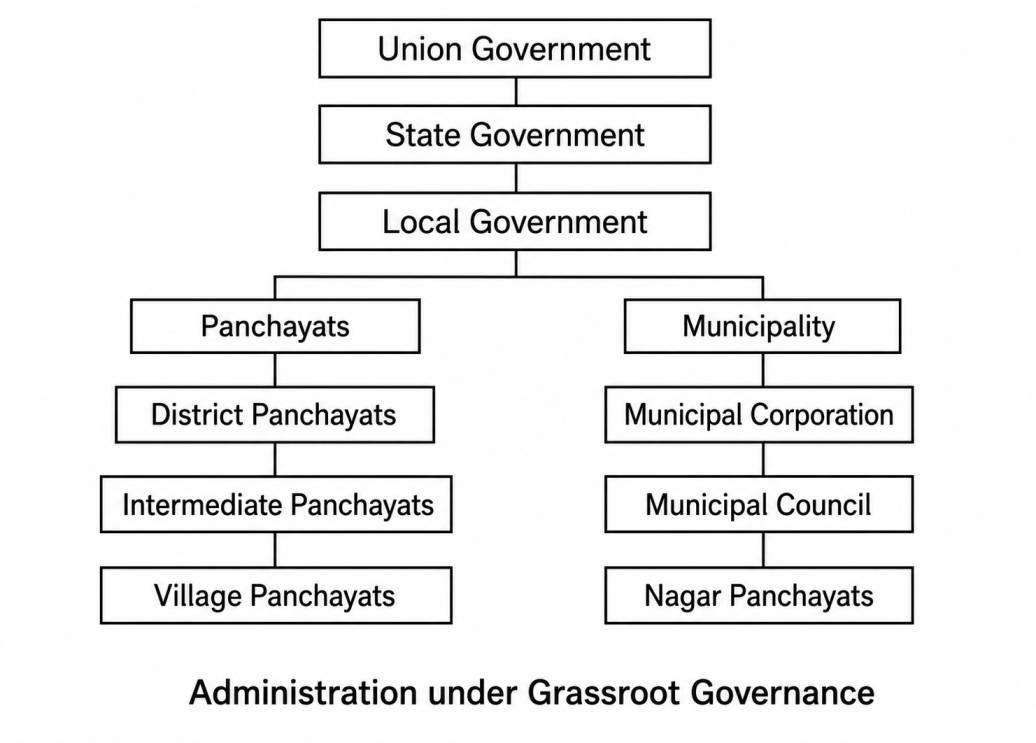
Panchayati Raj Institution
In India, the term 'Panchayati Raj' generally refers to the system of Local Self government introduced by a constitutional amendment in 1992. Panchayati Raj in India signifies the system of rural Local Self-government. It has been established in all the state Legislatures to build democracy at the grassroot level. It is entrusted with rural development. It was consitutionalised through the 73rd Constitutional Amendment Act of 1992.
It was first introduced in 1959. It is depicted as a mechanism of popular participation. The Panchayati bodies are expected to awake political consciousness at the local level and strengthen the roots of democracy at the grassroot level. The sole objective of the PRIs is to ensure to people's participation in developmental activities by creating awareness among them thereby strengthening the roots of democracy.
Development of Panchayati Raj in India
The development of Panchayati Raj Institutions in India passed through four distinct phases.
Phase of Domination (1959-1964):
The strengthening of the roots of village administration has been considered important by the rulers since the ancient times, Gandhi, in modern times strongly emphasised on strong village administrative agencies. An evidence of which may be pointed out as the presence of traditional Panchayats in one-third of the villages of India.
Strengthening Panchayats:
In 1957 a team was appointed for study on Community Development and National Extension Service. This team was headed by Shri Balwant Rai Mehta. The team in its report suggested the establishment of 'Panchayati Raj' or 'Democratic Decentralisation'. For strengthening, the roots of elected and of democracy, it recommended the setting up of organically linked democratic bodies at the village bloc and the district levels and the entrusting of all planning and developmental activities to these bodies.
In 1958, the National Development Council accepted the recommendations of the Balwant Rai Mehta Committee and various states in India started the implementation of the scheme of Panchayati Raj. The goal behind Panchayati Raj is the empowerment of the people at the village level.
India's experiment with democratic decentralisation started in Rajasthan on 2nd October, 1959, at Nagaur with the formal inauguration of Panchayati Raj. In Rajasthan, a three tier system of PRI revolved around the three statutory institutions i.e. Village Panchayats, Panchayat Samitis and Zila Parishads. The three-tier structure had continued to operate over a period of nearly three decades. Andhra Pradesh closely followed the system and adopted the system in 1959. Tamil Nadu adopted the two-tier system, West-Bengal on the other hand adopted the four-tier system. In some states Nyaya Panchayats ie. judicial Panchayats were established to try petty civil and criminal cases.
Recommendations of Balwant Rai Mehta Committee:
The major recommendations of Balwant Rai Mehta Committee on democratic decentralization were
- There should be a three-tier structure of Local Self government i.e. Gram Panchayat at the village level, Panchayat Samiti at the block level and Zila Parishad at the district level. These tiers should be organically linked through a device of indirect elections.
- There should be genuine transfer of power and responsibility to these institutions of local governments.
- Adequate resources should be transferred to these bodies to enable them to discharge those responsibilities.
- All programmes of social and economic development formulated through the network of planning should be channelled through those institutions.
- The whole system of Panchayati Raj should facilitate further devolution and dispersal of power, responsibilities and resources in the future.
- The Panchayat Samiti should be the executive body while the Zila Parishad should be the advisory, coordinating and supervisory body.