Tsunami
Tsunami meaning “harbour wave” in literal translation comes from the Japanese characters for harbour ( tsu ) and wave ( name ). A tsunami also called seismic sea waves, is one of the most powerful and destructive natural forces. It is a series of extremely long waves caused by a large and sudden displacement of the ocean due to earthquake, volcanic eruptions etc. When they reach the coast, they can cause dangerous coastal flooding and powerful currents that can last for several hours or days.
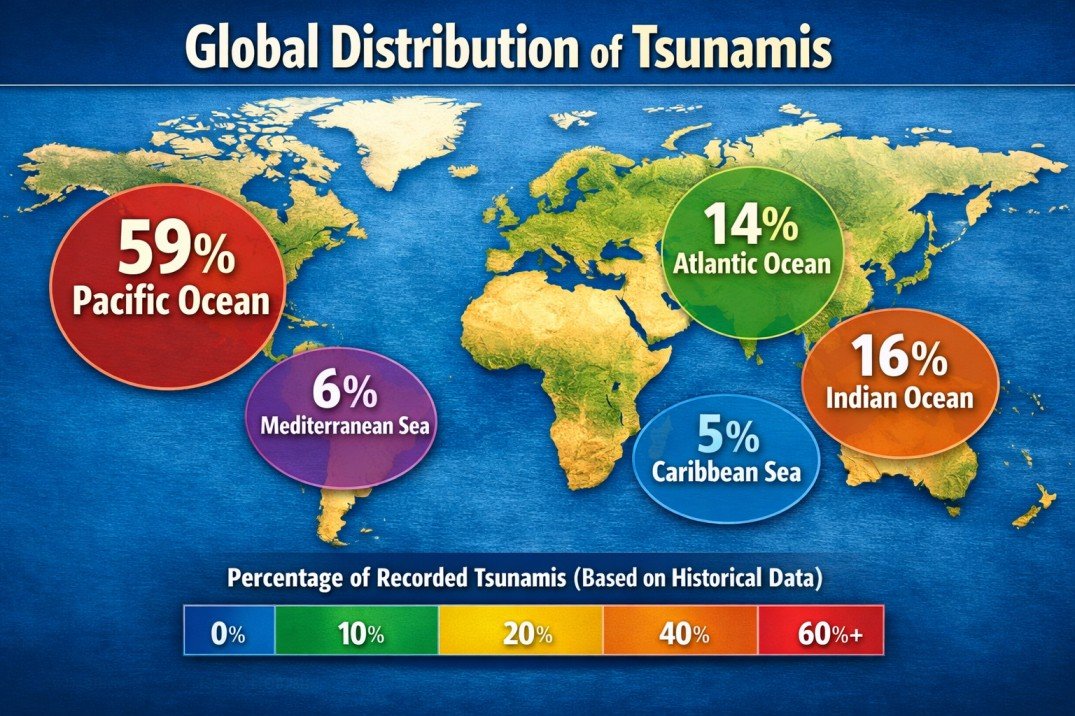
Global Distribution of Tsunami
Globally, 70% of the confirmed tsunami sources have been in the Pacific Ocean, 9% in the Caribbean Sea, 15% in the Mediterranean Sea and the Atlantic Ocean and 6% Indian Ocean. Most of these Tsunamis were generated by earthquakes.
Tsunamis are frequently observed along the Pacific ring of fire, particularly along the coast of Alaska, Philippines, Japan and other islands of South Asia and Southeast Asia including Malaysia, Indonesia, Myanmar, Sri Lanka and India etc.
Characteristics of Tsunami
- Tsunamis are among Earth’s most infrequent hazards and most of them are small and nondestructive.
- Tsunamis generally consist of a series of waves, with periods ranging from minutes to hours.
- Tsunamis radiate in all directions from the point of origin and they can cover entire ocean basins.
- There is no season for tsunamis. We cannot predict where, when or how destructive the next tsunami will be.
- Not all tsunamis act the same. And, an individual tsunami may impact coasts differently. A small tsunami in one place may be very large a few miles away.
- Most tsunamis are caused by large earthquakes. Though, not all earthquakes cause tsunamis.
- Tsunamis are waves generated by the tremors and not by an earthquake itself.
- The effect of Tsunami would occur only if the epicentre of the tremor is below oceanic waters and the magnitude is sufficiently high.
- A tsunami can strike any ocean coast at any time. They pose a major threat to coastal communities.
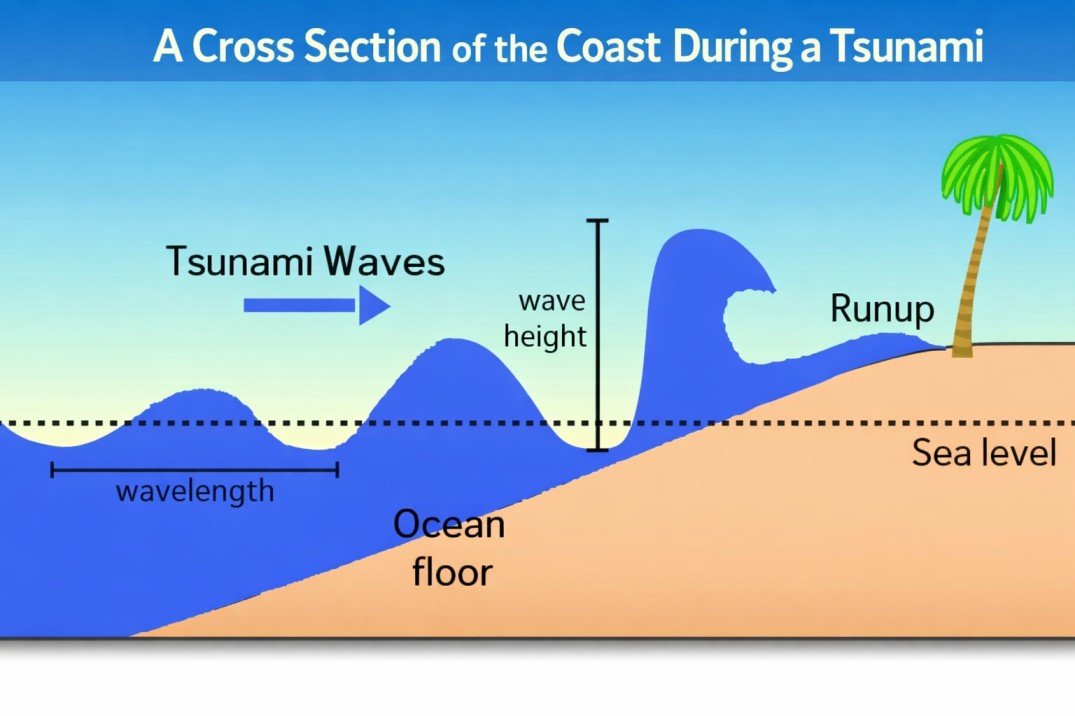
- The speed of the wave in the ocean depends upon the depth of water. It is more in the shallow water than in the ocean deep. As a result of this, the impact of a tsunami is more near the coast and less over the ocean.
- Over deep water, the tsunami has very long wavelengths (often hundreds of kilometres long) when a tsunami enters shallow water, its wave-length gets reduced and the period remains unchanged, which increases the wave height.
- Tsunamis have a small amplitude (wave height) offshore. This can range from few centimetres to over 30 m height. However, most tsunamis have less than 3 m wave height.