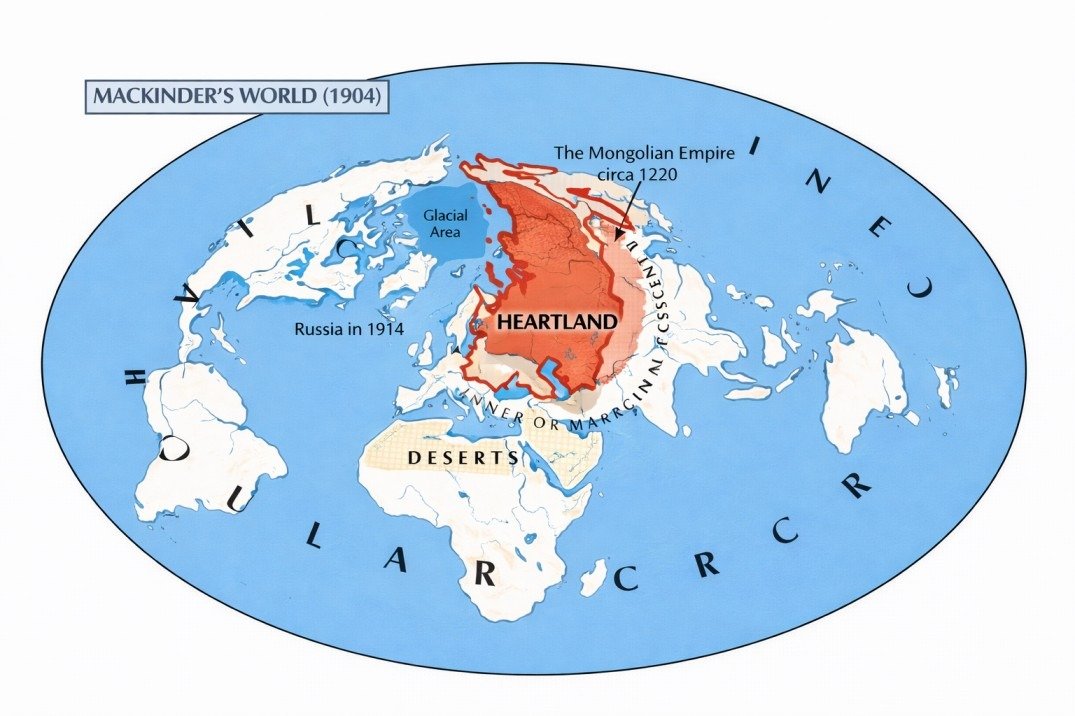
- Heartland and Rimland theories talk about the evolution of Geopolitics of the world.
- Geopolitics is made up of 2 words, Geo & Politics which refers to the changes in Polity of the world due to Geographical factors.
- The geopolitical history of the world has undergone a spatiotemporal analysis by political thinkers & geographers who had seen political history as the causation of geographical factors.
- The conflict between land & sea power was 1st hypothesized by Alfred Thayer Mahan in his book “The Influence of Sea Power upon History” who emphasized that Sea Power is superior to Land Power because of easy & faster movement, port facilities, better trade, etc.
- Sea Power refers to countries having a large sea boundary and Land Power refers to countries that are landlocked or have a large land boundary e.g. India has a long coastline while Nepal is a landlocked country.
- However, a British Political Geographer Prof. H. J. Mackinder contradicted his theory and proposed a reverse, antithetical spatial model of Land & Sea Power conflict where the Supremacy of Land Power was due to its location, inaccessibility from all sides, and resource pass.
Mackinder’s Heartland Theory
- Mackinder’s theory is a spatial analysis of the geopolitics in terms of its location, accessibility, and natural resource base.
- His theory has laid down the principle of geographical causation of history which means that the pulsations in human history have been caused by the geographical conditions.
- Mackinder interpreted history as essentially a struggle between Land & Sea Power and presented his paper “The Geographical Pivot of History” in order to elucidate his formula of ‘Geographical Causation in World History‘.
- The political history of the world, fates of civilization, and the changing paradigms of nations have been majestically controlled by Geographical Causation.
- Mackinder theorised the hypothesis of Geopolitical rivalry between Land Power and Sea Power and thus conflict led to several wars.
Actual Mackinder’s Theory:
- He postulated the resource theory & location as a resource
- The natural resource endowment is the basis of sustenance of a country & its supremacy over others as well since natural resources are found on Land e.g. Nuclear Energy requires Uranium as a Raw material which is found mainly in Land
- On the basis of physical map of the world, Mackinder concluded that on the global scale, the earth surface consisted of a huge & continuous landmass (Europe, Asia, and Africa) and some isolated Islands e.g. North and South America, Australia, Great Britain, and Japan.
- He named this huge united landmass of Europe, Asia & Africa as the ‘World Island’ which accounts for 2/3rd of the total land area of Earth, being 11 Mn. Sq. Km and also about 7/8th or 88% of the total population of the world
- The concept of World Island is central to the theoretical precepts of Mackinder
- The rest of the continents supported the only 1/8th of the mankind
- The concept of Heartland was later used in cold war discourse to denote an era of Eurasia
- Mackinder suggested that the Columbian era of Sea Power (Age of Discoveries with Columbus, Marco Polo, etc ) which had given Europe its pivotal role for the past 4 centuries (Colonial Era), was coming to a close & was being eclipsed by the ascendancy of Land-based powers & in particular with a new ‘Geopolitical pivot of History’ namely the Heartland of Europe-Asia.
Three Tiers
- Mackinder divided the world into 3 Tier spatially organized system
- In 1903, he published a book titled “Geographical Pivot of History” containing the following map.
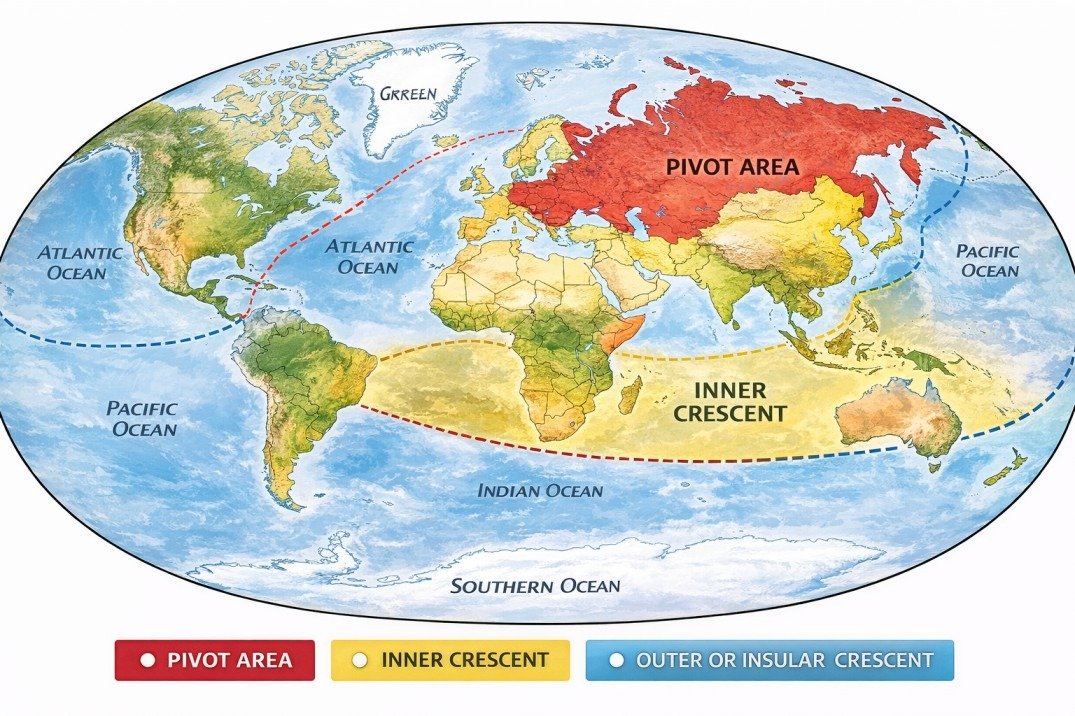
The 3 tiers were:
PIVOT AREA/HEARTLAND:
It is surrounded by mountains on three sides and by the ice-bound Arctic on the North
- It consisted of the whole Siberia & parts of Central Asia (Kazakhstan, Uzbekistan, Tajikistan, Kyrgyzstan, and Turkmenistan)
- It was surrounded by the vast icefields of Arctic in North, the Urals in West, Central Asian Highlands in South & East Siberian Highlands in East
- It was thus termed as a “Natural Fortress or the Uppermost Citadel of the world” as it was not accessible to sea powers
- The pivot area has a concentration of all-natural resources – mineral, water, soil, forest, etc.
INNER CRESCENT:
The Pivot Area was pictured by Mackinder as surrounded by an ‘Inner’ or ‘Marginal’ Crescent, consisting of an arch of coastland & characterized by drainage into navigable seas
- This inner or marginal crescent considered of the whole of Eurasia outside the heartland
- It symbolizes the Sea Power and includes –
- Europe
- South West Asia
- North Africa
- India
- China (some parts of China is in pivot area also)
- Most of the Human civilizations are located in the crescent and it is co-terminus with the old world i.e. Pre-Columbian
OUTER/INSULAR CRESCENT:
Outside the Inner or Marginal crescent lay Mackinder’s 3rd tier, which he named as the Outer or Insular crescent
- Mackinder suggested it to have no geographical significance in the contemporary world
- It included the New World (North America, South America, Other parts of Africa, Pacific Islands, Oceania)
- It is designated as Outer Crescent because of their complete insularity from the mainland of Eurasia
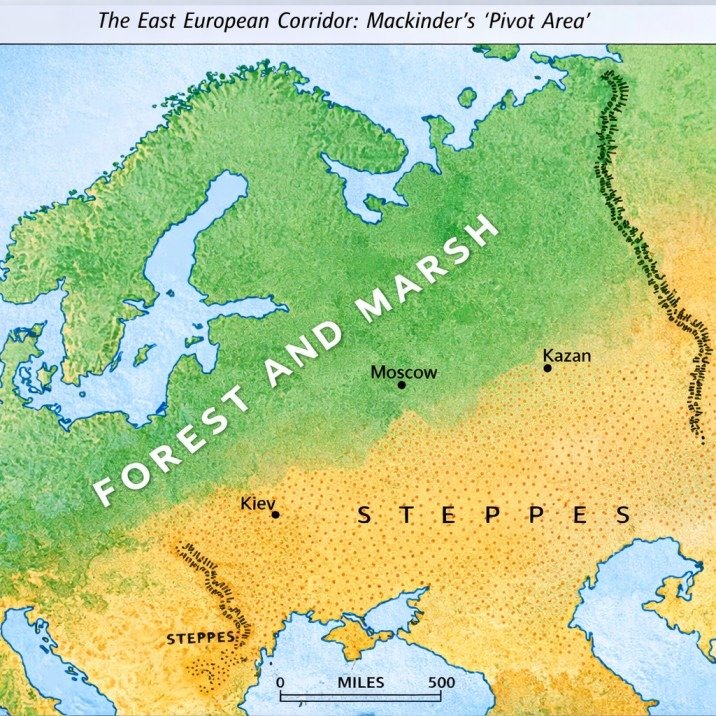
- For Mackinder, the concept of World Island is central to this theoretical percept
- For him, whoever could gain control of ‘World Island’ would be in an almost unstoppable position to dominate the entire globe
- In his opinion, the heartland having Agricultural resources could conquer Europe, Middle East & Far East
- The inner and outer crescent would follow later