
Introduction
The term identification was originally used to denote the possibility (or impossibility) of deducing the values of the parameters. In the preceding Unit while explaining the problem of SEM, we mentioned that in simultaneous equation models the major problem is, we could not understand from the data set which specific relationship it is representing.
It is impossible to estimate an equation unless we get a particular form of it. Thus our main problem is to specify the form of the equation and the method of doing this is known as identification. Thus identification comes prior to the estimation.
Once the equation is identified the problem of inconsistent estimation can be taken care of as identification ensures unique structure of the equation. Due to this unique specificity, the part that was not being explained earlier in the equation (and getting included as unexplained component causing correlation between dependent variable and error term), gets explained. Thus it also solves the problem of inconsistency in the estimator.
The Concept of Identification
The identification problem is logically prior to estimation. If more than one theory is consistent with the same data then they are said to be observationally equivalent, and we cannot distinguish them. In such cases the structure is said to be unidentified or needs to be identified.
Identification is a problem of model formulation, rather than of model estimation or appraisal. We say a model is identified if it is in a unique statistical form, enabling unique estimates of its parameters to be subsequently made from sample data. If a model is not identified then we cannot say exactly what relationship we are estimating.
To measure the coefficients of the demand equation, normally the published time series reporting the quantity bought of the commodity is used. However, the quantity bought is identical with the quantity sold at any particular price. Market data register points of interaction of equilibrium supply and demand at the price prevailing in the market at a certain point of time. A sample of time-series observations shows simultaneously the quantity demanded, and the quantity supplied, at the prevailing market price. That is, it only shows the points of interactions of demand and supply.
If we use these data for estimation, we actually measure the coefficients of a function of the form Q = f(p). This equation may be either the demand function or the supply function. But how can we be sure whether this equation represents demand function or supply function? If anyone is interested to measure the demand function then he can use the data. Similarly, the person who is interested to measure the supply equation will also be using the same data.
It is clear that we need some criteria, which will enable us to verify that the estimated coefficients belong to the one or the other relationship. Such criteria are known as ‘identification conditions’ of a function.
We begin with the concept of identification using the following diagrams.
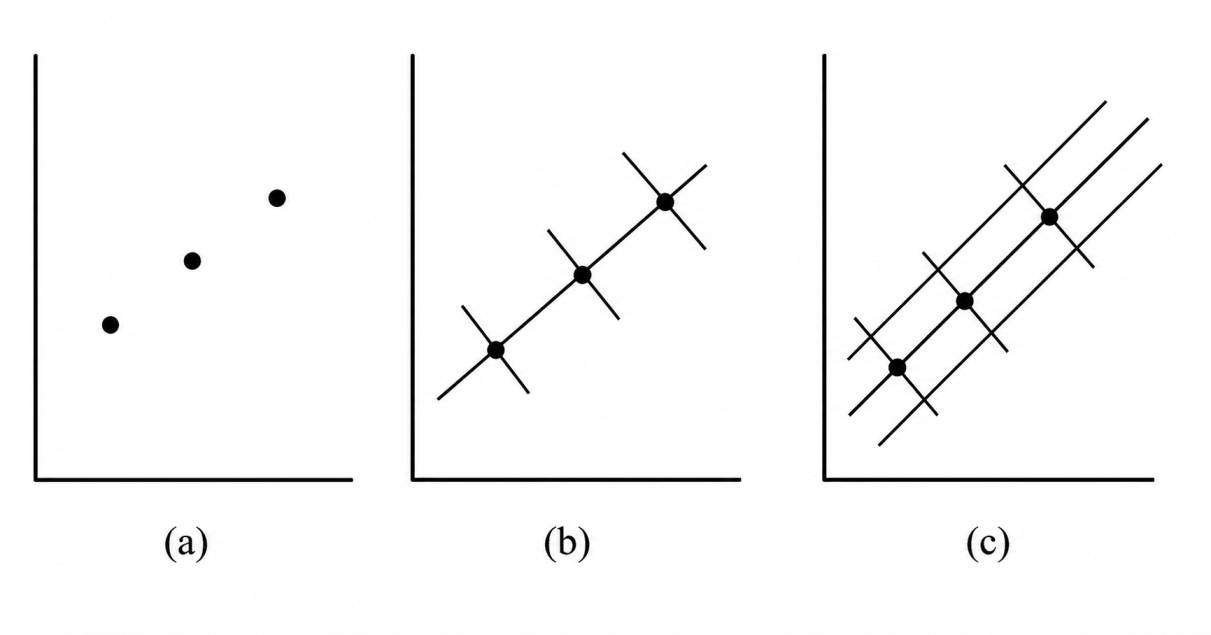
The observed data consist of the market outcomes shown in Fig. 1. We have no knowledge of the conditions of supply and demand beyond our consideration that the data represents equilibrium points, that is the interaction points of supply and demand. Fig. 1(a) shows three data points.
From Fig. 1(b) and 1(c) we can see that we can get the same data for the two different situations. In Fig. 1(b) the supply curve is stable and the demand curve is shifting. The data represents points on the supply equation under the assumption that supply function is fairly stable and the demand curve shifts.
But if both the demand and supply curves are shifting randomly as shown in Fig. 1(c), then if we wish to estimate Q = f(p) from the same data set then we estimate neither demand nor the supply curve; rather we end up estimating the mongrel equation.
Thus for estimation of the equation we need to first identify the equation; otherwise we cannot say exactly what function we are estimating. Identification ensures unique structural form of an equation so that we can easily estimate the equation.
It should be noted that identification problems arise only for those equations which contain coefficients which must be estimated statistically (from sample data). Identification difficulties do not arise for definitional equations, identities, or statements of equilibrium conditions, because such relationships do not require measurement.