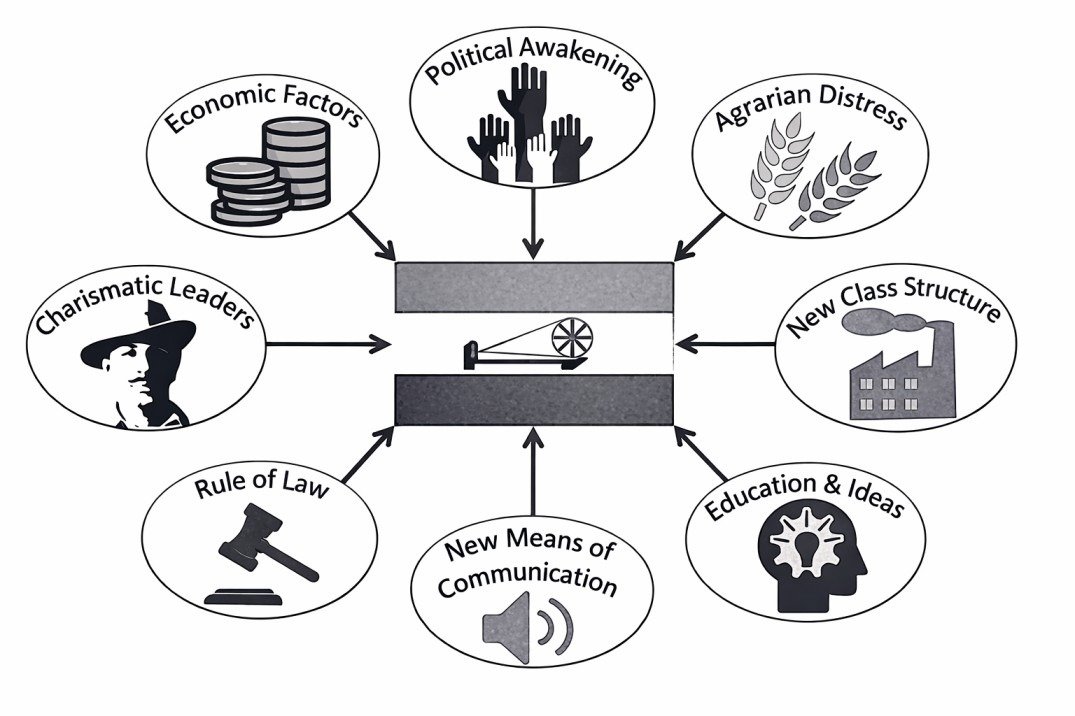
Colonial rule in India brought major changes in social institutions, initiated industrialisation, replaced traditional occupations with new forms of work, transformed food and clothing habits, suppressed practices conflicting with modernity, introduced colonial laws creating administrative uniformity while simultaneously threatening traditional institutions, leading to social mobilisation and resistance.
Though colonialism was oppressive and caused deep cultural damage, it also introduced modernity, social reforms and nation formation, while colonial capitalism integrated India into the world economy in a subservient manner.
India was reduced to a supplier of cheap raw materials and an importer of finished goods, destroying domestic industries, resulting in extremely low domestic savings of less than 3% of GNP at independence, compared to around 30% today.
Whatever little savings existed were drained by colonial rulers through economic drain, military expenditure and administrative costs, with military spending alone accounting for nearly 50% of government expenditure between 1890 and 1947.
State support to Indian industry was almost non-existent, while British industries enjoyed strong domestic protection, free trade was imposed on India without tariff protection for Indian industries, and currency policy was manipulated in colonial favour.
The tax structure was highly inequitable, heavily burdening the peasantry, while bureaucrats and landlords paid minimal taxes, with land revenue contributing over 50% of government income in 1900 and salt tax adding another 16%, both later abolished after independence.
Poor investment and lack of agricultural modernisation caused low productivity and stagnation, while moneylenders, landlords and middlemen preferred exploiting sharecroppers, tenants and labourers rather than investing in agriculture.
At independence, nearly 70% of land was controlled by landlords, landlessness reached 28%, and landholdings were highly fragmented and uneconomical.
British rule transformed the administrative structure through formation of provinces, establishment of a new bureaucratic system, and introduction of rule of law, though it remained discriminatory against Indians.
Political ideas such as democracy and equality spread, leading to the formation of the Indian National Congress in 1885, administrative unity translated into political unity, and a pan-Indian consciousness fostered nationalism.
In the cultural sphere, English education and missionary activities weakened traditional education systems but introduced modern ideas and new opportunities.
Port towns and coastal regions were most affected by colonial rule, becoming centres of economic and political activity, while older towns declined and cities like Madras, Calcutta and Bombay rose to prominence.
Social Background of Indian Nationalism
The colonial period produced a specifically pan-Indian consciousness, as British rule unified India economically, administratively and geographically through modern communication networks, spreading capitalist change and modernisation, though this unification was achieved through severe exploitation and domination, and British attempts to divide society and prevent common identity paradoxically generated nationalism.
Economic contradictions of British rule were exposed by early nationalists like Dadabhai Naoroji and R. C. Dutt, who highlighted unequal control over production, export of surplus, contrast between pre-colonial prosperity and colonial poverty, strengthened by the Swadeshi Movement, and interpreted by A. R. Desai as rooted in anti-imperialist and anti-bureaucratic ideology.
Political awakening began with the establishment of the Indian National Congress in 1885, recognition that political power was essential for national goals, and gradual reforms accompanied by mass mobilisation.
Charismatic leadership of figures like Mahatma Gandhi, Bhagat Singh, Subhas Chandra Bose and Tilak mobilised millions and exposed the social and economic contradictions of colonial rule.
Modern education and ideas of liberalism and freedom created a contradiction between Western ideals and colonial denial of liberty, which nationalist leaders spread through vernacular languages to popularise democracy and modernity.
The urban middle class, created by colonialism and Western education, became the main carrier of nationalism, challenged colonialism, rediscovered tradition, strengthened regional and national communities, and formed early political organisations.
Cultural revolt arose against colonial attacks on religious and caste identities, inspired the 1857 Revolt, reacted to British cultural arrogance, and was articulated by leaders like Tilak, Annie Besant and Veer Savarkar, who linked Swaraj with political, cultural and economic freedom.
Reformist and revivalist movements led by Raja Ram Mohan Roy and Dayanand Saraswati combined social reform with nationalism, and according to A. R. Desai, socio-religious movements expressed national awakening due to conflict between old values and new economic realities, with Bahadur Shah Zafar symbolising revival in 1857.
Global events such as the Russian Revolution, defeat of Italy by Ethiopia, and growth of socialist nationalism in the 1930s inspired Indian nationalism.
Communalism and divisive politics under the British divide and rule policy created a parallel nationalism, leading to Partition.
Indian nationalism emerged through a plurality of factors, initially led by moderate elites with limited mass base, transformed into a mass movement under Gandhian leadership, alongside revolutionary nationalism, but faced internal divisions with Jinnah’s demand for a separate nation.
Additional obstacles included casteism, communalism, regionalism, weak response from Southern provinces and princely states, and British divisive strategies.