
India's Long Road to Independence
Class 8th
NCERT
Language
Choose your preferred language
India’s Long Road to Independence
🎨 Reading Colors
Background
Text Color
Table of Contents
- A Royal Proclamation
- Reform Movements
- Other Influences
- The Rise of the Indian National Congress
- Growing Discontent
- The 1905 Partition of Bengal and National Awakening
- The Nationalist Agenda
- The All-India Muslim League
- The 1907 Surat Split
- The Revolutionaries
- Home Rule Movement and the Lucknow Pact
- Gandhi and the Non-Cooperation Movement
- The Jallianwala Bagh Massacre and its Aftermath
- The Khilafat Movement and its Aftermath
- Protests, Repression and Revenge
- Purna Swaraj and Civil Disobedience
- The Gandhi-Irwin Pact
- The Idea of Separate Nations
- World War II and the Indian National Army
- The Quit India Movement
- Partition, Turmoil, and Independence
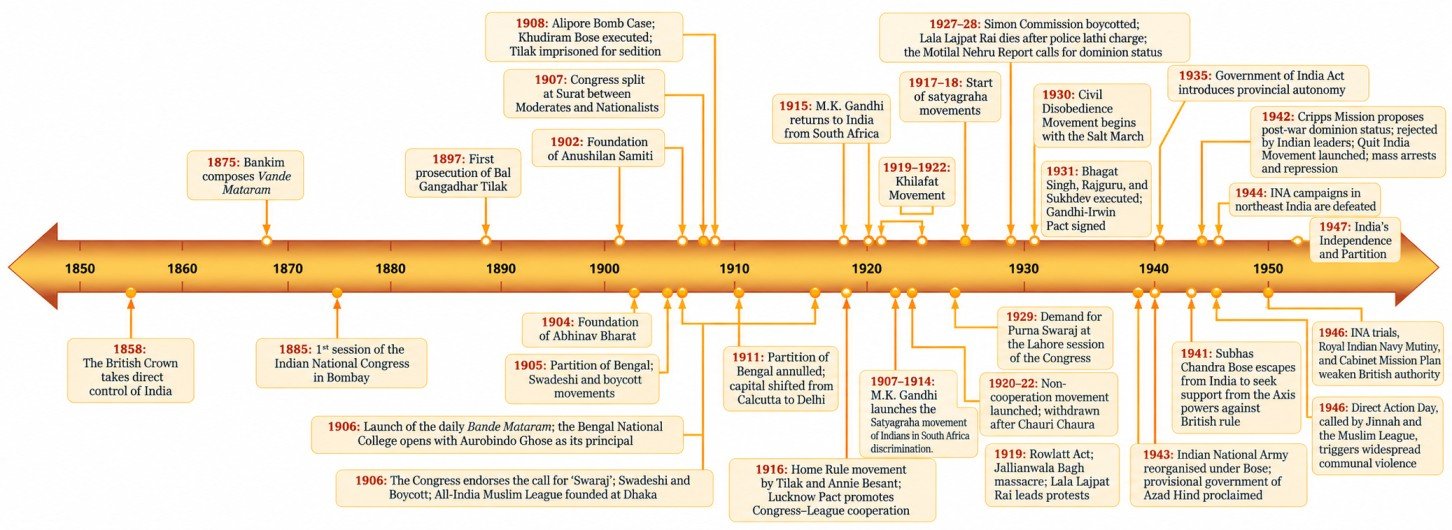
A Royal Proclamation
- After the Great Uprising of 1857, the British Crown under Queen Victoria took direct control of India from the East India Company in 1858.
- The territories of British India were now governed in the Queen’s name by the Secretary of State for India, based in London, and by the Viceroy, the Queen’s representative in India, who was also known as the Governor General.
- In 1858, a ‘royal proclamation’ was issued in Queen Victoria’s name, promising to respect the ‘rights, dignity and honour of native Princes’; therefore, about 560 Indian princes continued to rule their own states, but under British supremacy, called ‘paramountcy’.
- The proclamation assured the ‘natives of our Indian territories’ that they would be cared for like all other British subjects and that there would be no attempt to impose Christianity on them.
- These promises were meant to show that the colonial rulers would now prefer to rule in peace rather than through military force, but in practice none of these assurances were respected.
- The princely states remained closely monitored; in almost all of them, the colonial government posted a ‘Resident’ or ‘Political Agent’, who often interfered in their government and administration, reducing their autonomy to a largely symbolic one.
- Christian missionary activity continued with indirect state support, such as concessions of urban land, and often with open encouragement from high British officials.
- The economic exploitation of India continued; heavy land taxes caused several severe famines and widespread discontent, especially among peasants and tribals.
- Local Indian industries could not compete with cheap British-manufactured goods flooding Indian markets.
- Indians were treated as inferior to the British because they were regarded as belonging to ‘inferior races’, while the white race claimed it was destined to dominate the world.
- Indians employed in the army, civil services, or universities received lower pay than British employees in the same posts; most court juries had a British majority and were lenient towards Europeans who committed crimes against Indians.
- Indians were not allowed to mix with Europeans in clubs, trains, specific areas of cities, and some public spaces.
- In 1878, the Arms Act was passed, which prohibited Indians from keeping arms while allowing the British to do so.
- In the same year, the Vernacular Press Act was passed to regulate and censor the Indian-language press.
Reform Movements
- British rule brought major changes to governance and created intense debates within Indian society; many members of India’s elite looked to Europe as a model to ‘modernise’ India.
- Indian reformers used European ideas while challenging the lack of formal education and harmful social practices such as child marriage, the degraded status of widows, and caste-based discrimination.
| Reform movement | Founder / leader | Year & place | Key ideas and contributions |
|---|---|---|---|
| Brahmo Samaj (earlier Brahmo Sabha) | Raja Ram Mohan Roy | 1828, Calcutta | Opposed child marriage and caste discrimination; supported widow rights and girls’ education; promoted a monotheistic interpretation of Hinduism; favoured English education; later weakened due to internal disagreements. |
| Arya Samaj | Swami Dayananda Saraswati | 1875, Bombay | Emphasised a return to the Vedas, rational thinking, equality, and self-reliance; opposed ritualism and birth-based caste; supported women’s education and widow remarriage; inspired many later freedom fighters in north India. |
| Shuddhi Movement | Arya Samaj leaders | Late 19th century | Aimed to reconvert people who had left Hinduism; encouraged social pride, debates, and education. |
| Other reformers | Iswar Chandra Vidyasagar, Syed Ahmed Khan, Jyotirao and Savitribai Phule | 19th century | Promoted modern education, especially for girls and marginalised groups; challenged caste-based discrimination and gender inequality; opened schools and supported social reform. |
- There were many more reform movements and reformers across India beyond those listed in the table.
Other Influences
- Before the rise of political nationalism, two important cultural currents helped develop nationalist feelings in India: the writings of Bankim Chandra Chattopadhyay and the ideas of Swami Vivekananda.
- In the 1860s, Bankim Chandra Chattopadhyay was a sub-magistrate in a district of Bengal; he became successful through popular Bengali novels dealing with themes of romance and Indian history, which were among the first novels in any Indian language.
- In 1882, Bankim Chandra published Anandamath, a novel set during the Sannyasi Rebellion and the 1770 famine that devastated Bengal.
- In Anandamath, the sannyasis worshipped the motherland as the divine mother; in an important scene, they recited the poem ‘Bande Mataram’, which became a rallying cry and mantra during the 1905 awakening.
- The poem invoked spiritual and cultural pride from India’s past for the cause of freedom.
- Although Anandamath was published in 1882, the poem ‘Bande Mataram’ was composed earlier, in 1875.
- The title ‘Bande Mataram’ is the Bengali version of the Sanskrit ‘Vande Mātaram’, meaning ‘Praise to the Mother’ or ‘I bow to the Motherland’; Bengali has no letter ‘va’, only ‘ba’.
- Rabindranath Tagore set the poem to music and sang it at the 1896 Congress Session in Calcutta; in 1950, the Constituent Assembly adopted it as India’s National Song.
- Narendranath Datta was born in 1863; he studied Western literature, history, and philosophy, along with ancient Indian texts and classical Indian music, and also practised several sports.
- At the age of 18, he met Sri Ramakrishna and later became a prominent disciple under the name Swami Vivekananda.
- Swami Vivekananda travelled widely across India; in 1893, his powerful speech defending India’s civilisation and culture made a strong impression at the Parliament of the World’s Religions in Chicago.
- He wrote and lectured extensively in America, Europe, and India on spirituality, education, and national regeneration.
- He founded the Ramakrishna Mission, which aimed to combine spiritual practice with social service.
- Swami Vivekananda did not take part in political action; instead, he urged Indians to discover their inner strength and overcome fear, weakness, and self-doubt.
- His call, “Arise, awake, and stop not till the goal is reached,” encouraged self-confidence and action.
- He encouraged the cultivation of science; he once advised Jamsetji Tata to create a research institute, which eventually became the Indian Institute of Science.
- At the same time, he rejected blind imitation of the West and encouraged Indians to return to the ancient roots of Indian spirituality, believing that the future should be built from the strength of the past.
- Swami Vivekananda died at the young age of 39, but his life had a profound impact, and many freedom fighters drew inspiration from him.
- His birthday, 12 January, is observed in India as National Youth Day.