Introduction
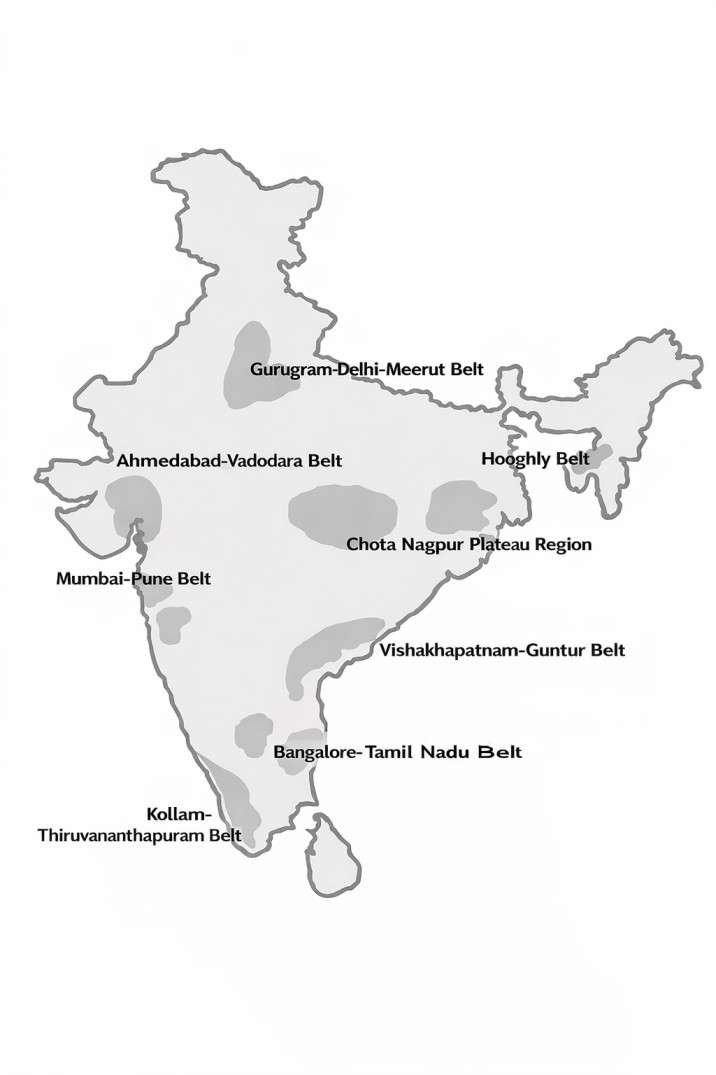
- There are eight major industrial regions of India. In these regions, more industries are concentrated because of their favorable geo-economic backgrounds. These areas will have manufacturing plants or industries on a large scale and provide the people more number of jobs.
- Location of industries are generally based on the vicinity of raw materials as well as the availability of the market. Raw materials can be Gross raw materials, which lose considerable weight during production process and Pure raw materials, which do not lose their weight.
- Industries using gross raw materials always tied to the location, e.g. Cement, Steel, Sugar Industries, etc. Pure raw material based industries can be located at the raw material centre or at the market centre, e.g. Woolen industry will be located at market centres and Cotton industry will be located at the cotton fields.
Location of industries also depends on:
- Availability of infrastructure for transportation, e.g. Cement and Iron industries are located near railway lines and
- Government policies which encourage for the industrial development, e.g. BHEL unit in Haridwar in Uttarakhand, where neither infrastructure nor raw materials are available, was established purely on Government policies.
Background
- Industrial regions are those areas, where the concentration of industries has occurred due to favorable geo-economic conditions. These are areas within which the manufacturing industry is carried out on a relatively large scale and employs a relatively large proportion of the population.
- An industrial region is usually a lot larger, such as the Ruhr in Germany, being even a significant proportion of the whole country, such as the Midlands in the UK.
- It is often developed around some natural resource, often coal or iron ore, or a water supply. It is usually well serviced by transport arteries eg rail, and may not be homogenous, that is, there may be several different unrelated types of manufacturing in the one area. So, in an industrial area, you may find steel manufacture, power generation, primary food processing, and service industries like education altogether.
- This is because such areas need more labour than a complex, and then you find residential areas nearby or even mixed in.
- Delineation of industrial regions empirically has been attempted by a number of geographers. The parameters used by them, however, differ from each other.
- It was Trewartha and Burner (1944) who divided India into industrial regions. Subsequently, P.P. Karan and W.M. Jenkrins (1959) demarcated the industrial regions of India.
- Industrial regions of India were also delineated by Spencer and Thomas (1968), R.L. Singh (1971), B.N. Sinha (1972), M.R. Chaudhry (1976), and the Centre for Monitoring Indian Economy (CMIE) (1971, 1982).
- The industrial district concept was initially used by Alfred Marshall to describe some aspects of the industrial organization of nations. An industrial district (ID) is a place where workers and firms, specialized in the main industry and auxiliary industries, live and work. At the end of the 1990s, the industrial districts in developed or developing countries had gained recognized attention in international debates on industrialization and policies of regional development.
- Industrial regions emerge when a number of industries locate close to each other and share the benefits of their closeness. They tend to concentrate on certain locations because of the favorable locational factors. Several indices are used to identify the clustering of industries, important among them are:
- The number of industrial units
- Number of industrial workers.
- Population engaged in the secondary activities.
- Percentage of industrial workers to the total workers.
- Quantum of power used for industrial purposes.
- Total industrial output (Gross industrial output).
- Value added by manufacturing, etc.