
Introduction
- Insolation is the incoming solar radiation and is received in the form of short waves. The earth’s surface receives insolation at the rate of two calories per square centimetre per minute.
- The total radiant solar energy that strikes the outer surface of the atmosphere, only half (approximately 51%) is able to reach the earth’s surface directly or indirectly and is absorbed by the earth. But not every part receives the same energy.
- The amount of available insolation depends on the intensity and duration of radiation from the sun. It is determined by: – 1. The number of day light hours. 2. Angle at which sun’s ray strike the earth.
- The rest is lost through scattering, reflection and absorption.
- The annual insolation is maximum within the tropics and it gradually decreases towards the poles. Along the parallels of 45∘ latitude it is only 75 per cent of that at equator and reduced to 50 per cent along the Arctic and Antarctic circles and 40% at the poles.
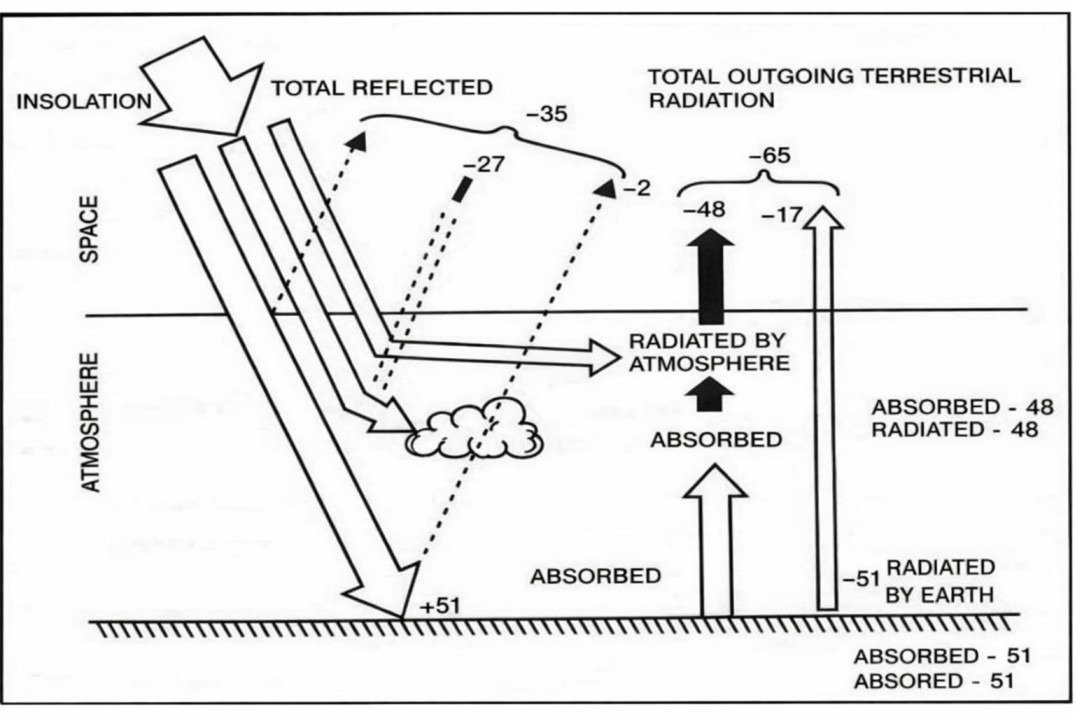
- The term insolation is derived from the words “incoming solar radiation”. Insolation is specifically applied to radiation which is arriving at earth’s atmosphere first and then earth surface. The heat is derived from solar energy, normally called solar radiation.
- Insolation’ is the solar radiation that reaches the earth’s surface. It is measured by the amount of solar energy received per square centimetre per minute. Similarly, solar energy received by the earth is called insolation. It is the amount of incoming solar radiation that is received over a unit area of the earth’s surface.
- Solar energy received over the planet’s surface varies according to season, latitude, transparency of the atmosphere, and aspect or ground slope.
- Insolation affects temperature. The more the insolation, the higher the temperature.
- In any given day, the strongest insolation is received at noon.
- Not all of the solar energy that reaches the Earth actually reaches the surface of the Earth. Although 1367 W/m² of sunlight strikes the outer atmosphere, about 30% of it is reflected back into space. After this reflection, a certain spot on the Earth might see almost all or almost none of this sunlight.
- There are many factors that help determine how much sunlight actually reaches a given area, but some of them include sun angle, air mass, day length, cloud coverage, and pollution levels.