
Introduction
- General intelligence, also known as the g factor, refers to the existence of a broad mental capacity that influences performance on cognitive ability measures. Charles Spearman first described the existence of general intelligence in 1904. According to Spearman, this g factor was responsible for overall performance on mental ability tests.
- Spearman noted that while people certainly could and often did excel in certain areas, people who did well in one area tended also to do well in other areas. For example, a person who does well on a verbal test would probably also do well on other tests. Those who hold this view believe that intelligence can be measured and expressed by a single number, such as an IQ score. The idea is that this underlying general intelligence influences performance on all cognitive tasks.
- General intelligence can be compared to athleticism. A person might be a very skilled runner, but this does not necessarily mean that they will also be an excellent figure skater. However, because this person is athletic and fit, they will probably perform much better on other physical tasks than an individual who is less coordinated and more sedentary.
- Psychologist Robert Sternberg defined intelligence as “the mental abilities necessary for adaptation to, as well as shaping and selection of, any environmental context. (1997)
History of Intelligence
- The study of human intelligence dates back to the late 1800s when Sir Francis Galton (the cousin of Charles Darwin) became one of the first to study intelligence.
- Galton was interested in the concept of a gifted individual, so he created a lab to measure reaction times and other physical characteristics to test his hypothesis that intelligence is a general mental ability producing biological evolution.
- Galton theorized that because quickness and other physical attributes were evolutionarily advantageous, they would also provide a good indication of general mental ability.
- Thus, Galton operationalized intelligence as reaction time.
- Operationalization is an important process in research that involves defining an unmeasurable phenomenon (such as intelligence) in measurable terms (such as reaction time), allowing the concept to be studied empirically.
- Galton’s study of intelligence in the laboratory setting and his theorization of the heritability of intelligence paved the way for decades of future research and debate in this field.
Theories of Intelligence
Some researchers argue that intelligence is a general ability, whereas others make the assertion that intelligence comprises specific skills and talents. Psychologists contend that intelligence is genetic, or inherited, and others claim that it is largely influenced by the surrounding environment.
As a result, psychologists have developed several contrasting theories of intelligence as well as individual tests that attempt to measure this very concept.
Spearman’s General Intelligence (g)
- General intelligence, also known as g factor, refers to a general mental ability that, according to Spearman, underlies multiple specific skills, including verbal, spatial, numerical, and mechanical.
- Charles Spearman, an English psychologist, established the two-factor theory of intelligence back in 1904 (Spearman, 1904). To arrive at this theory, Spearman used a technique known as factor analysis.
- Factor analysis is a procedure through which the correlation of related variables is evaluated to find an underlying factor that explains this correlation.
- In the case of intelligence, Spearman noticed that those who did well in one area of intelligence tests (for example, mathematics) also did well in other areas (such as distinguishing pitch; Kalat, 2014).
- In other words, there was a strong correlation between performing well in math and music, and Spearman then attributed this relationship to a central factor, that of general intelligence (g).
- Spearman concluded that there is a single g-factor that represents an individual’s general intelligence across multiple abilities and that a second factor, s, refers to an individual’s specific ability in one particular area (Spearman, as cited in Thomson, 1947).
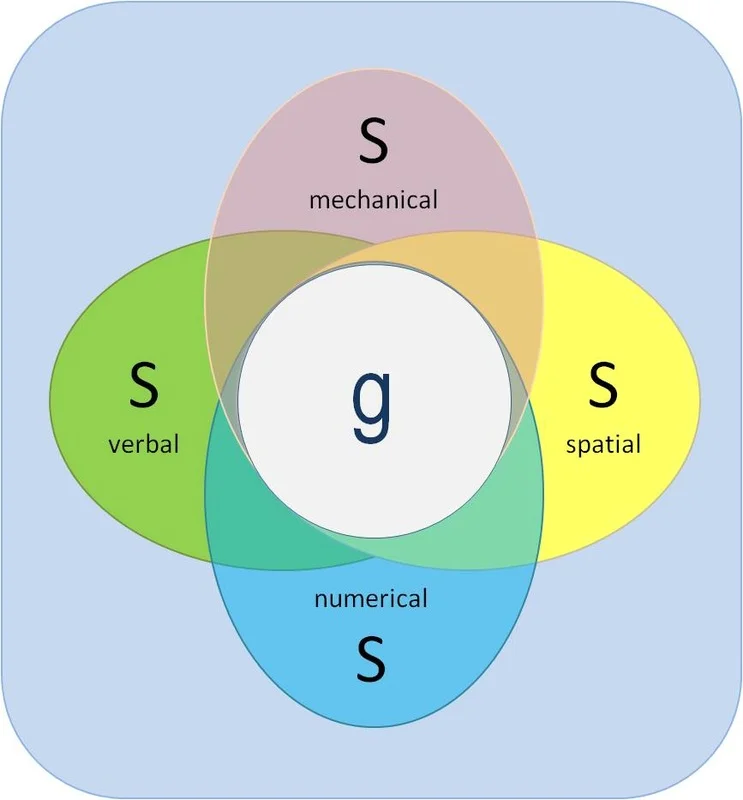
Together, these two main factors compose Spearman’s two-factor theory.
Challenges to the Concept of General Intelligence:
- The notion that intelligence could be measured and summarized by a single number on an IQ test was controversial during Spearman’s time and has remained so over the decades. Some psychologists, including L. L. Thurstone, challenged the concept of the g-factor and instead proposed primary mental abilities.
- More recently, Howard Gardner argued against the idea of a single general intelligence, proposing the theory of multiple intelligences, where each type—such as visual-spatial, verbal-linguistic, and logical-mathematical intelligence—represents abilities in specific domains. However, research today still supports the idea of an underlying general mental ability influencing performance on many cognitive tasks.
- IQ scores, designed to measure this general intelligence, are often linked to academic success and life outcomes. Yet, other important factors such as childhood experiences, education, socioeconomic status, motivation, maturity, and personality also play a crucial role in determining overall success.
- In the early 1900s, Charles Spearman used factor analysis to study intelligence and identified g, a single underlying factor explaining various cognitive abilities. He observed that children’s performance across school subjects was highly correlated, meaning those who performed well in one subject tended to do well in others.
- This led to Spearman’s two-factor theory, which proposed that cognitive performance is influenced by general ability (g) and specific abilities (s). Later findings suggested that g alone could explain the correlations among different tests.
- Today, when people refer to intelligence or IQ, they are often referring to this general mental ability.
Alternatives and Criticism:
- The existence of a single quantifiable factor for human intelligence has been widely debated since Spearman first proposed it. Criticism came from his student Raymond Cattell, who argued that intelligence consists of two main capacities: fluid intelligence (Gf) and crystallized intelligence (Gc).
- Cattell described crystallized intelligence as accumulated knowledge gained through experience and learning over time. In contrast, fluid intelligence refers to the ability to learn, reason, and solve problems in new situations. He believed that what Spearman called g was more accurately Gc, and that focusing only on g ignored an important developmental aspect of intelligence.
- Other psychologists, such as L. L. Thurstone and J. P. Guilford, also criticized the idea of a single general intelligence. They proposed that intelligence consists of multiple independent domains, although later research found correlations among these abilities, suggesting the presence of a general factor.
- Further criticism came from Howard Gardner, who proposed multiple intelligences, including non-cognitive types such as musical, existential, and bodily-kinesthetic intelligence.
- Many people can think of individuals who perform poorly in school but excel in areas like sports, dance, or music. Gardner argued that traditional academic systems overemphasize verbal and logical skills while neglecting these other forms. However, critics argue that abilities like athletic performance are better described as skills rather than forms of intelligence.