
Jet Streams
Warm air masses collide with cold air masses in the atmosphere, forming Jet Streams. To the north and south of the Himalayas, the western and eastern jets streams, respectively, flow. The eastern jet amplifies and arrives at 15 degrees north latitude. This causes the southwest monsoon to become more active, resulting in heavy rainfall. Understanding the Jet Stream is critical for comprehending temperate cyclones and the Indian monsoons.
- In the upper atmosphere, jet streams are relatively narrow bands of strong wind.
- Jet streams blow from west to east, but the flow frequently shifts to the north and south.
- This airband can be 160-480 kilometres wide and 900-2150 kilometres thick, with a core speed of over 300 kilometres per hour.
- Aircraft routes that run counter to jet stream’s movements are restricted due to their strength.
- Jet streams are associated with major tropopause breaks.
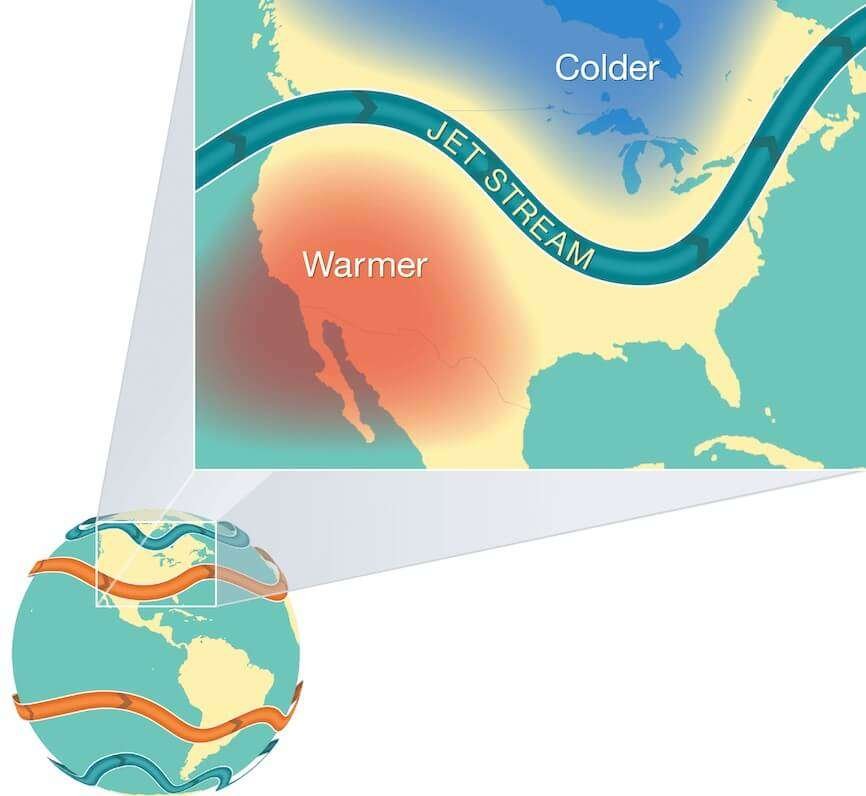
Jet Streams Theory
- Monsoon is driven by the atmospheric circulation phenomenon which produced by unequal and differential heating of continental and oceanic areas. Jet Stream play an important role in the possible formation, streering or intensifying weather phenomena such as monsoons, cyclones, anti-cyclones and other weather conditions.
- The Jet Stream Theory is a study of a narrow belt of high altitude westerly winds in the troposphere. It’s speed varies from 110 km/h in summer to 184 km/h in winter. This system works as a cover over the Earth which affects the weather of the lower atmosphere. This theory was propunded by the Yest.
- It is driven by air pressure, temperature and moisture differences between one place and another. The greater the difference in temperature, the faster the wind velocity inside the jet stream. The path of the stream have a meandering shape which may start, stop, split into two or more parts, combine into one stream, or flow in various directions including opposite to the direction of the remainder of the jet. The main types are the polar jets, the subtropical westerly jets and the less common tropical easterly jets.