Pareto laid the foundation of New Welfare Economics through the concept of social optimum, based on ordinal utility, while avoiding interpersonal comparisons of utility and value judgements.
Pareto sought to formulate a value-free and objective criterion for judging whether a proposed economic policy change increases social welfare or not.
According to the Pareto Criterion, an economic change increases social welfare only when:
It harms no one.
It makes at least one person better off.
The criterion is not applicable to economic changes that benefit some individuals but harm others, since evaluating such changes would require interpersonal utility comparisons, which Pareto rejects.
In terms of the Edgeworth Box Diagram, the Pareto criterion cannot determine whether social welfare rises or falls when movement occurs in either direction along the contract curve, because such movement generally benefits one individual while reducing the welfare of another.
Every tangency point between the two individuals’ indifference curves on the contract curve represents a Pareto optimum, where no further mutually beneficial reallocation is possible.
Since there are multiple tangency points on the contract curve, there is no unique optimum position under the Pareto criterion.
The criterion cannot indicate whether social welfare has increased or decreased when moving from one Pareto-optimal tangency point to another on the contract curve, because one individual gains while the other loses, and Pareto analysis refuses to compare their utility changes.
Welfare analysis based on Pareto optimality therefore remains indeterminate to a considerable extent, as the existence of numerous Pareto-optimal points on the contract curve prevents identification of a single socially best allocation.
Kaldor-Hicks Welfare Criterion: Compensation Principle
Economists Kaldor, Hicks, and Scitovsky further developed New Welfare Economics to evaluate changes in social welfare arising from economic reorganisations that benefit some individuals while harming others.
Their work was aimed at removing the indeterminacy present in Pareto optimality analysis, which could not assess welfare changes involving both gainers and losers.
To address this limitation, they proposed the Compensation Principle as a criterion for evaluating changes in economic policy or economic organisation.
The Compensation Principle claims to provide a basis for judging whether a welfare-improving change has occurred even when:
Some individuals become better off.
Other individuals become worse off.
The validity and application of the Compensation Principle rest upon a specific set of assumptions, which form the foundation of this welfare criterion.
Assumptions
The Compensation Principle of Kaldor, Hicks, and Scitovsky rests on the following assumptions:
An individual’s satisfaction is independent of others, and each individual is the best judge of his own welfare.
There are no consumption or production externalities.
Individual tastes remain constant.
Problems of production and exchange can be separated from problems of distribution; social welfare is treated as a function of the level of production, while the effects of changes in distribution on welfare are ignored.
Utility is ordinally measurable, and interpersonal utility comparisons are impossible.
On the basis of these assumptions, Kaldor, Hicks, and Scitovsky claimed to develop a value-free and objective criterion for measuring welfare changes through the concept of compensating payments, enabling evaluation of situations where some individuals gain and others lose.
Nicholas Kaldor was the first to formulate a welfare criterion based on compensating payments, designed to evaluate movements in either direction along the contract curve that Pareto criterion could not assess.
According to Kaldor’s Criterion, when a policy change or economic reorganisation benefits some people and harms others, social welfare increases if:
The gainers can fully compensate the losers for their losses.
After compensation, the gainers are still better off than before.
As stated by Prof. Baumol, a change is an improvement when the gainers value their gains more highly than the losers value their losses.
A policy change benefiting one section of society increases social welfare if the beneficiaries remain better off even after compensating the adversely affected groups from the gains received.
Kaldor argued that when a policy increases physical productivity and aggregate real income, it becomes possible to make everyone better off; even after fully compensating those who lose, the rest of the community remains better off than before.
J.R. Hicks supported the compensation principle and formulated a similar criterion from the losers’ perspective:
If the gainer benefits enough to compensate the loser and still retain some surplus, the reorganisation is an improvement.
Alternatively, a change is desirable if the losers cannot profitably bribe the gainers to prevent the change.
Kaldor’s criterion views the issue from the gainers’ standpoint, whereas Hicks’ criterion views it from the losers’ standpoint; despite different wording, both express the same principle and are collectively known as the Kaldor–Hicks Criterion.
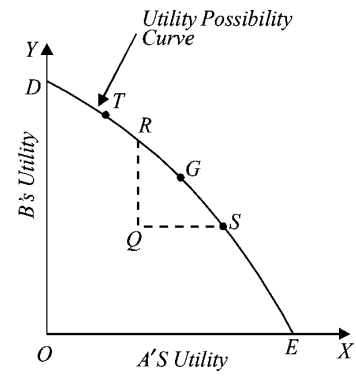
The utility possibility curve illustrates the criterion:
The curve shows different combinations of utilities enjoyed by individuals A and B.
Moving downward along the curve increases A’s utility while reducing B’s.
Moving upward increases B’s utility while reducing A’s.
Suppose the economy initially lies at point Q inside the utility possibility curve and moves to point T on the curve due to a policy change:
B becomes better off while A becomes worse off.
Such a movement cannot be evaluated by the Pareto Criterion, since one gains and the other loses.
Points on the utility possibility curve such as R, G, or S are Pareto-superior to Q, but Pareto analysis cannot determine whether T is socially preferable to Q.
The Kaldor–Hicks Criterion evaluates the movement from Q to T by asking whether the gainer (B) can compensate the loser (A) and still remain better off:
Through redistribution of income, movement from T to a point such as R on the same utility possibility curve becomes possible.
At R, A is restored to the welfare level enjoyed at Q, while B remains better off than at Q.
Since compensation is feasible and the gainer still retains a net benefit, the movement from Q to T represents an increase in social welfare.
Under the Kaldor–Hicks Criterion, actual payment of compensation is not necessary:
It is sufficient that compensation is potentially possible.
Economists only determine whether gainers could compensate losers and still remain better off.
The decision regarding actual redistribution or compensation is left to the government.
A gainer can compensate losers and still remain better off only when the policy change leads to an increase in output or real income.
Kaldor and Hicks therefore claimed to distinguish changes in output from changes in distribution:
Satisfaction of the criterion indicates movement to a potentially more efficient position.
Social welfare is judged to have increased irrespective of whether compensation is actually paid.
The implications become clearer when redistribution moves individuals from T to G:
At G, both A and B are better off than at the original position Q.
Since movement from T to G is possible through redistribution alone, position T is socially superior to Q under the Kaldor–Hicks criterion.
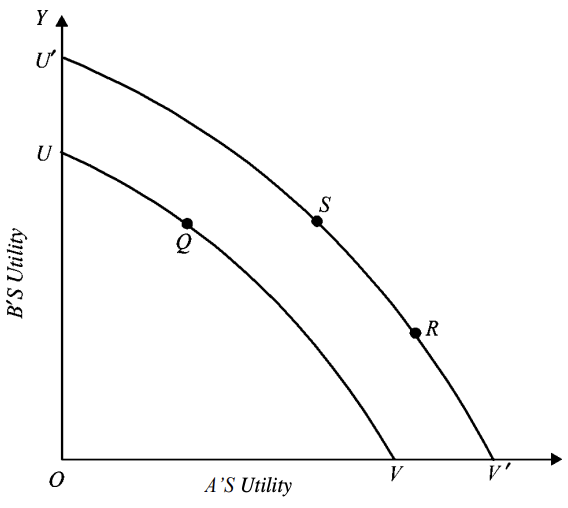
The criterion also applies when a policy shifts the economy from a point on a lower utility possibility curve to a point on a higher utility possibility curve:
Suppose the economy moves from point Q on the original curve to point R on a new outward-shifted curve.
A’s utility rises while B’s utility falls.
Through redistribution, movement from R to a point such as S becomes possible where B is fully compensated and A still remains better off than at Q.
Since compensation is feasible and a net gain remains, position R represents higher social welfare than Q.
Any economic change that moves individuals from a position on a lower utility possibility curve to a position on a higher utility possibility curve results in an increase in social welfare according to the Kaldor–Hicks Compensation Criterion.