

General Introduction
Genesis of Arthashastra
Kautilya was an ancient Indian philosopher and the celebrated author of Arthashastra, a major treatise on the science of polity and statecraft.
Historians identify Kautilya as the pen-name of Chanakya, the famous Prime Minister of Chandragupta Maurya in the fourth century B.C.
Chanakya also wrote several works on ethics and political administration under his own name.
The works of Kautilya marked a significant departure from earlier Indian traditions, which were dominated by the supremacy of religion in all aspects of life.
Kautilya emphasized the independent status and importance of polity in social organization.
This intellectual shift was somewhat similar to the transformation in sixteenth-century Europe, when the authority of religion began to be challenged by the concept of state sovereignty.
Kautilya is regarded as the chief exponent of the Arthashastra tradition in ancient Indian political thought.
To understand the meaning of Arthashastra, it is necessary to examine the concept of the four Purusharthas, the principal objectives of human life in Indian philosophy.
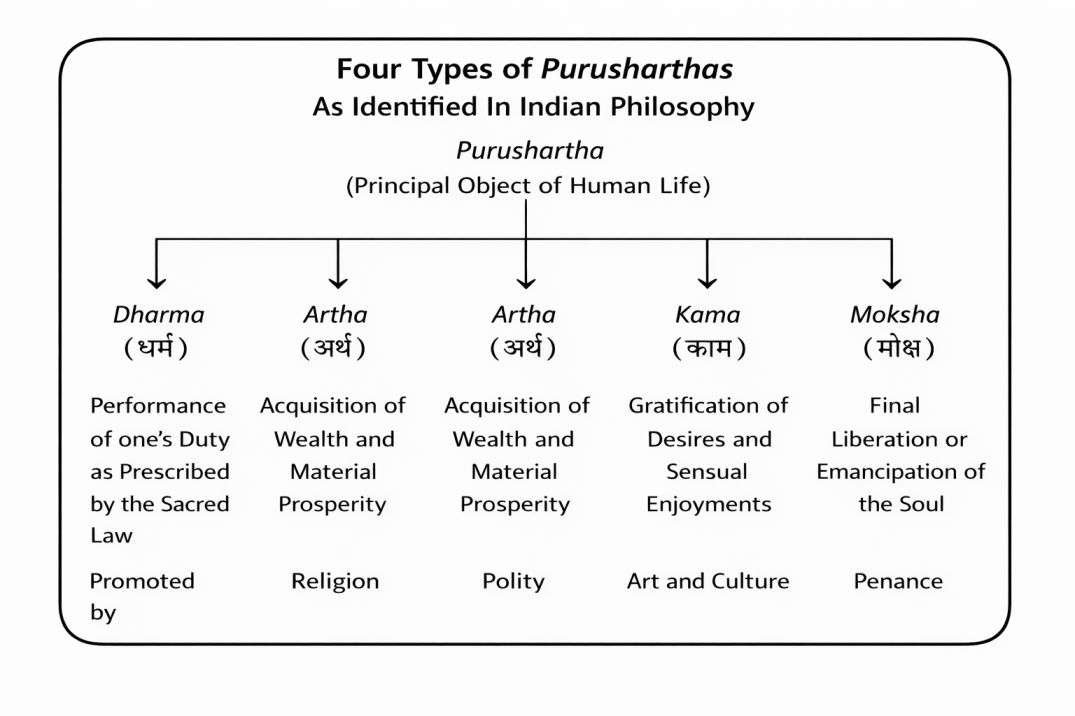
The four Purusharthas are:
Dharma (धर्म) – virtue derived from performing one’s duties according to sacred law; in society it is promoted mainly by religion.
Artha (अर्थ) – virtue derived from acquisition of wealth and material prosperity; in society it is promoted through political institutions and governance.
Kama (काम) – virtue derived from fulfillment of desires and sensual enjoyment; promoted by art, culture, and social life.
Moksha (मोक्ष) – spiritual liberation or emancipation of the soul, generally achieved through penance and spiritual discipline.
Before the time of Kautilya, the intellectual climate was dominated by the primacy of Dharma.
Dharmashastra regulated most aspects of life by prescribing religious duties and moral laws.
The pursuit of Artha, Kama, and Moksha was generally regarded as secondary to the pursuit of Dharma.
Discussions on other Purusharthas were therefore subordinate to religious discourse.
The emergence of Arthashastra represented a major intellectual shift.
It asserted that the pursuit of Artha (material prosperity and political power) could be treated as an independent objective, rather than merely a means to achieve Dharma.
Before Kautilya, knowledge about statecraft and political science existed in fragmented form across many texts.
Moreover, this knowledge did not enjoy independent status, as it was considered subordinate to religious teachings.
Kautilya was the first thinker who systematically compiled and organized this scattered knowledge into a comprehensive treatise called Arthashastra.
This work was intended as a guide for princes, rulers, and statesmen.
In the opening statement of Arthashastra, Kautilya declares that his work is a compendium of earlier treatises on polity composed by ancient teachers, focusing on the acquisition and maintenance of the earth (state power).
Toward the end of the text, he reiterates that the work is a collection of earlier Arthashastras written to guide kings in acquiring and preserving political authority.
Although Kautilya was one of the most original political thinkers of ancient India, he did not claim personal originality.
This may be explained by two reasons:
His modesty and intellectual humility.
His intention to strengthen the authority of his work by linking it with ancient traditions.
By presenting Arthashastra as a work equal in importance to Dharmashastra, Kautilya attempted to elevate the status of Artha (material prosperity and political power) to the same level as Dharma (religious duty).
Earlier discussions of political science mainly focused on the duties of kings.
However, Kautilya’s Arthashastra was designed as a practical manual for rulers seeking to acquire, expand, and maintain their kingdoms.
Thus, Arthashastra can be regarded as the first systematic manual on statecraft, governance, diplomacy, and administration in ancient India.
In the happiness of the people lies the ruler’s happiness. Their welfare is his welfare. The ruler shall not consider what pleases and benefits him personally, but what is pleasing and beneficial to the people. ~ Kautilya (Arthashastra)
Kings rule over willing subjects but tyrants rule over unwilling subjects; the king pursues honour, the tyrant pleasure. ~ Aristotle (Politics)
Sovereignty
Sovereignty refers to the supreme legal authority which is an essential element of the State. It is by virtue of this authority that a State can make binding laws, command obedience to its orders, and punish those who fail to obey its orders. Only a sovereign State can enter into treaty with other States and conduct war against enemy States.