Introduction
The present analysis explains the determination of wages in detail under conditions of both perfectly competitive and imperfectly competitive labour markets, building upon the general theory of factor price determination discussed earlier.
Labour possesses certain special characteristics that distinguish it from other factors of production:
Workers often combine to form trade unions to demand higher wages and better working conditions from entrepreneurs.
Labour cannot be separated from the labourer, unlike land and capital, which are distinct from their owners (landlords and capitalists).
Workers enjoy a degree of freedom in deciding whether or not to work on a particular day, as they can take leave or abstain from work.
Unlike other factors of production, workers can also influence the supply of labour by deciding whether to work longer hours per week, thereby increasing their labour supply within certain limits.
Nominal and Real Wages
Nominal (money) wage refers to wages expressed in monetary terms, whereas real wage refers to wages measured in terms of the goods and services that the wage can purchase.
When the general price level rises, the same money wage purchases fewer goods and services; therefore, with money wages remaining constant, an increase in prices causes a decline in real wages.
Real wages are obtained after adjusting money wages for inflation (rise in the general price level) and are expressed as:
\(p=\frac{W}{P}\)
Where p = real wage, W = money wage rate, and P = general price index number.
The term real wage is also sometimes used in a broader sense to include money wages plus non-monetary benefits received by workers in particular occupations.
Workers may prefer jobs with lower money wages if they provide significant non-monetary advantages:
For example, college professors with qualifications and skills comparable to business executives in private firms may accept lower money wages because teaching offers benefits such as flexible working hours, pleasant surroundings, and opportunities for advancement.
In this sense, the real wage of a college professor consists of his money salary together with these non-monetary benefits.
Like the prices of other factors of production, the wage rate is determined by the demand for and supply of labour; understanding wage determination therefore requires first understanding the nature of labour demand.
Demand for labour differs from demand for consumer goods in important respects:
Consumer goods are demanded because they directly satisfy human wants.
People demand food to satisfy hunger, clothing to cover their bodies, and other goods for similar direct consumption purposes.
Since consumer goods possess utility that directly satisfies wants, people are willing to pay prices for them.
Demand for labour is a derived demand, unlike the demand for consumer goods; labour is not demanded because it directly satisfies human wants.
Labour is demanded because it is used in the production of consumer goods and services, which ultimately satisfy human wants; therefore, the demand for labour arises from its role in production rather than direct consumption.
Since labour helps produce goods that consumers demand, the demand for labour is derived from the demand for the products it helps to produce.
The greater the demand for a product, the greater will be the demand for the particular type of labour required to produce that product; product demand and labour demand are therefore directly related.
While the demand for goods depends on their utility in satisfying human wants, the demand for labour depends on its marginal revenue product (MRP).
Understanding wage determination requires analysing both demand and supply conditions; the discussion therefore proceeds next to the supply of labour.
Supply Curve of Labour for the Economy asa Whole
The supply curve of labour for a group of individuals or for the entire economy is derived by horizontally summing the individual labour supply curves.
The shape of the aggregate labour supply curve depends on the relative composition of workers:
It will be upward sloping if the number of individuals with upward-sloping labour supply curves is relatively greater.
It will be backward sloping if the number of individuals with backward-sloping labour supply curves is relatively greater.
Determining the overall shape of the labour supply curve is complicated because different individuals reach the backward-sloping portion of their labour supply curves at different wage ranges, rather than at a common wage level.
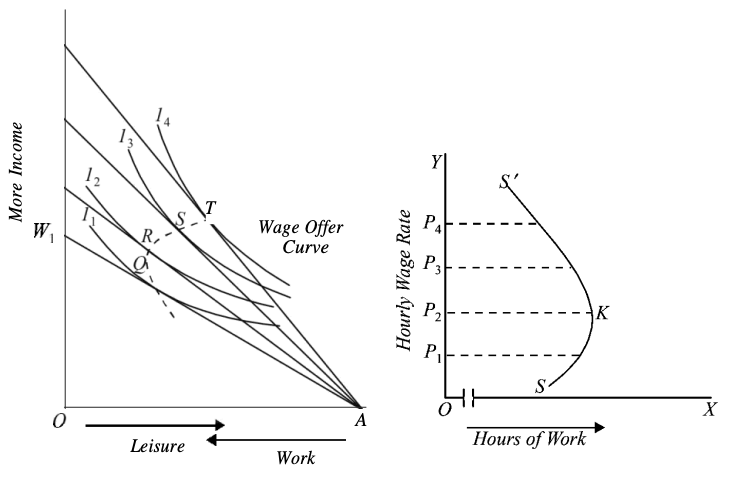
In general, when the wage rate rises from an initially low level to a sufficiently high level, the total supply of labour in the economy increases; during this range, the aggregate labour supply curve slopes upward.
Beyond a certain wage rate, further increases in wages lead to a decline in the total supply of labour, causing the aggregate labour supply curve to bend backward.
The overall labour supply curve for the economy is therefore generally believed to be backward bending, with an initial upward-sloping segment followed by a backward-sloping segment after a critical wage level is reached.