Concepts of Rent
Rent is the price paid for the use of land and other natural resources. Unlike other factors of production, land is a free gift of nature; no human effort or sacrifice was required to make it available to society, and society incurs no cost in obtaining land. Since land is not producible by man, its total supply is fixed and perfectly inelastic, though its productivity can be increased through improvements such as clearing, drainage, and irrigation; these improvements are products of human effort and constitute capital goods.
Since the quantity of land available for use is scarce relative to demand, a payment must be made for its use. This payment, called rent, accrues to those who own the land. The unique feature of land is that its supply to society is absolutely fixed, making rent the price paid for the use of a factor whose supply is perfectly inelastic.
The concept of rent extends beyond land to include all natural resources whose supply is fixed. The earnings of such resources are called rent (or pure rent), distinguishing them from wages, interest, and profits from the social point of view.
The term rent, originally used for the payment made for the use of land and fixed natural resources, was later extended to mean the surplus earnings of any factor of production over the cost incurred to obtain its services. Since society bears no cost in obtaining land as a whole, the entire earnings of land are a surplus over cost; from society’s viewpoint, the whole earnings of land constitute economic rent.
The concept of economic rent is broader than land rent and applies to all factors of production—labour, capital, and entrepreneurship. It refers to earnings that exceed the factor’s transfer earnings (the minimum payment required to keep the factor in its present use).
A clear distinction must be maintained between:
Land rent: payment made by a tenant or user for hiring or using land.
Economic rent: surplus earnings of any factor over its transfer earnings.
These are different concepts and should not be confused. Modern economists generally use land rent for payment for the use of land and economic rent for surplus earnings above transfer earnings.
Marshall extended the concept of rent to the earnings of fixed capital equipment (after deducting depreciation and interest charges) in the short run. His reasoning was based on the similarity between land and fixed capital in the short period:
Land earns rent because its supply is perfectly inelastic and its earnings depend mainly on demand.
Once machinery and other fixed capital equipment are installed, their supply is also perfectly inelastic in the short run, and their cost of production becomes irrelevant for current output decisions.
Consequently, their short-run earnings depend mainly on demand conditions, just as land rent does.
Marshall called the short-run earnings of fixed capital equipment Quasi-Rent rather than rent because, unlike land, such capital goods are not permanently fixed in supply. Their supply becomes highly elastic in the long run, so their earnings cannot be treated as true rent in the long-term sense.
Modern economic theory uses the term rent in two senses:
As the reward for the use of land.
As the surplus return over transfer earnings of any factor of production.
In the latter sense, the concept has been fully generalised and is no longer confined to land.
The discussion of rent proceeds through three related concepts:
Determination of land rent as payment for the use of land and natural resources.
Economic rent as surplus earnings over transfer earnings.
Quasi-rent as the short-run earnings of fixed capital equipment.
Determination of Land Rent
Rent is defined as the price paid for the use of factors such as land whose supply is perfectly inelastic. Classical economists, especially David Ricardo, regarded payment to fixed factors as pure economic rent (simple pure rent); later, the concept was extended to any factor whose supply is perfectly inelastic.
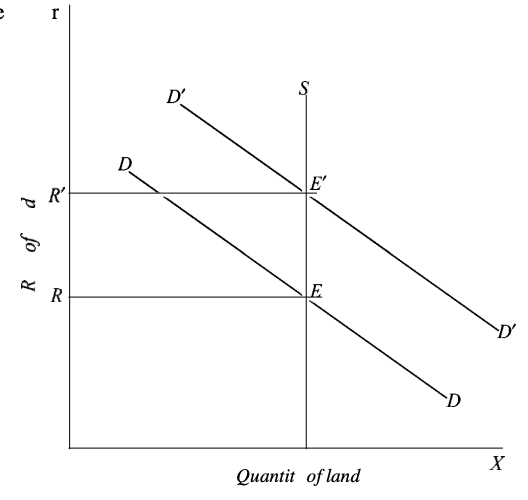
The distinctive feature of land is the fixity of its supply: unlike other factors, the quantity of land supplied does not change when its price (rent) changes. Its supply curve is therefore perfectly inelastic (vertical), implying that regardless of the level of rent, the total supply of land remains fixed.
Demand for land is determined by its Marginal Revenue Product (MRP) and slopes downward because of the law of diminishing marginal returns. Since land helps produce goods such as wheat, rice, pulses, and sugarcane, its demand is derived demand and depends on:
The productivity of land.
The price of the product produced with land.
The prices of complementary factors such as labour and capital used along with land.
Under the assumptions of a competitive land market, homogeneous land (equally fertile and equally well-situated), and single-use land (used only for producing foodgrains), rent is determined by the interaction of demand and supply. With demand curve DD and fixed supply curve SS, equilibrium rent is OR, where demand and supply intersect.
At rent OR per acre, total earnings of land are represented by ORES. Since the social opportunity cost (transfer earnings) of land is zero, the entire earnings of land constitute economic rent, i.e., a surplus over transfer earnings.
If the demand for foodgrains increases (for example, due to population growth), the demand for land rises, shifting the demand curve from DD to D’D’. Since land supply remains fixed, the new equilibrium rent increases from OR to OF’, while the quantity of land remains unchanged.
A cause–effect relationship emerges: greater demand for land leads to a higher rent, whereas changes in rent do not affect the quantity of land supplied because supply is perfectly inelastic.
An important conclusion is that rent of land is entirely demand-determined. Since the supply of land is completely unresponsive to changes in rent, variations in rent arise solely from changes in demand.
The same principle applies not only to land but also to other fixed natural resources whose supply is perfectly inelastic; their rent is likewise determined by demand.