
- Learning: Definition & Features
- Features of Learning
- Behaviourist Theories of Learning
- Connectionism – Edward L. Thorndike
- Classical Conditioning – Ivan Pavlov
- Operant Conditioning – B. F. Skinner
- Drive Reduction Theory – Clark L. Hull
- Contiguity Theory – Edwin R. Guthrie
- Evolution of Behaviourist Approaches to Learning
- Cognitive Theories of Learning
- Major Pure Cognitivists and Their Contributions
- Cognitive Constructivists
- David Ausubel – Meaningful Verbal Learning
- Robert Gagné's Theory of Learning
- Atkinson and Shiffrin – Multi-Store Model of Memory
- Allan Paivio – Dual Coding Theory
- George Miller – Information Processing and Chunking
- David Rumelhart – Schema Theory
- Ulric Neisser – Cognitive Psychology
- Gestalt Theory of Learning
- Behavioural and Cognitive Theories of Learning
- Additional Cognitive Learning Theories
- Evolution of Cognitivism
- Constructivist Learning Theories
- Core Principles of Constructivist Learning
- Major Theorists Associated with Constructivism
- Constructionism – Seymour Papert
- Situated Learning Theory – Jean Lave and Etienne Wenger
- Major Educational Features of Constructivist Learning
- Social Learning Theory
- Major Processes of Observational Learning
- Key Concepts of Social Learning Theory
- Albert Bandura: Major Contributions
- Bobo Doll Experiment
- Reciprocal Determinism
- Self-Efficacy
- Self-Efficacy and Self-Concept
- Factors Affecting Social Learning
- Social Competence
- Humanistic Theories of Learning
- Abraham Maslow – Hierarchy of Needs
- Carl Rogers – Learner-Centred Education
- Factors Affecting Learning
- Motivation: Definition and Theories
- Major Theories of Motivation
- Attention: Definition and Theories
- Major Theories of Attention
- Educational Implications of Attention
- Guidance and Counselling
- Guidance
- Counselling
Learning: Definition & Features
- Learning is commonly understood as a relatively permanent change in behaviour, knowledge, skill or attitude that occurs through experience, practice or interaction with the environment. It enables an individual to acquire new ways of thinking and acting and to modify existing behaviour.
- Learning can take place in formal settings such as schools and universities, non-formal settings such as training programmes, and informal settings through everyday experiences, observation and interaction with family, peers and society. It is not restricted to academic knowledge; it also includes the development of skills, habits, attitudes, values and social behaviours.
- B. F. Skinner described learning as a process of progressive behaviour adaptation, highlighting the role of environmental consequences in shaping behaviour. Robert M. Gagné described learning as a change in human disposition or capability that persists over time and is not simply attributable to processes of growth. Gagné's definition is important because it distinguishes learning from temporary changes and natural maturation.
Features of Learning
- Learning is a process: Learning develops over time through continuous interaction between the learner and the environment. It may involve several stages of practice, feedback, correction and improvement.
- Learning involves change: Learning produces some change in behaviour, knowledge, skills, attitudes, emotions or ways of thinking. The change may be observable or may occur internally.
- Learning is relatively permanent: Learning produces a change that tends to persist for some period. Temporary changes caused by fatigue, illness, drugs or short-term physiological conditions are generally not regarded as learning.
- Learning results from experience and practice: Experience, practice, observation, instruction and interaction contribute to learning. It is different from changes that occur solely because of biological maturation.
- Learning is purposeful: Much learning is directed towards a goal, such as acquiring a skill, solving a problem, passing a course, improving performance or adapting to a new situation.
- Learning may be positive or negative: Learning does not always produce socially desirable behaviour. Individuals can learn useful skills and positive social behaviours, but they can also learn undesirable habits, stereotypes or prejudices.
- Learning can be individual or social: Some learning occurs through individual exploration and practice, while other learning occurs through teachers, parents, peers, observation, imitation and social interaction.
- Learning promotes adaptation: Learning helps individuals adjust their behaviour to changing environmental and social conditions.
- Learning is continuous: Learning begins from early life and continues throughout the lifespan. This idea is reflected in the concept of lifelong learning.
- Learning is influenced by many factors: Motivation, attention, prior knowledge, intelligence, readiness, reinforcement, emotional state, learning environment, teaching methods and quality of instruction can influence learning.
- Learning involves both internal and external processes: Behaviourist theories emphasise observable changes, while cognitive approaches also consider mental processes such as memory, attention, thinking and problem solving.
Behaviourist Theories of Learning
Behaviourism focuses primarily on observable and measurable behaviour. Behaviourist theorists explain learning largely in terms of changes produced by environmental conditions, stimulus-response associations and consequences of behaviour.
Early behaviourist approaches generally treated learning as the formation or strengthening of connections between stimuli and responses (S-R). Later approaches, particularly operant conditioning, gave greater importance to the consequences that follow behaviour.
The major behaviourist approaches include Thorndike's Connectionism, Pavlov's Classical Conditioning, Skinner's Operant Conditioning, Hull's Drive Reduction Theory and Guthrie's Contiguity Theory.
Connectionism – Edward L. Thorndike
- Edward L. Thorndike was one of the earliest psychologists to investigate learning systematically through controlled experiments. His theory, known as Connectionism or Trial-and-Error Learning, proposes that learning involves the formation and strengthening of connections between situations or stimuli and responses.
- Thorndike conducted experiments using a puzzle box with hungry cats. A cat placed inside the box had to perform a particular response, such as pressing a lever or pulling a mechanism, to escape and obtain food. Initially, the cat made several random movements. Through repeated trials, it gradually performed the successful response more quickly.
- Thorndike concluded that successful responses become strengthened through their satisfying consequences. Learning was therefore closely connected with trial and error and the Law of Effect.

Thorndike's Major Laws of Learning:
1. Law of Readiness
Learning is more effective when the learner is physically and mentally prepared to perform an activity. When an individual is ready to act and is allowed to do so, the resulting state is satisfying. When the individual is ready but prevented from acting, the experience may be frustrating.
Educational implication: Teachers should consider learners' readiness, developmental level, prior knowledge and motivation before introducing new material.
2. Law of Exercise
The law emphasises the role of practice in strengthening stimulus-response connections. Connections become stronger through use and weaker through disuse.
Repeated practice can improve fluency and retention, particularly for skills that require automatic performance. Modern learning research, however, shows that the effectiveness of practice depends on its quality, spacing and relationship to meaningful understanding.
Educational implication: Regular practice, revision and appropriate repetition can strengthen learning.
3. Law of Effect
Responses followed by satisfying consequences are more likely to be repeated, whereas responses followed by unpleasant or unsatisfying consequences are less likely to recur.
This law became an important foundation for later theories of reinforcement, particularly Skinner's operant conditioning.
Educational Implications of Connectionism:
- Provide opportunities for practice and repetition.
- Reinforce correct responses.
- Consider learners' readiness before introducing difficult material.
- Provide timely feedback.
- Use meaningful motivation and satisfying learning experiences.
- Allow students to learn through guided trial and error rather than simply giving answers.
Classical Conditioning – Ivan Pavlov
Ivan P. Pavlov developed the principles of classical conditioning through his experiments on digestion in dogs. Pavlov observed that dogs salivated naturally when food was presented, but they eventually began salivating in response to signals associated with food, such as the footsteps of the laboratory assistant.
Classical conditioning occurs when a previously neutral stimulus becomes capable of producing a response after repeated association with a stimulus that naturally produces that response.
Basic Elements of Classical Conditioning:
| Term | Meaning | Example |
|---|---|---|
| Unconditioned Stimulus (UCS/US) | Stimulus that naturally produces a response | Food |
| Unconditioned Response (UCR/UR) | Natural, unlearned response | Salivation to food |
| Neutral Stimulus (NS) | Stimulus that initially does not produce the target response | Bell before conditioning |
| Conditioned Stimulus (CS) | Previously neutral stimulus that acquires the ability to produce a response | Bell after conditioning |
| Conditioned Response (CR) | Learned response produced by the conditioned stimulus | Salivation to the bell |
Process of Classical Conditioning:
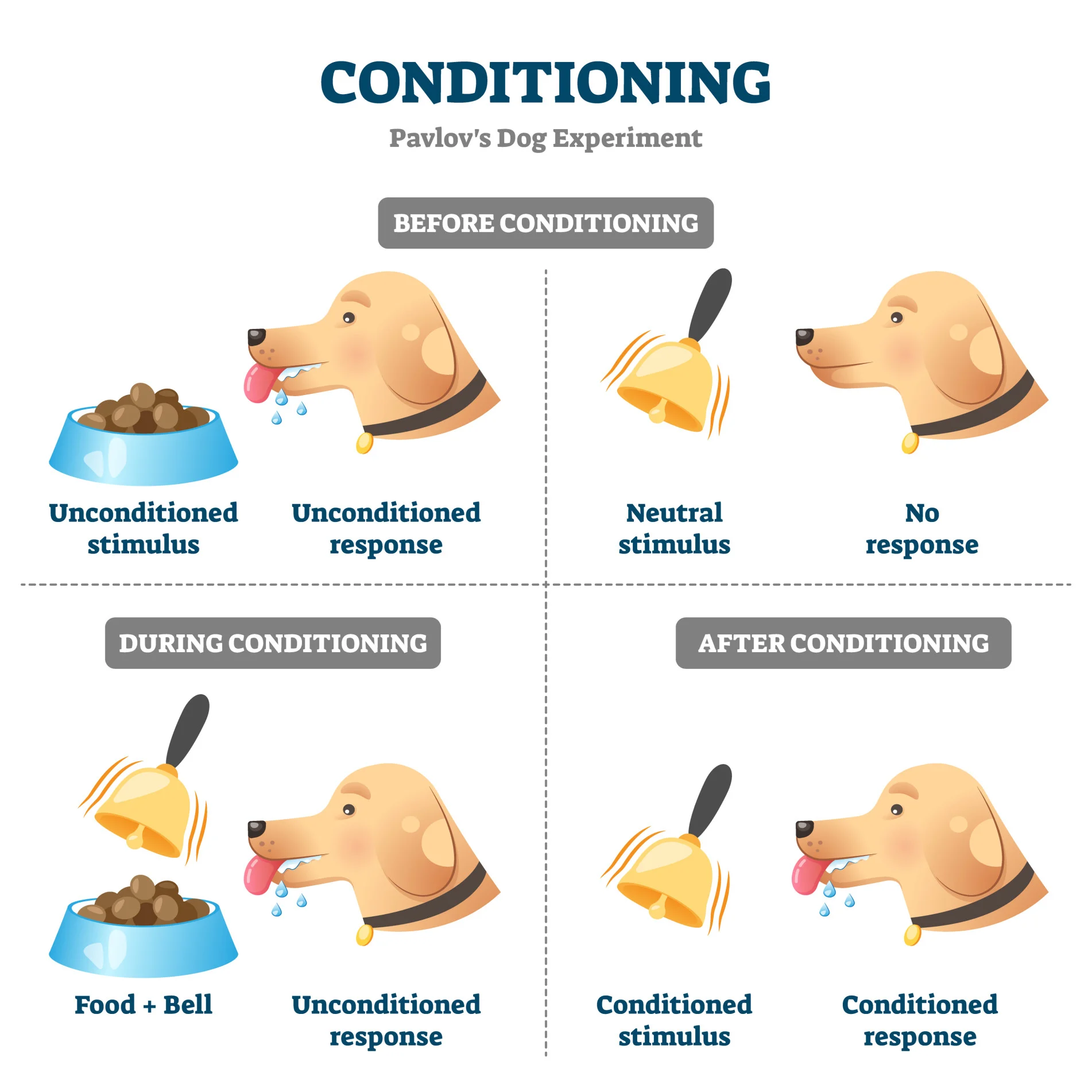
Before conditioning:
Bell → No significant salivation
Food → Salivation
During conditioning:
Bell + Food → Salivation
The bell is repeatedly paired with food.
After conditioning:
Bell → Salivation
The bell has become a conditioned stimulus, and salivation to the bell has become a conditioned response.
Classical conditioning is associated with several processes, including acquisition, extinction, spontaneous recovery, generalisation and discrimination. Acquisition refers to the formation of the conditioned association. Extinction occurs when the conditioned stimulus is repeatedly presented without the unconditioned stimulus and the conditioned response gradually weakens. Spontaneous recovery refers to the temporary return of an extinguished response after a rest period.
Classroom Example:
Suppose a school bell is repeatedly associated with the beginning of recess, a highly enjoyable activity for students. After repeated pairings, students may begin to experience excitement simply on hearing the bell.
Similarly, if a student repeatedly receives encouragement and positive feedback while reading aloud, reading may gradually become associated with confidence and positive feelings.
Educational Implications:
Classical conditioning demonstrates that emotional responses can be learned through association. Teachers therefore need to consider the emotional environment they create.
- Positive classroom experiences can create positive associations with learning.
- Repeated humiliation, fear or harsh treatment can produce negative emotional associations with particular subjects or classroom activities.
- Teachers should create supportive learning environments.
- Encouragement and constructive feedback can help students associate challenging tasks with confidence and achievement.
- Test anxiety and subject-related fear may sometimes involve learned emotional associations.