Introduction
The classical comparative cost theory failed to satisfactorily explain why comparative costs of producing commodities differ across countries. Heckscher and Ohlin went deeper and argued that differences in comparative costs arise from:
Differences in factor endowments (availability of factors of production) among countries.
Differences in factor proportions required for producing different commodities.
These differences create variations in comparative costs and consequently determine the pattern of international trade.
The theory developed by Heckscher and Ohlin is known as the Heckscher–Ohlin Theory of International Trade; it is also called:
The Modern Theory of International Trade, because it is widely accepted by modern economists.
The General Equilibrium Theory of International Trade, because it is based on general equilibrium analysis of price determination.
Contrary to the classical economists, Ohlin argued that there is no fundamental distinction between domestic (inter-regional) trade and international trade; international trade is merely a special case of inter-regional trade.
Ohlin rejected the view that transport cost distinguishes international trade from domestic trade because transport costs exist in inter-regional domestic trade as well.
Differences in currencies do not create a basic distinction either, since currencies of different countries are linked through foreign exchange rates, which determine their relative value and purchasing power.
Ohlin viewed different nations as essentially regions separated by national frontiers, languages, customs, and similar factors, but these differences are not sufficient to prevent trade between countries.
Since the same economic forces operate in both cases, Ohlin maintained that the general theory of value used to explain trade between regions within a country can also be applied to explain trade between nations.
According to the general equilibrium theory of value:
Relative prices of commodities are determined by their demand and supply.
In long-run equilibrium under perfect competition, relative prices become equal to their average costs of production.
The cost of production of a commodity depends on the prices paid to the factors of production used in producing it.
Factor prices determine the incomes of factor owners, and these incomes influence the demand for goods; thus:
Commodity prices and factor prices are mutually interdependent.
Demand for commodities and demand for factors are also interconnected.
Exchange relationships among goods and factors are explained within a single general equilibrium framework.
General equilibrium theory explains the determination of commodity prices and factor prices among different individuals within a region or country through this network of interdependent demand and supply relationships.
Ohlin criticized the classical analysis for assuming a single market within a country and for ignoring the space factor, whose introduction is essential for explaining trade between different regions.
The same forces that explain trade between regions—differences in demand, supply, factor endowments, factor prices, and commodity prices—also explain trade between nations, making international trade an extension of inter-regional trade within the general equilibrium framework.
Heckscher-Ohlin Theory of International Trade
Heckscher-Ohlin (H-O) theory accepts the classical proposition of Ricardo that international trade is based on differences in comparative costs, but goes further by explaining the underlying causes of these cost differences rather than replacing the comparative cost theory itself.
Ricardo and classical economists explained comparative cost differences mainly through differences in the skill and efficiency of labour, but Ohlin considered this explanation inadequate and identified two deeper causes of comparative cost differences:
Different countries possess different factor endowments.
Different goods require different factor proportions in production.
Countries are unequally endowed with productive factors such as capital, labour, and land. Some countries have relatively more capital, some more labour, and others more land. The factor that is relatively abundant tends to be cheaper, while the relatively scarce factor tends to be more expensive.
According to Ohlin, factor endowments and factor prices are closely related:
If Country A has relatively abundant capital and scarce labour compared with Country B, then capital will be relatively cheaper and labour relatively costlier in Country A.
Differences in factor endowments create differences in factor prices.
Differences in factor prices create differences in comparative costs of producing commodities.
Differences in factor proportions (factor intensities) required for producing various goods are equally important:
Some commodities require relatively more capital and are called capital-intensive goods.
Some commodities require relatively more labour and are called labour-intensive goods.
Some commodities require relatively more land and are called land-intensive goods.
Since commodities use factors in different proportions, variations in factor prices across countries generate differences in production costs and market prices.
A country gains a comparative advantage in producing goods that intensively use its relatively abundant and cheap factor, while it faces a comparative disadvantage in goods requiring factors that are relatively scarce and expensive.
A capital-abundant, labour-scarce country specializes in capital-intensive commodities and imports labour-intensive goods.
A labour-abundant, capital-scarce country specializes in labour-intensive commodities and imports capital-intensive goods.
The H-O theory predicts trade patterns:
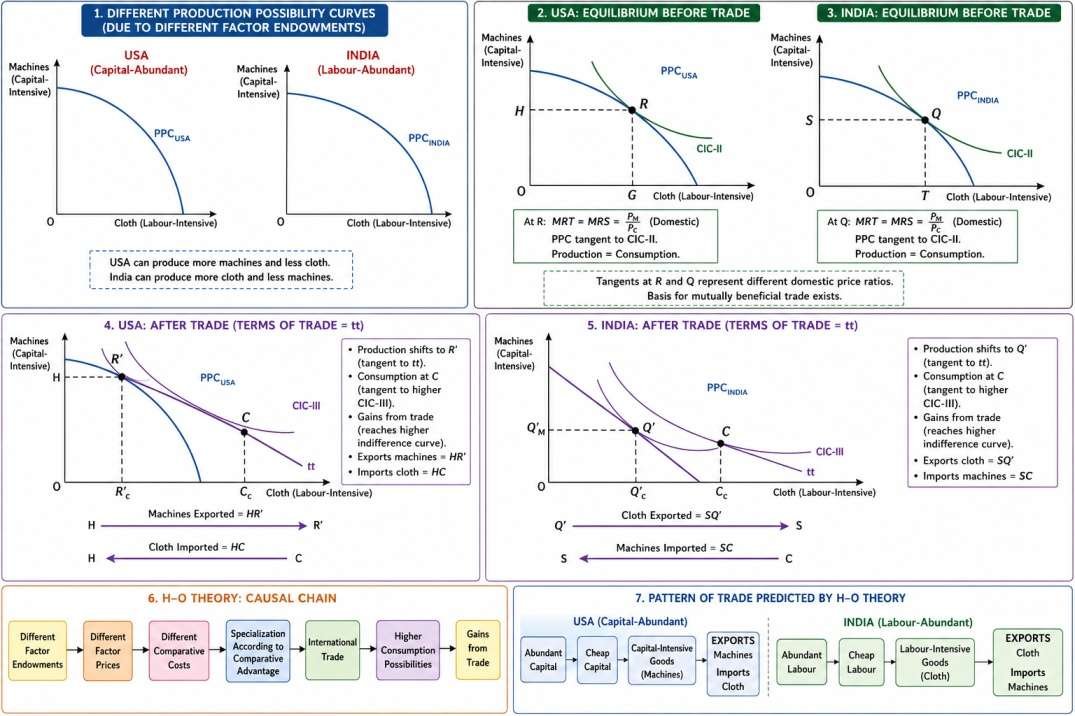
Capital-abundant countries export capital-intensive goods and import labour-intensive goods.
Labour-abundant countries export labour-intensive goods and import capital-intensive goods.
If:
Factor endowments are identical across countries, and
Different commodities require identical factor proportions,
Then relative factor prices will not differ between countries, comparative costs will be the same, and no gains from international trade will arise.
Graphical illustration using U.S.A. and India:
U.S.A. is assumed to be capital-abundant and labour-scarce.
India is assumed to be labour-abundant and capital-scarce.
Because of different factor endowments, their production possibility curves (PPCs) differ.
U.S.A.’s PPC shows a greater capacity to produce machines (capital-intensive good) and a lower capacity to produce cloth (labour-intensive good).
India’s PPC shows a greater capacity to produce cloth and a lower capacity to produce machines.
In the absence of trade, equilibrium in each country is determined where:
Marginal Rate of Transformation (MRT) = Marginal Rate of Substitution (MRS) = relative commodity price ratio.
Geometrically, equilibrium occurs at the tangency of the PPC and the highest attainable community indifference curve.
Production and consumption occur at the same point.
Before trade:
U.S.A. reaches equilibrium at point R, where its PPC is tangent to community indifference curve II.
India reaches equilibrium at point Q, where its PPC is tangent to community indifference curve II.
The tangents at these equilibrium points represent the domestic price ratios (domestic rates of exchange) of cloth and machines.
Since these price ratios differ between the two countries, the basis for mutually beneficial trade exists.
Assuming international terms of trade are represented by line tt:
In U.S.A., production shifts to point R′, where the terms-of-trade line is tangent to the PPC.
Consumption occurs at point C, where the terms-of-trade line is tangent to a higher community indifference curve III.
Movement to a higher indifference curve indicates gains from trade.
U.S.A. produces more machines and less cloth than it consumes.
It exports HR′ amount of machines and imports HC amount of cloth.
In India:
Production shifts to point Q′, where the terms-of-trade line is tangent to the PPC.
Consumption occurs at point C, where the terms-of-trade line is tangent to a higher community indifference curve III.
India also gains from trade because consumption occurs on a higher indifference curve.
India produces more cloth and fewer machines than it consumes.
It exports SQ′ amount of cloth and imports SC amount of machines.
The H-O theory concludes that differences in factor endowments across countries and differences in factor proportions required by commodities create differences in comparative costs, providing the basis for international trade. Countries gain by specializing in goods that use their relatively abundant factors intensively and importing goods that require factors that are relatively scarce within their economies.