Introduction to Logical Reasoning
We are starting our discussion on a very positive keynote, how to explore the knowledge in a logical and innovative manner.
Newton’s Apple Story: There is well-known story of Newton sitting under an apple tree, where an apple falling on his head is said to have inspired his thinking about the Universal Law of Gravitation. This story illustrates the process of an idea becoming explicit knowledge.
Implicit versus Explicit Knowledge: Before Newton’s realization, apples were falling to Earth, but the understanding of gravity was implicit and not formalized into a theory. What Newton did was make this implicit knowledge explicit through the formulation of the Universal Law of Gravitation.
Knowledge and Theories: The development of theories is essential for understanding the world and solving problems.
The Importance of Reasoning: In life, many problems require solutions. Reasoning is a crucial tool in solving these problems. It helps people differentiate between what is right and what is wrong. The basic types of reasoning are deductive and inductive.
Variety of Theories: The different individuals may express or formulate the same theory in various ways. This diversity in approaches leads to progress in life, as it encourages new perspectives and ideas.
Logic as a Way of Life: This trains individuals in methods to differentiate between right and wrong. It is a fundamental tool for critical thinking and rational decision-making.
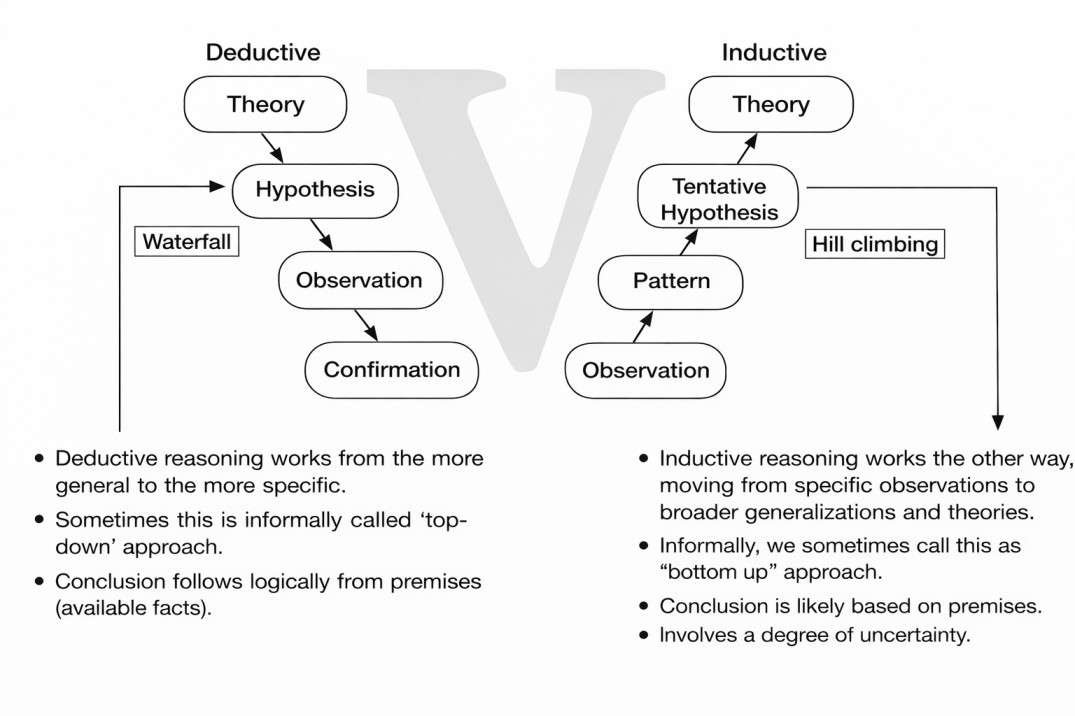
Flow of Knowledge: The flow of knowledge occurs in two ways: deductive and inductive reasoning. Deductive reasoning moves from general principles to specific conclusions, while inductive reasoning goes from specific observations to general principles.
Just like solving a fun puzzle or playing with Lego bricks, logic is all about making connections and discovering new things!
Basic Structure of Arguments
An argument, in the context of logic and critical thinking, is a set of statements, propositions and conclusions. Premises intend to provide evidence or reasons to accept the conclusion.
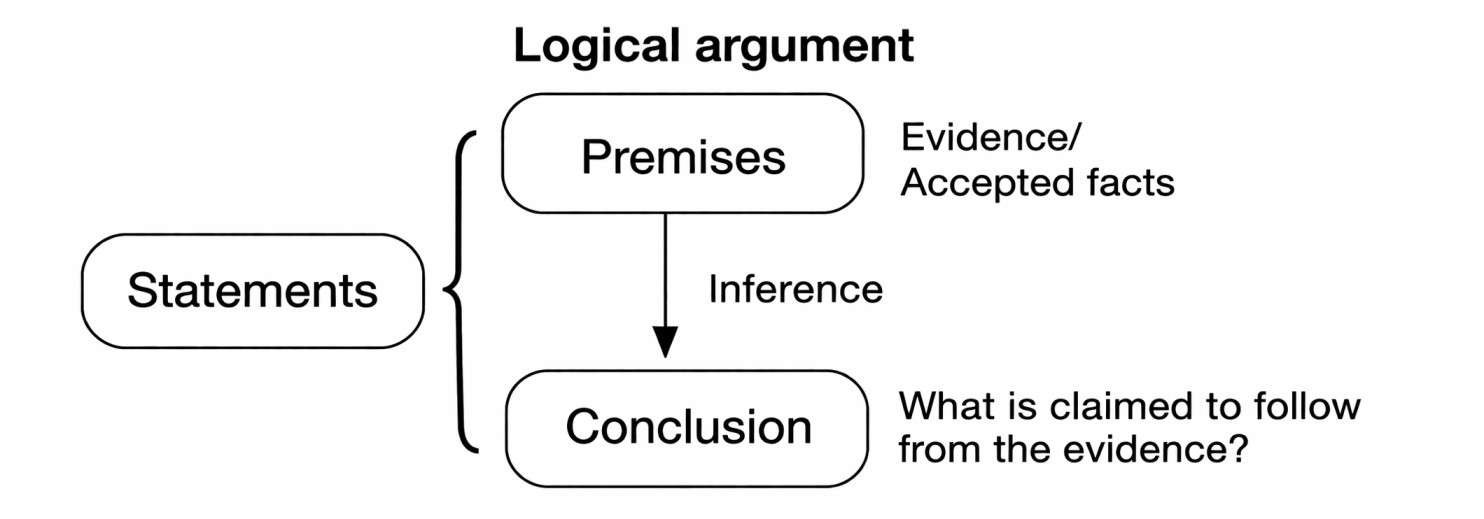
Premises: These are the statements, claims, or pieces Premises are intended to provide reasons or support of evidence presented to support the conclusion, for accepting the conclusion as true.
Conclusion: The conclusion is the statement that the argument seeks to establish or prove. It is the main conclusion is what the arguer wants the audience to point or claim that follows from the premises. The accept.
Inferential Relationship: This is again based on arguments. The concept of an inferential relationship is linked to both deductive and inductive reasoning. In deductive reasoning, the inferential relationship is very strong and strict. In inductive reasoning, the inferential relationship is weaker. We will study more about these in validity, soundness, strength and cogency.
Arguments can take the form of simple everyday conversations to formal and structured logical arguments used in philosophy, law, and other fields.
Arguments play a crucial role in critical thinking and reasoning, evaluating evidence, make a case, and persuade others. The critical thinking involves assessing the strength and validity of arguments, identifying fallacies, and making informed judgments about the truth or acceptability of conclusions based on the provided evidence.
Probable Words in Premises
- The term ‘because’ serves as an indicator for presenting a reason or premise to support a claim. Proving an argument ‘as an argument’ is important to us.
- The claims can be categorized into three main types: Value, Policy, and Factual claims.
- The premises, or supporting reasons, may be introduced using various words and phrases like ‘as,’ ‘due to,’ ‘as indicated by,’ ‘for the reason that,’ ‘owing to,’ ‘through,’ ‘in the view of,’ and more.
Identifying Concluding Statements
- Conversely, the presence of the word ‘therefore’ or its synonyms signals the formulation of a conclusion or claim.
- Words such as ‘accordingly,’ ‘consequently,’ ‘infer that,’ ‘hence,’ ‘prove that,’ ‘conclude that,’ and similar terms also signify the conclusion of an argument.
Example Illustration
- Consider the argument: “The internet is a valuable invention.’
- Practically, we get flexible with the use of such words or marks.
- In this example, we reinforce the claim that the internet is valuable with logical reasons such as ‘It is a vast source of information’ and ‘It offers extensive entertainment options.’ The logical reasons provided lead us to the conclusion that the internet is indeed a valuable invention.
Evaluating Arguments
- When assessing an argument, it is crucial to examine both its structural elements and its content.
- Further exploration of argument evaluation will be discussed in the upcoming sections.
This revised structure breaks down the discussion into distinct sections, making it easier for readers to follow and understand the key concepts related to argument construction and evaluation.
Syllogism: Syllogism is also a form of argument that is connected with deductive reasoning, basically follows a structured and standardized pattern, which consists of a major premise, a minor premise, and a conclusion which will be discussed afterwards. This intends to draw the conclusion in a valid and logically sound manner. Through deductive reasoning, we get an idea about validity, truth, soundness.
Analogous Argument
Analogous argument uses an analogy to support its conclusion. An analogy is a comparison of two things that are similar in some ways but different in others.
The structure of an analogous argument is as follows:
A is similar to B in certain ways.
B has property C.
Therefore, A probably has property C.
For example:
The human brain is like a computer.
Computers can be programmed to perform complex tasks.
Therefore, the human brain can probably be programmed to perform complex tasks.
This argument is analogous because it compares the human brain to a computer, two things that are similar in some ways (e.g., they can both process information and perform complex tasks) but different in others (e.g., the human brain is biological and a computer is electronic).
Reasoning – Deductive and Inductive
Deductive arguments aim to provide logically conclusive support for their conclusions while inductive arguments aim to provide probable or likely support for their conclusions.
Deductive reasoning, championed by Aristotle, is seen as a way to attain certainty and approach the truth. Immanuel Kant (1724-1804) rightly wrote in the ‘Critique of Pure Reason’ that Aristotle’s theory of logic completely accounted for the core of deductive inference. Thomas Aquinas and Gottlob Frege also made important contributions in deductive reasoning.
On the other hand, philosophers like Francis Bacon and J.S. Mill emphasized inductive reasoning as a means to generate new knowledge. The development of the scientific method, particularly in the works of figures like Galileo and Newton, further solidified the role of inductive reasoning in scientific inquiry.
First, we try to get the general idea and then difference between deductive and inductive so that we have some clarity in mind.
Deductive Reasoning:
This set of reasoning moves from a general premise or premises to a specific conclusion. In deductive reasoning, if the premises are true, the conclusion must be true. We always aim for certainty in life. It is characterized by a high degree of certainty.
The structure of a deductive argument often follows this pattern:
- Premise 1: General statement
- Premise 2: Additional information
- Conclusion: A specific, certain statement that logically follows from the premises.
Example
Premise 1: All humans are mortal. (General)
Premise 2: Chanakya is a human. (Cause)
Conclusion: Therefore, Chanakya is mortal. (Effect)
General: The first premise is a general statement about all humans. It says that all humans are mortal.
Cause: The second premise states that Chanakya is a human. This premise can be seen as the cause of the conclusion, because it is the reason why Chanakya is mortal.
Effect: The conclusion is a specific statement about Chanakya. It says that Chanakya is mortal. This conclusion can be seen as the effect of the cause stated in the second premise.
As we discussed, deductive reasoning is a logical process that leads to conclusions with a high degree of certainty. It is a method of thinking that is foundational in the field of logic.
The example of a valid form of deductive reasoning known as a categorical syllogism is given as under:
- Premise 1: All A are B.
- Premise 2: C is an A.
- Conclusion: Therefore, C is a B.
Inductive Reasoning:
There is always a ‘inductive leap’ from certain to uncertain, from particular to general, because the conclusion tends to contain more information than the premises. This leap is based on two:
Law of Uniformity of Nature: This says that under similar conditions nature behaves in a similar manner – that is future repeats the past.
Law of Causation: Every event has a cause, so if X is the cause of Y, whenever there is X, it will always be followed by Y.
The structure of an inductive argument may look like this:
- Observation (or Premise) 1: Specific instance or data point
- Observation (or Premise) 2: Additional specific instance or data
- Inductive Conclusion: A general statement or hypothesis based on the observed instances.
Here is an example of an inductive argument:
- Observation 1: All swans that I have ever seen are white.
- Observation 2: The swan that I am looking at now is white.
- Inductive Conclusion: Therefore, all swans are white.
Chanakya example of inductive reasoning is also being discussed here for clarification:
Specific Observations (Causes):
Chanakya is a man.
Another man, John, is mortal.
Yet another man, Sarah, is mortal.
And so on, with numerous specific instances of men being mortal.
General Conclusion (Effect):
- The general conclusion is that all men observed so far are mortal.
- We should rather use the words ‘basis’ and ‘inference’ to describe the relationship between specific observations and the general conclusion in this inductive reasoning process.
- The basic rule is that inductive reasoning is a useful tool for making predictions and decisions in everyday life.