National Income Accounting
Introduction
National Income refers to the total monetary value of all final goods and services produced by a country’s residents within a specific period, usually one financial year. It acts as a key indicator of a nation’s economic health and development. It reflects the productive capacity and income-generating ability of the economy.
National Income is the aggregate value of all goods and services produced by firms in a given financial year. It can be stated that when the aggregate revenue generated by the firms is paid out to factors of production, it equals aggregate income or National Income. There are different variants or aggregates of National Income and each of the aggregates has a specific meaning, use, and method of measurement.
Policymakers, economists, and analysts rely on national income data to make informed decisions on budgeting, planning, and economic reforms. National income is crucial for understanding living standards, resource allocation, and income distribution in a country.
Meaning of National Income
National Income denotes the total worth of all final goods and services generated within a country during a specific time frame, typically over the course of one financial year.
- From a macroeconomic perspective, national income plays a central role in measuring the economic performance and prosperity of a nation.
- It is utilised in evaluating per capita income, understanding inequality, and comparing growth across countries. It also forms the basis for fiscal policy formulation, taxation, and welfare schemes.
- Globally, institutions like the World Bank, the IMF, and the United Nations rely on national income statistics to assess global economic trends and design development frameworks.
- In India, agencies such as the National Statistical Office (NSO) under the Ministry of Statistics and Programme Implementation (MoSPI) handle national income estimation.
Components of National Income
National income is comprised of various components that reflect the flow of money within an economy. These components not only show how income is generated but also where it is spent or invested. The primary components include:
- Consumption (C): Consumption refers to the total spending by households on goods and services for their personal use.
- Investment (I): Investment refers to capital formation — the creation of new assets that contribute to future production. It includes business expenditure on machinery, tools, buildings, inventory accumulation, and residential construction.
- Government Spending (G): This includes all expenditure by central, state, and local governments on: public goods and services, salaries of government employees, welfare programs and subsidies.
- It does not include transfer payments (like pensions or unemployment benefits), as these do not correspond to the production of goods or services.
- Net Exports (X-M): This is the difference between a country’s exports and imports. A positive net export (trade surplus) adds to national income, while a negative net export (trade deficit) reduces it.
- Factor Income: Additionally, factor incomes (wages, rent, interest, profits) contribute to National Income at Factor Cost, adjusted for taxes and subsidies.
Circular Flow of Income
Before understanding the different aggregates of national income, it is important to know how income is generated and circulated in an economy. The circular flow of income represents the continuous movement of goods, services, and money between the two main sectors of an economy—households and firms. In this simple two-sector model, households provide factors of production such as land, labor, capital, and entrepreneurship to firms. In return, firms make factor payments in the form of rent, wages, interest, and profit.
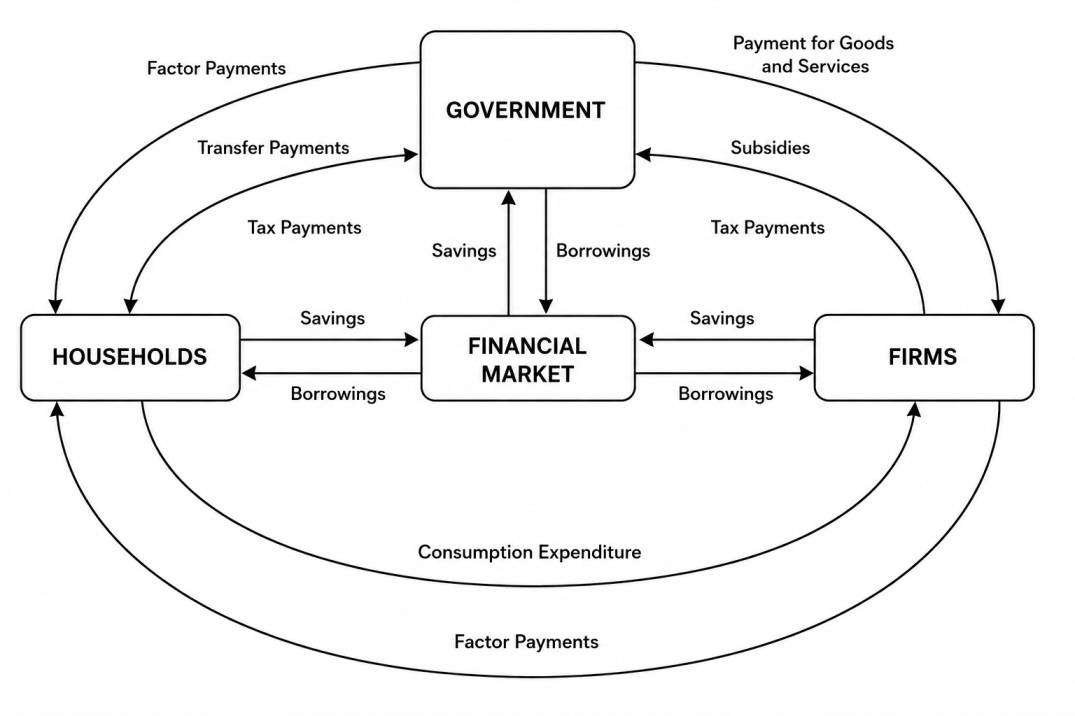
The income received by households is then spent on the goods and services produced by firms. This creates a continuous loop of production, income, and expenditure within the economy. The real flow of goods and services moves from firms to households, while the money flow moves from households to firms. This circular movement ensures that the total value of production, income, and expenditure remains equal, forming the foundation for measuring national income.
Basic Aggregates of National Income
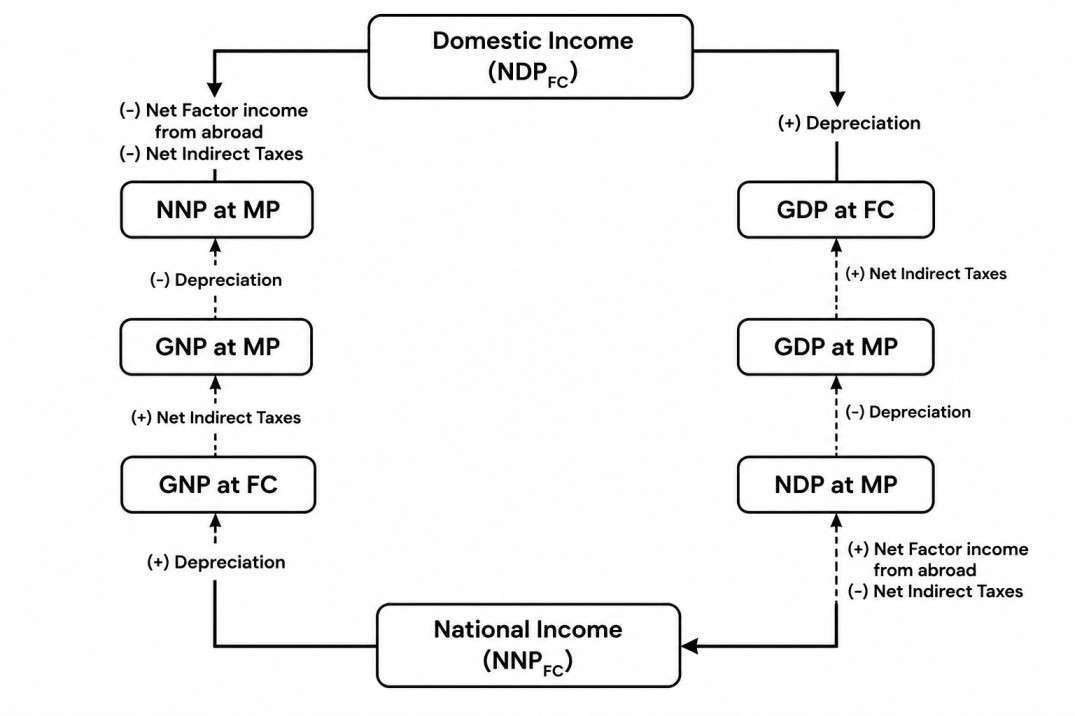
A number of goods and services are produced in a year by different production units within an economy. It is not possible to add those goods and services in terms of their quantity; therefore, these are added in terms of money. There are eight aggregates in National Income for measuring the value of goods and services in terms of money. These are as follows:
Gross Domestic Product at Market Price (GDPMP):
- GDPMP refers to the gross market value of all the final goods and services produced during a year within the domestic territory of a country.
- Gross in GDPMP means that the total value of final goods and services includes depreciation, i.e., no provision has been made for it.
- Domestic in GDPMP means that the final goods and services produced are located within the domestic boundaries of the country.
- Product in GDPMP indicates that only final goods and services are included.
- Market Price in GDPMP means that the amount of indirect taxes paid is included in GDP; however, the subsidies are excluded from it.
The rest of the aggregates are determined by making some adjustments in GDPMP.
Gross Domestic Product at Factor Cost (GDPFC):
GDPFC refers to the gross money value of all the final goods and services produced during a year within the domestic territory of a country. It can be determined as:
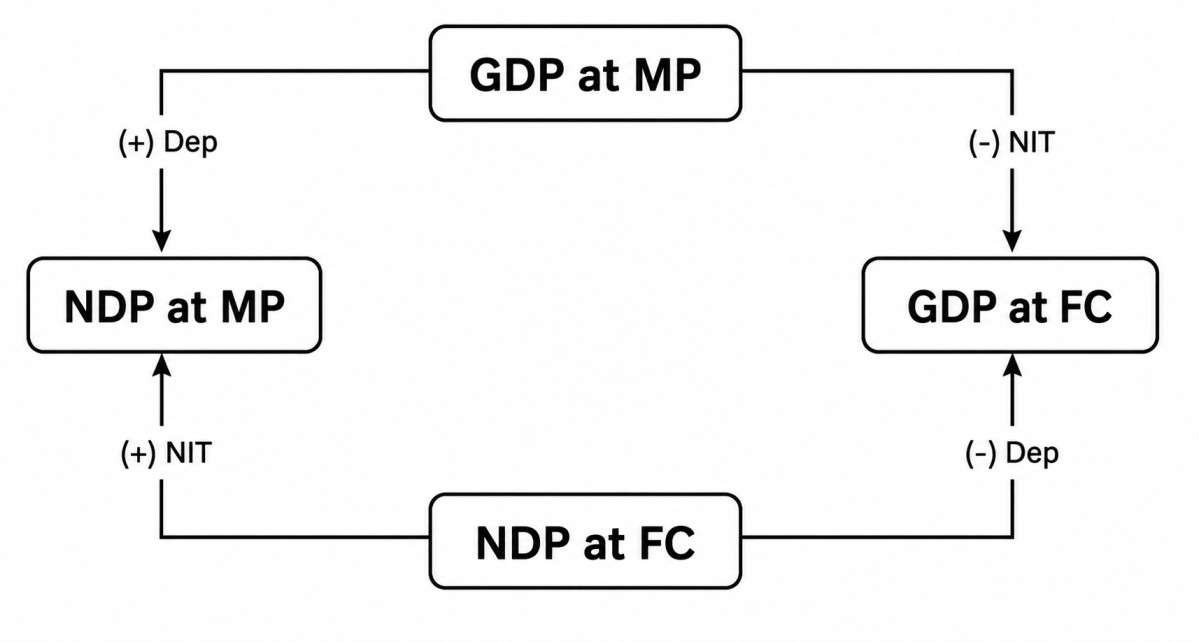
GDPFC = GDPMP – Net Indirect Taxes
Net Domestic Product at Market Price (NDPMP):
NDPMP refers to the net market value of all the final goods and services produced during a year within the domestic territory of a country. It can be determined as:
NDPMP = GDPMP – Depreciation
Net Domestic Product at Factor Cost (NDPFC):
NDPFC refers to the net money value of all the final goods and services produced during a year within the domestic territory of a country. It can be determined as:
NDPFC = GDPMP – Net Indirect Taxes – Depreciation
NDPFC is also known as Domestic Factor Income or Domestic Income.
Relationship between the four Domestic Aggregates (GDPMP, GDPFC, NDPMP, and NDPFC):
Domestic in each of these aggregates states that the contribution of only those producers whether they are resident or non-resident will be included who are producing within the domestic territory of the country.
Gross National Product at Market Price (GNPMP):
GNPMP refers to the gross market value of all the final goods and services produced during a year by the normal residents of a country. It can be determined as:
GNPMP = GDPMP + Net Factor Income from Abroad
GNPMP of a country can be less than its GDPMP if NFIA is negative. However, it can be more than GDPMP if NFIA is positive.
Gross National Product at Factor Cost (GNPFC):
GNPFC refers to the gross money value of all the final goods and services produced during a year by the normal residents of a country. It can be determined as:
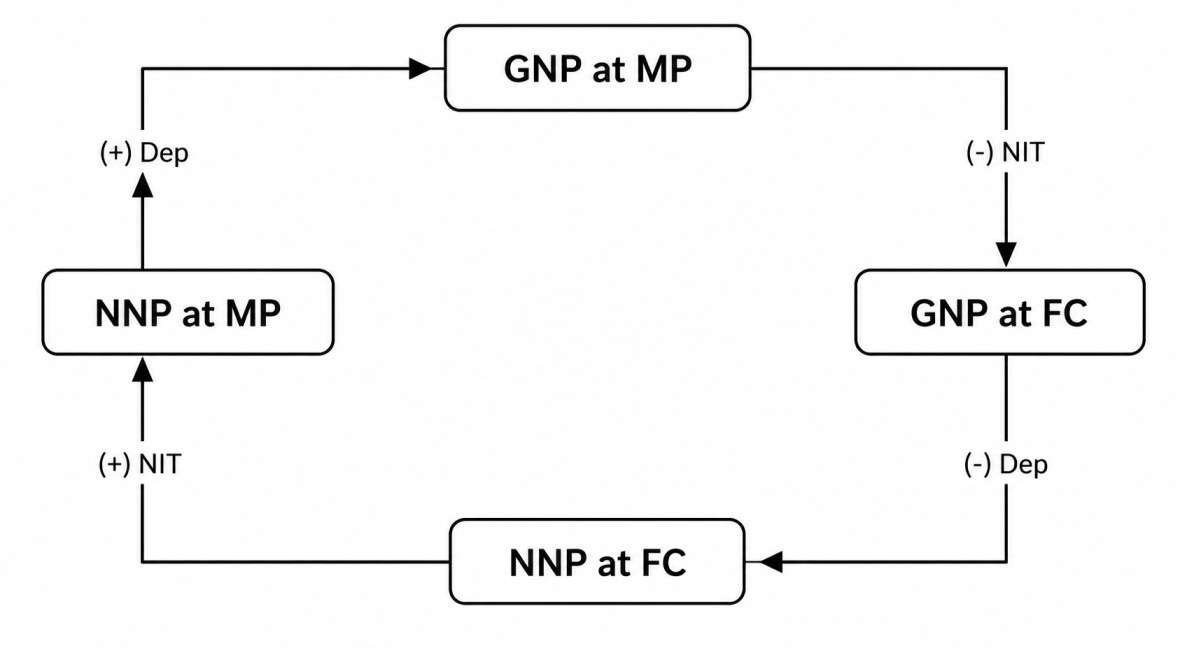
GNPFC = GNPMP – Net Indirect Taxes
Net National Product at Market Price (NNPMP):
NNPMP refers to the net market value of all the final goods and services produced during a year by the normal residents of a country. It can be determined as:
NNPMP = GNPMP – Depreciation
Net National Product at Factor Cost (NNPFC):
NNPFC refers to the net money value of all the final goods and services produced during a year by the normal residents of a country. It can be determined as:
NNPFC = GNPMP – Net Indirect Taxes – Depreciation
NNPFC is also known as National Income.
Relationship between the four Domestic Aggregates (GNPMP, GNPFC, NNPMP, and NNPFC):
National in each of these aggregates states that the contribution of only those producers who are normal residents of a country will be included. It does not matter if the production is being held outside the domestic territory of the country.
Domestic Income (NDPFC) vs National Income (NNPFC):
Basis | Domestic Income | National Income |
|---|---|---|
| Meaning | It refers to the net money value of all the final goods and services produced during a year within the domestic territory of a country. | It refers to the net money value of all the final goods and services produced during a year by the normal residents of a country. |
| Nature of Concept | Domestic Income is a territorial concept. It includes the value of all the final goods and services produced within the domestic territory of a country. | National Income is a national concept. It includes the value of all the final goods and services produced in the whole world. |
| Category of Producers | All producers within the domestic territory of the country are included in Domestic Income. | All producers who are normal residents of the country are included in National Income. |
| NFIA | Domestic Income does not include NFIA. | National Income includes NFIA. |