
- Introduction
- Leadership
- Meaning and Definition of Leadership
- Context of Gender in Leadership
- Theories of Leadership
- Great Man Theory/Trait Theory of Leadership
- Behavioural Theories
- Contingency/Situational Theories
- Cognitive Resource Theory
- Hersey and Blanchard’s Situational Theory
- Leader-Member Exchange Theory
- Path-Goal Theory
- Leader-Participation Model
- Transactional Theory of Leadership
- Transformational Theory of Leadership
- Leadership Theories in Context of Gender
- Motivation
- Definition
- Motive, Motivators and Motivating
- Motivation Process
- Types of Motivation
- Motivational Theories
- Maslow’s Motivation Theory
- Maslow’s Extended Motivation Theory
- Alderfer's Hierarchy of Motivational Needs
- McClelland’s Theory of Needs (Achievement Theory of Motivation)
- Herzberg's Two Factor Theory
- McGregor’s Theory X and Theory Y
- Theory Z (US-Japanese Management Style) by William Ouchi
- Instinctive Theory of Motivation
- Importance of Motivation in an Organization
Introduction
Planning, organizing, and supervising different aspects of an organization in order to accomplish its goals and objectives is known as organizational management. Managing the organization entails ensuring that everyone gets along and that everything goes without a hitch. A school, club, company, or even a team might be considered an organization. The one in charge is frequently referred to as a manager or leader. They assist others in carrying out their tasks, resolving issues, and creating future goals. Effective managers guide their people, listen, and assist everyone in achieving a single objective. An organization can expand and succeed if it is well managed.
Organization management is the process by which individuals plan, coordinate, and guide a team to collaborate and accomplish their objectives. It entails ensuring that everyone is aware of their responsibilities and supports one another. In order for the group to prosper, managers assist in issue solving and wise decision making. To achieve the best results, they also carefully manage their time, money, and instruments. Effective leadership maintains the group's structure and progress. It would be difficult for the group to function effectively and complete their tasks without management.
Leadership
Meaning and Definition of Leadership
Leadership has been defined in different ways by different set of scholars. Leadership is defined as the ability to influence a group towards the achievement of a vision or set of goals. Keith Davis observes that, “without leadership, an organization is but a muddle of men and machines…Leadership transforms potential into reality. It is the ultimate act which brings to success all the potential that is in an organization and its people”.
In 1938, Chester Bernard gave a new definition of leadership and stated that, “leadership is the ability of a superior to influence the behaviour of subordinates and persuade them to follow a particular course of action”. A recent theorist on leadership, Williams (2005), states that, “leadership is an interactive art in which the leader is dancing with the context, the problem, the faction, and the objective”.
A person in an organization may assume leadership both in a formal and informal way. By formal leadership we mean to say that a person assumes leadership role, based on the position that he holds in an organization and in such form of leadership, the leader is designated with the title, along with the authority and responsibility to lead the team. In the second form of leadership, a person assumes leadership without any formal sanction of authority and duty. That is, in informal leadership, the ability to influence the group arises outside the formal structure of the organization and people in the organization oblige to such influence even without the formal influence.
Leadership is quite important for an organization and they act as agents who cope with change and bring about change for the betterment of the organization. Leaders establish direction by developing a vision of future, communicate the vision to the people in the organization and synchronize them with the organizational vision and mission, thereby inspire the people to translate the goals, vision and mission into reality. Thus, leadership is the ultimate act that brings to success all of the potent potential, that is in an organization and its people.
Context of Gender in Leadership
Some of the concern that is raised about women leadership is the capability and competence of a woman in playing the role of a leader. The gender that a woman carries sometimes acts as both a boon and bane in reaching leadership positions. Because of gender, a woman is given high profile positions in an organization at times, and again because of her gender, a woman is denied the opportunity of becoming a leader, on the ground that whether, she will be able to face the leadership challenges. A cause of concern that has been observed in recent years is that, women tend to occupy dangerous leadership positions, when things are getting hairy and when things go great, the top leadership position typically go to men (Klenke, 2011).
Though women have been occupying a place of prominence in various sectors, there seems to be underrepresentation of women in certain sectors, especially in finance sector and corporate management sector. Such underrepresentation of women in leadership positions is a global phenomenon, which extends across public and private sector industries and professions. Even if found in few leadership positions, women are often evaluated less favorably than their male counterparts with similar backgrounds and experience. The term, ‘glass-ceiling’ and ‘glass-escalator’ are widely used metaphors in recent times, which are used to explain such gender differences. ‘Glass-ceiling denotes the presence of invisible barriers that obstruct the upward movement of women in leadership positions. On the contrary, men are more likely to be accelerated into leadership positions by means of ‘glass escalators’ (Klenke, 2011).
However, in spite of all such challenges, the role of women in leadership positions has been widely recognized in recent times, and female leaders are on the rise, especially after the era of globalization.
Thus in recent times, the male model of leadership that was a dominating theory, research and practice has been fading away. Women now are reaching top management positions, breaking the glass-ceiling and pursue the role of leadership with success, by exhibiting personality characteristics and leadership styles.
Theories of Leadership
In influencing the people in the organization towards the goals of the organization, there have been various approaches adopted by different set of leaders, as one model may not be suitable for different organizations with different set of objectives. Moreover, such models or theories of leadership also depend on the qualities that a leader inherit or display in managing her/his team. Some of the theories of leadership ranging from conventional theories to contemporary theories have been dealt with over here, the chief of them being the following:
- Great Man Theory/Trait Theory
- Behavioural Theories
- Contingency/Situational Theories
- Transactional Theory of Leadership
- Transformational Theory of Leadership
Great Man Theory/Trait Theory of Leadership
Some of the leaders in the history have always been identified as strong leaders based on the qualities or traits that they display. Leaders like Mahatma Gandhi, Indira Gandhi, Margaret Thatcher, Nelson Mandela, Narayana Murthy of Infosys, Steve Jobs etc. has been identified, based on the traits that they displayed. For instance, when Margaret Thatcher was the prime minister of the Great Britain, she was regularly described as a confident, iron-willed, determined and decisive leader. Thus, the trait theories of leadership consider personal qualities and characteristics that differentiate leaders from non-leaders (Robbins, Judge, & Sanghi, 2007).
In the beginning, the assumption behind trait theory was that ‘leaders are born and not made’. This concept was popularly known as the ‘Great Man Theory’ of leadership. The great man theory was originally proposed by Thomas Carlyle (1949) and the assumption behind this theory is that ‘great leaders will arise, when there is great need’. The theory also assumes that a leader cannot be a normal person and they are different from the average person in terms of personality traits such as intelligence, perseverance and ambition. However, a proposition of ‘Great Woman’ finds no place, especially in leadership studies mainly due to the fact that gender issues were out of context, when the theory was proposed and moreover, it was only male members of the society who were into such research and such biasness was hardly realized by the people then.
In the period of 1960s, various research studies were made on the traits of a leader and about 80 traits that a leader could display was identified. The trait theory assumes that leaders are born with inherited traits and good leaders have the right combination of traits. In 1974, Stogdill identified certain traits and skills that are essential for a leader, which are as follows:
Traits and Skills
| Traits | Skills |
|---|---|
| Adaptable to situations | Clever (Intelligent) |
| Alert to social environment | Conceptually skilled |
| Ambitious and achievement oriented | Creative |
| Assertive | Diplomatic and tactful |
| Cooperative | Fluent in speaking |
| Decisive | Knowledgeable about group task |
| Dependable | Organised (administrative ability) |
| Dominant (desire to influence others) | Persuasive |
| Energetic (high activity level) | Socially-skilled |
| Persistent | |
| Self-confident | |
| Tolerant to stress | |
| Willing to assume responsibility |
A comprehensive review of the leadership literature on traits, reveal that one of the significant approach that was developed was the Big Five Personality Framework. Though various traits were identified by different studies, it was possible that such traits were somehow clubbed or subsumed under the Big Five approach. Though the approach seems to be complex, it offers useful insights. Leaders who are extraverted (individuals who like being around people and are able to assert themselves), conscientious (individuals who are disciplined and keep commitments they make), and open (individuals who are creative and flexible) do seem to have an advantage when it comes to leadership, suggesting that good leaders do have key traits in common.
In recent years, another trait that has been identified with leadership is the Emotional Intelligence (EI). Advocates of EI argue that without it, a person can have outstanding training, a highly analytical mind, a compelling vision, and an endless supply of terrific ideas, but still not make a great leader. The general assumption is that, empathetic leaders can sense others‟ needs, listen to what followers say (and don‟t say), and are able to read the reactions of others.
Behavioural Theories
In the 1940s, apart from the research studies being conducted on the traits displayed by leaders, research was also conducted on the behaviours exhibited by leaders. The first and foremost study on leadership was carried out by psychologist, Kurt Lewin and his associates in 1939 and identified different styles of leadership, viz. autocratic, democratic and laissez-faire leadership, which has been discussed in the next unit. While the assumption behind trait theory is that ‘leaders are born, rather than made’, behavioural theories assume that specific behavioural patterns of leaders can be acquired through learning and experience. While the trait theory concentrates on ‘what the leaders are’, the behavioural theories concentrate on ‘what the leaders do’. In this section, four different behavioural pattern of leadership has been dealt with, which are as follows:
(1) Ohio State Studies:
One of the foremost studies that emanated on behavioural theories was the study made by Ohio State University (1945) by E.A. Fleishman, E.F. Harris and H.E. Burtt. The study narrowed the leadership behaviours into two categories, viz. initiating structure and consideration, under which the various leadership behaviours were clubbed.
(i) Initiating Structure: Initiating structure refers to the extent to which a leader is likely to define and structure his or her role and those of employees in the search for goal attainment. It includes behaviour that attempts to organize work, work relationships, and goals. A leader with initiating structure is generally task oriented, with focus on performance of employees and meeting of deadlines.
(ii) Consideration: As per ‘consideration’ category, a leader pays more attention to the employee of the organization rather than the task and shows concern for the well-being, comfort and satisfaction of employees. That is, a leader focuses on the relationships that are characterised by mutual trust, respect for employees’ ideas, and regard for their feelings.
The two-factor conceptualization of Ohio Studies has been gaining wide recognition in recent times.
(2) University of Michigan Studies:
Similar to the Ohio State University studies, research on leadership studies was also carried out by the University of Michigan’s Research centres, in 1946 by Rensis Likert and his associates. The study made an analysis of the relationship between leadership behaviours and organizational performances. Michigan Studies also identified a two-factor component, viz. ‘employee-oriented leader’ and ‘production-oriented leader’.
(i) Employee-Oriented Leader: The concern of the employee-oriented leaders were more on the interpersonal relations with the employees and such leaders paid more attention on the needs of the employees and accepted the individual differences among members.
(ii) Production-Oriented Leader: The production oriented-leaders paid attention to the technical aspects of the job or the tasks assigned to the employees, rather than on employees. Such leaders gave least importance to the group members, and regarded the employees as only a means to achieve the ends, that is, the goals of an organization.
It can be found that the two-factor conceptualization of the Ohio study is similar to the two way dimension of the Michigan studies. While the employee-oriented leadership can be compared with the ‘consideration’ component of Ohio studies, production-oriented leadership can be compared with ‘initiating structure’. While the Ohio studies considered both its components to be important for effective leadership, the Michigan studies gave supremacy to the component of ‘employee-orientation’ over ‘production-orientation’.
(3) The Managerial Grid:
Like the Ohio State studies and Michigan studies, the Managerial Grid theory of leadership was also based on the styles of ‘concern for people’ and ‘concern for production’. The Managerial Grid theory of leadership was proposed by Robert Blake and Jane Mouton in 1964. This theory which is depicted in a graphical form is also known as the ‘Leadership Grid Theory’.
The grid is a nine-by-nine matrix which outlines 81 different styles of leadership. The grid has 9 possible positions along each axis creating 81 different positions in which the leader’s style may fall.
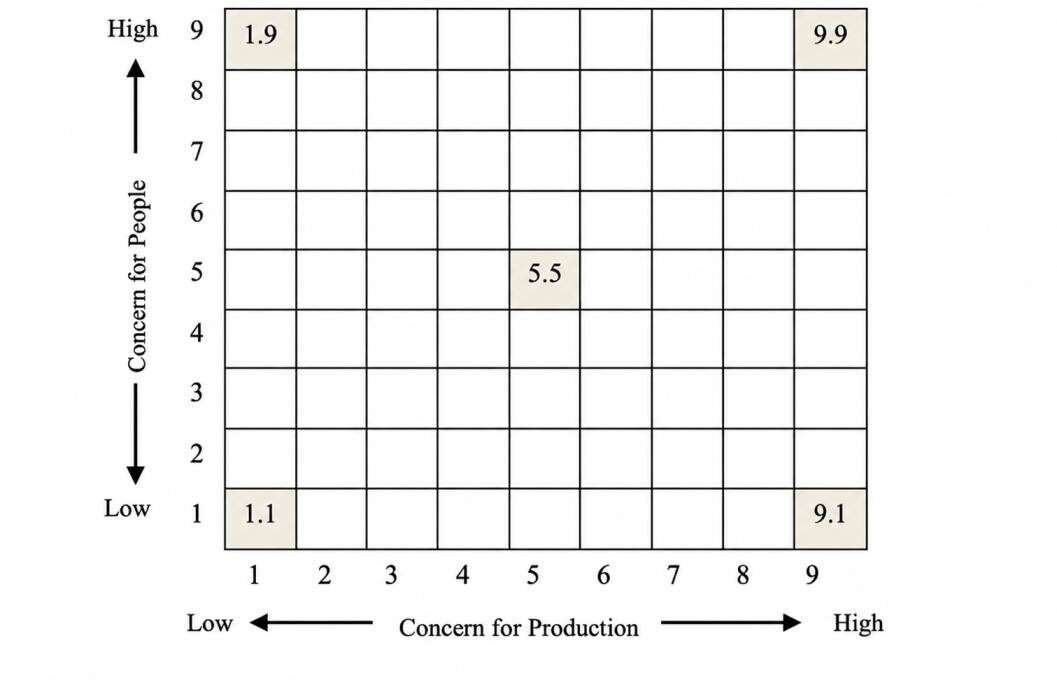
Through the Managerial Grid, 5 kinds of Leadership Style was identified, which include the following:
(i) Impoverished, in which there is low concern for people and production (1 by 1)
(ii) Country Club, wherein the concern for production is low, but for people is high (1 by 9)
(iii) Task, in which there is high concern for production and low concern for people (9 by 1)
(iv) Middle of the Road, where there is moderate concern for both the production and the people (5 by 5)
(v) Team, wherein there is high concern for both the people and production (9 by 9). Concern for People Concern for Production
This theory, thus offers a useful framework for conceptualizing and understanding the leadership styles.
Though behavioural theories make its contribution in understanding leadership effectiveness, it cannot be considered as the utmost option, to determine the success of leadership. In other words, it cannot be said with utmost clarity that a leader depicting a certain kind of leadership traits and behaviours are always successful. At times, the situational contexts play a strong role in determining the effectiveness of leaders.