Introduction
Urban poverty is not a monolithic experience but an amalgamation of factors that result in deprivation and limited access to essential resources for individuals and communities within urban areas. Take, for instance, the sprawling informal settlements in Mumbai, India, where millions reside in cramped conditions with inadequate sanitation and limited access to education and healthcare. To address urban poverty effectively, one must navigate through its root causes. Rapid urbanisation, exemplified by the unprecedented growth of megacities like Beijing and Lagos, often outpaces the development of necessary infrastructure, resulting in pockets of poverty amidst urban prosperity. Inadequate urban planning exacerbates these issues, as exemplified by the favelas in Rio de Janeiro, Brazil, where a lack of proper planning has led to substandard living conditions and limited access to basic services. Resource disparities, unemployment, educational gaps, discrimination, and social exclusion further contribute to the complexities of urban poverty. For example, consider the racial wealth gap in the United States, where historical discrimination has left certain urban communities disproportionately affected by poverty.
Beyond statistics, urban poverty manifests in both tangible and intangible ways. In sub-Saharan Africa, where rapid urbanisation is occurring amidst economic challenges, informal settlements like Kibera in Nairobi, Kenya, epitomise the struggle for basic necessities. Overcrowded living conditions, inadequate sanitation, and limited access to quality education and healthcare underscore the daily challenges faced by the urban poor. Efforts to alleviate urban poverty encounter a myriad of challenges, each demanding careful consideration. The intricate nature of urban environments, exemplified by the diverse landscapes of cities like Tokyo and Lagos, poses unique hurdles. The needs of impoverished populations vary widely, and the limited resources available often fall short of addressing the scale of the issue.
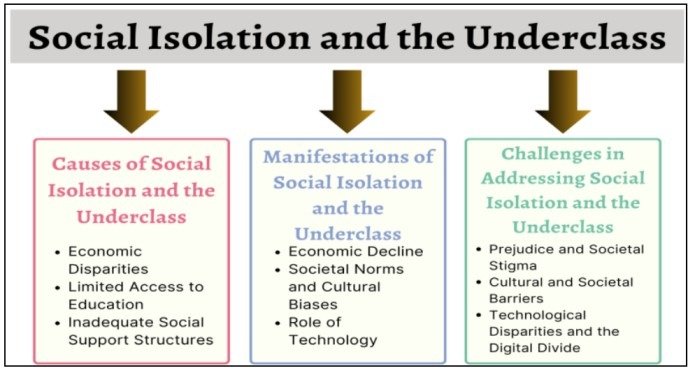
Social Isolation and the Underclass
The intricate relationship between social isolation and the underclass presents a formidable challenge for societies worldwide. Social isolation, a state characterised by detachment from meaningful social interactions, intertwines with the underclass—a segment entrenched in persistent poverty and social exclusion. This intricate connection creates a web of challenges, impacting individuals and communities in nuanced ways.
Defining Social Isolation and the Underclass
Social isolation goes beyond mere physical separation; it encapsulates emotional and psychological detachment from communal engagement. Simultaneously, the underclass represents individuals caught in the grip of unrelenting poverty, facing barriers to education, employment, and enduring social marginalisation. The experiences within the underclass are further complicated by intersecting factors, such as race, gender, and ethnicity, creating a complex tapestry of challenges.