
Reasoning
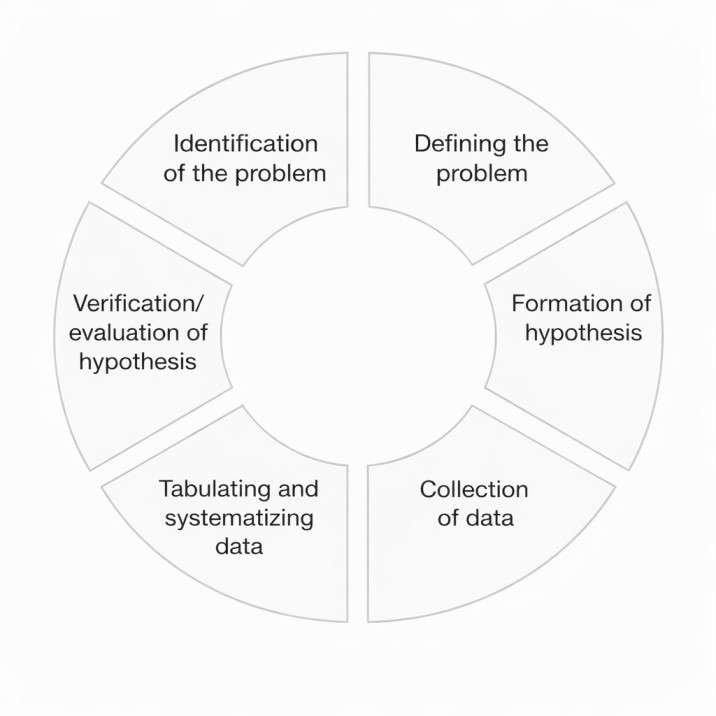
Reasoning, one of the highest orders of thinking, is the stepwise thinking and mental recognition of cause and effect relationships. It involves productive think ing in which insight and past experiences are required. Reasoning is a factor of intelligence. It is a process in which pre-knowledge, experiences, insight and under-standing of relationship are used to solve problems. The ability to reason is closely related to intelligence. It goes in the direction given to the learner, that is, it is always goal-oriented. It is creative and reflective in nature. Reasoning ability develops gradually. It means that experiences are also helpful in developing reasoning power along with intelligence. There may be more than one logic to draw an inference-reasoning is multi-dimensional. Numerous philosophical mathematicians and psychologists have given the following six steps for reasoning:
Types of Reasoning
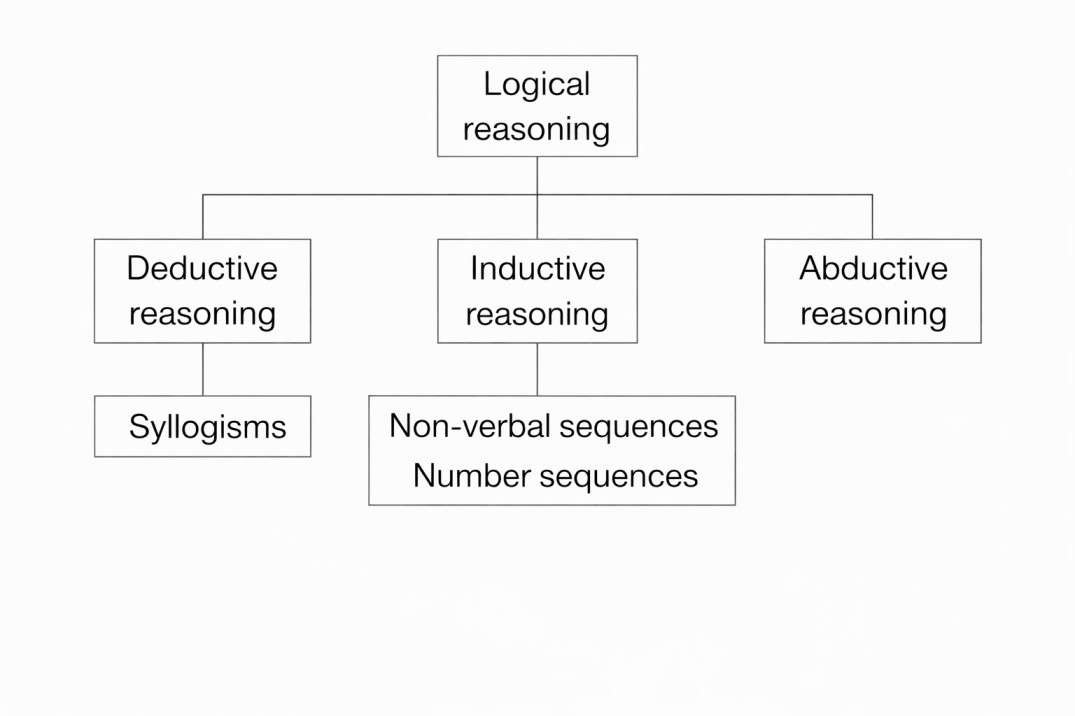
Aristotle gave an extended, systematic treatment of the methods of human reasoning. The three methods were deductive, inductive and abductive reasonings (Fig. 5.1).
Deductive reasoning: Deductive reasoning is also known as analytical reasoning as it deals with objects by looking at its component parts. Formal logic has been described as the science of deduction. The concept of syllogism has been explained in Chapter 6.
Inductive reasoning: Inductive reasoning is also known as ‘synthetic reasoning’ and deals with a class of objects by looking at the common properties of each object in the class. The study of inductive reasoning is generally carried out within a field known as ‘informal logic’ or ‘critical thinking’.
Abductive reasoning: Abductive reasoning is considered as the third form of reasoning. It is somewhat similar to inductive reasoning. It takes its clues from the term ‘guessing’, since conclusions drawn here are based on probabilities. Here, it is presumed that the most plausible conclusion is also the correct one.
Example:
Major premise: The container is filled with yellow pebbles.
Minor premise: Bobby has a yellow pebble in his hand.
Conclusion: The yellow pebble in Bobby’s hand was taken out of the container.
By abductive reasoning, the possibility that Bobby took the yellow pebble from the container is reasonable, though it is purely based on speculation. Anyone could have given the yellow pebble to Bobby, or probably Bobby could have bought a yellow pebble at a retail store. Therefore, abducing that Bobby took the yellow pebble, from the observation of ‘the yellow pebble-filled container’, may lead to a false conclusion. Unlike deductive and inductive reasoning, abductive reasoning is not commonly used for psychometric testing. Here, we can discuss other forms of reasoning as well.
Hypothetical Syllogism (Modus Ponens)
A syllogism is simply a three-line argument that consists of exactly two premises and a conclusion. A hypothetical syllogism is a syllogism that includes at least one hypothetical or conditional (if-then) premise. This is why such type of deductive reasoning is also known as conditional reasoning. This pattern of reasoning is also known as modus ponens. The four varieties of modus ponens are as follows.
Chain Argument:
Chain arguments consist of three conditional statements that are linked together. Here is an example of a chain argument.
If I do not appear in the exam, then I will fail in graduation.
If I fail in graduation, then I will lose my time and money.
Therefore, if I do not appear in exam, I will lose my time and money.
Modus Tollens:
These are sometimes called ‘denying the consequences because they consist of one conditional premise, a second premise that denies (asserts to be false) the consequences of the conditional and a conclusion that denies to be the antecedent of the conditional. Here is an example of modus tollens argument.
If we are in Manchester, then we are in Gujarat.
We are not in Gujarat.
Therefore, we are not in Manchester.
Denying the Antecedent Argument:
In such arguments, the first premise denies (i.e. asserts to be false) the antecedent of the conditional and a conclusion denies the consequent of the conditional.
Here is an example.
If we are in Chandigarh, then we are in the North.
We are not in Chandigarh.
Therefore, we are not in the North.
We can notice that the premises in the above-mentioned examples are true and the conclusion is false. The pattern of reasoning of this argument is not logically reliable.
Affirming the Consequent:
This pattern of reasoning is also faulty and affirms the consequent.
For example, if we are on Venus, then we are in the solar system.
We are in the solar system.
Therefore, we are on Venus.
Such pattern of reasoning has true premises and a false conclusion; it is clear that affirming the consequent is not logically reliable.