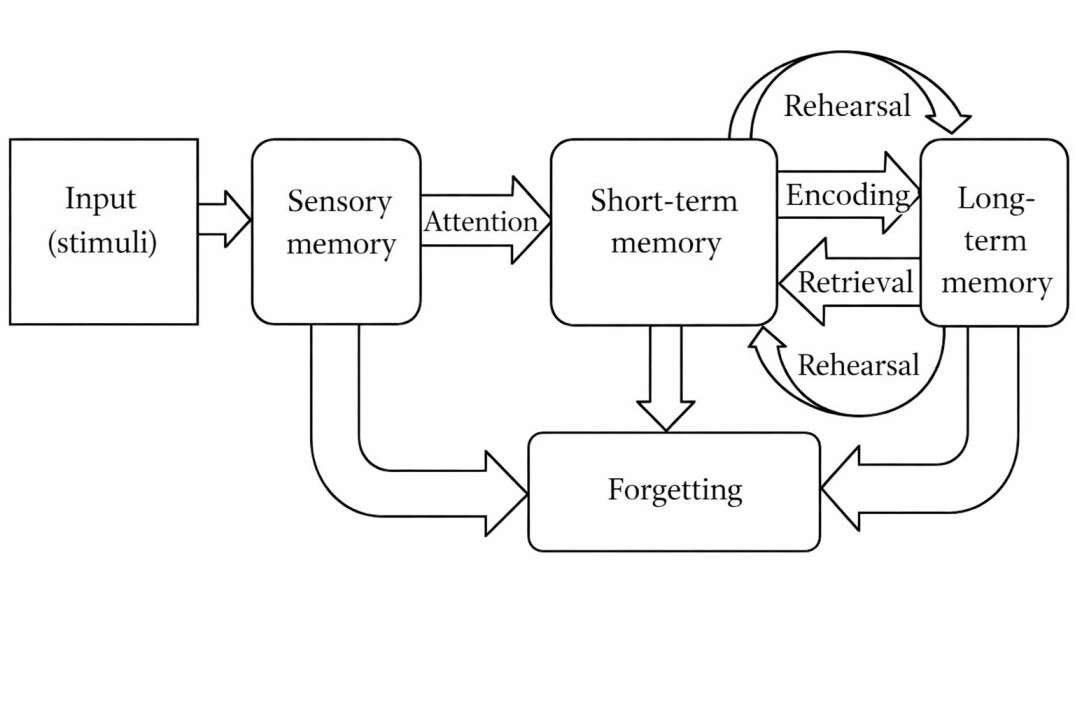
- Memory
- Concept of Memory
- Memory Storage System
- Types of Memory
- Process of Memory: Encoding, Storage, Retrieval
- Forgetting
- Concept of Forgetting
- Meaning of Forgetting
- Definitions of Forgetting
- Forgetting Curve by Ebbinghaus
- Nature/Characteristics of Forgetting
- Kinds of Foregetting
- Causes of Forgetting
- Theories of Forgetting
- How to Prevent Forgetting
- Strategies to Minimize Forgetting
Memory
Concept of Memory
- There is a two-way relationship between learning and memory. If information acquired from learning is not stored in the memory, it will be lost and so we would be unable to recall it. On the other hand, the information we have already stored in our memory influences our new learning. To be effective, a teacher must acquaint himself with the way memory works. He must find out why children forget and be able to prevent it. He must consciously teach to promote effective storage of the material learnt by the students.
- Here, you will read how memory works, the major reasons why we forget and the implications of these for learning and teaching. Memory is at the center of human living, progress and activities. Without memory, we cannot remember; we cannot think; we cannot learn; and we cannot solve problems. We would not be able to know danger and run away from it. We would not be able to invent Science and Technology. We would be completely blank. It would then mean that the individual would be experiencing afresh the same thing over and over again, like trying to fill a bottomless pit.
- But with memory, we are able to store away useful information and recall it when needed. We can think and solve problems. We are able to learn, store what we have learnt and recall it for use whenever necessary. Memory and learning cannot be separated because memory is the reservoir of accumulated learning. It is therefore catastrophic for one to lose his memory, that is, to lose all that he has learnt including his language and even his name.
- Memory is a fundamental cognitive process that enables us to retain, recall, and utilize information from our past experiences. It is characterized by various types, such as short-term memory and long-term memory, each with distinct functions and capacities.
- Enhancing memory involves strategies like mnemonic devices, regular mental exercises, adequate sleep, and a healthy diet, all of which can significantly improve our ability to store and retrieve information effectively.
- Understanding the characteristics of memory and applying these enhancement techniques can lead to better cognitive performance and overall mental well-being.
- In psychological literature, memory is our ability to store and retrieve information. It is very important for the survival of the human species, for without it, no one would retrieve any previously learned information. People think and reason using remembered facts and can only deal with the concept of time—past, present and future—with the aid of memory.
Many psychologists have defined memory variously. Some of the definitions are as follow:
- According to Woodworth and Schlosberg (1954), “Doing what one has learned to do.”
- According to Hilgard and Atkinson (1967), “To remember means to show in present responses, some signs of earlier learned responses.”
- Guilford: “Memory is the retention or storage of information in any form.”
- Woodworth & Marquis: “Memory consists in learning what was previously learned.”
- Ryburn: “The power that we have to store our experience and to bring them back into the field of consciousness some time after the experience has occurred is termed as memory.”
- Spearman has defined memory in this way, “To recall a learnt thing or an incident is a sign of memory.”
Memory is the special ability of our mind to store information, recollect and reproduce it after some time. Memory is a complex process involving learning, retention, recall and recognition. The experiences which we undergo leave traces in our minds in the form of schemas. The length of our retention depends on the strength and quality of these traces.
Memory appears like a tape recorder which records a song or music and plays it whenever we demand. Our memory system does perform this function but it is far more dynamic and versatile than a tape recorder. When someone asks us to sing a particular song and we sing, then we are working like a tape recorder. However, human memory differs from a tape recorder in many important ways.
For instance, we remember not only verbal material but also visual experiences, tactile impressions, feelings of pain and joy, motor skills, events and activities. Second, retrieval of information may occur in the same form or in a modified form. Third, the reception of new information depends largely on prior knowledge. Fourth, we do not receive or retain all the information presented to us because there is a high degree of selectivity in attention and retention. Fifth, while tape recorders have limitations in storage, human memory can retain vast amounts of information.
Finally, our memory system is an active system. It works on the information received and may integrate, modify, reorganize or omit parts of it. It is not passive like a tape recorder, which simply reproduces information in its original form.
Memory Storage System