
Demand for Money
Demand for Money explains why people want a specific sum of money. According to Keynes, the demand for money, or liquidity preference refers to the desire to hold money. In general, the nominal demand for money increases with the level of the nominal output and decreases with the nominal interest rate. The amount of money that people want to keep depends on the value of the transactions that need to be managed.
- In economics, demand for money is commonly associated with cash or bank demand deposits. In general, the nominal demand for money increases with the level of the nominal output and decreases with the nominal interest rate.
- The demand for money is influenced by a variety of factors, including income level, interest rates, inflation, and future uncertainty.
- The late Lord Keynes, the famous English economist who gave birth to Keynesian Economics, proposed the modern concept of demand for money.
- Monetary policy can help to stabilise an economy when the demand for money is stable.
- When the demand for money is not stable, real and nominal interest rates change, and economic fluctuations occur.
- Money is required to manage transactions, and the value of the transactions determines how much money people wish to keep. The greater the number of transactions, the greater the amount of money demanded.
- Since the quantity of transactions is determined by earnings, it should be obvious that an increase in earnings leads to an increase in the demand for money.
- When people save their money rather than putting it in a bank where it earns interest, the money they save is also subject to the rate of interest.
- People become less focused on stockpiling money when interest rates rise because holding money leads to holding fewer interest-earning deposits.
- As a result, at high-interest rates, the amount of money demanded decreases.
Reasons/ Motives for Demanding Money
Transaction Motive:
- Transaction Motive refers to the demand for money to meet the current needs of individuals and businesses.
- Individuals require money to meet their immediate needs, which is referred to as the income motive.
- Businesses, on the other hand, require money to carry out their operations, which is known as the business motive.
(i) Income Motive:
- Income Motive refers to the motivation of individuals who seek money in order to meet their own and their family’s needs. In general, people keep cash to bridge the gap between their income and their expenses.
- The income is received once a month, but the expenses are incurred on a daily basis. As a result, some income must be held in order to make current payments.
- The holding amount is determined by an individual’s income and the frequency with which he or she receives income.
(ii) Business Motive:
- Business Motive refers to the need for money in liquid form by businesses to meet their current needs.
- Businesses require funds to purchase raw materials and pay transportation costs, as well as wages, salaries, and other expenses.
- The amount of money demanded by businesses is determined by their turnover. The higher the turnover, the greater the need for additional funds to cover expenses.
Precautionary Motive:
- Precautionary Motive refers to people’s desire to save money for various contingencies that may arise in the future.
- Unemployment, sickness, and accidents are examples of contingencies.
- The amount of money required for the precautionary motive is determined by a person’s nature and living conditions.
Speculative Motive:
- The speculative motive for demanding money arises when holding money is perceived to be less risky than lending the money or investing it in another asset.
- It refers to the motivation of individuals to hold cash in order to profit from market movements regarding changes in future interest rates.
- For example, if a stock market crash appeared to be imminent, the speculative motive for demanding money would come into play; those anticipating a crash would sell their stocks and keep the proceeds as money.
- The precautionary and speculative motives serve as a store of value for various purposes.
Liquidity Trap
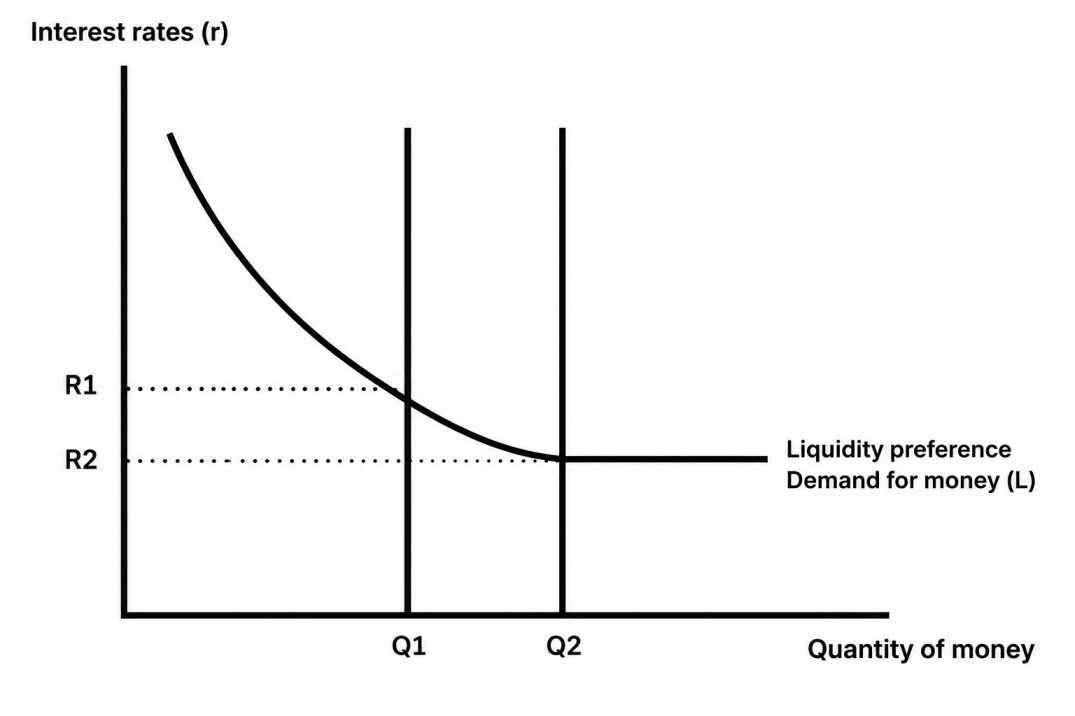
- The demand for money is a decreasing function of the rate of interest.
- The higher the rate of interest, the lower the demand for money for speculative motives and less money would be kept as an inactive balance and vice versa.
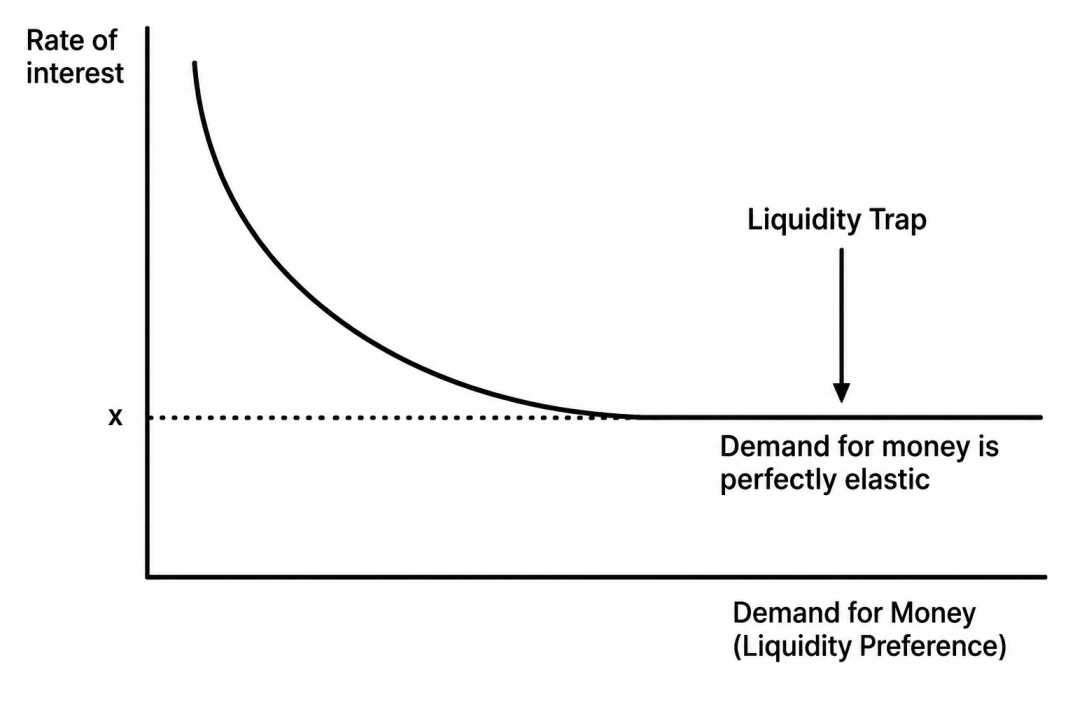
- Money demand is perfectly elastic in a liquidity trap.
- Increasing the money supply has no effect on interest rates, and it has no effect on increasing demand.
- At a low rate of interest, people will hold money as an inactive balance which is called a liquidity trap.
- The expansion of the money supply gets trapped and cannot affect the rate of interest and the level of investment.
- However, the demand for money does not depend so much upon the current rate of interest as on expectations about changes in the rate of interest.
Factors Affecting Demand for Money
Interest Rates:
- The amount of money people keep in reserve to pay for transactions and to meet precautionary and speculative demand is likely to vary with the interest rates they can earn on alternative assets such as bonds.
- People hold less money when interest rates rise relative to the rates available on money deposits.
- People hold more money when interest rates fall.
- The logic of these conclusions about money and interest rates is dependent on people’s motivations for holding money.
Technological Changes:
- Technological changes such as debit cards make the importance of holding cashless important.
- People who have easy access to current accounts may be able to keep less cash on hand.
- The transaction motive drives the demand for money (we want money so we can buy things).
- We keep less money on hand when new technologies make it easier to convert wealth into money.
Availability of Credit:
If credit becomes more widely available, precautionary demand for money will fall as people believe they can borrow – even if they face short-term difficulties.
Irrational Behavior of Asset Prices:
- Markets can go through booms and busts as a result of psychological factors such as over-exuberance.
- During these bubble periods, demand for assets rises while demand for holding money falls.
Changes in National Income:
- When real GDP rises, more goods and services are available for purchase. They will cost more money to purchase.
- A fall in real GDP, on the other hand, will cause the money demand curve to fall.
Changes in the Price Level (inflation or deflation):
- If the price of everything increases by 20%, you will need 20% more money to buy things. When the price level rises, the demand for money rises as well.
- In contrast, when the price level falls, so does the demand for money.