
Introduction
Motivation is an internal state that propels individuals to engage in goal-directed behavior. It is often understood as a force that explains why people or other animals initiate, continue, or terminate a certain behavior at a particular time. It is a complex phenomenon and its precise definition is disputed. It contrasts with amotivation, which is a state of apathy or listlessness. Motivation is studied in fields such as psychology, motivation science, neuroscience, and philosophy.
Motivational states are characterized by their direction, intensity, and persistence. The direction of a motivational state is shaped by the goal it aims to achieve. Intensity is the strength of the state and affects whether the state is translated into action and how much effort is employed. Persistence refers to how long an individual is willing to engage in an activity. Motivation is often divided into two phases: in the first phase, the individual establishes a goal, while in the second phase, they attempt to reach this goal.
Many types of motivation are discussed in academic literature. Intrinsic motivation comes from internal factors such as enjoyment and curiosity; it contrasts with extrinsic motivation, which is driven by external factors such as obtaining rewards and avoiding punishment. For conscious motivation, the individual is aware of the motive driving the behavior, which is not the case for unconscious motivation. Other types include: rational and irrational motivation; biological and cognitive motivation; short-term and long-term motivation; and egoistic and altruistic motivation.
Theories of motivation are conceptual frameworks that seek to explain motivational phenomena. Content theories aim to describe which internal factors motivate people and which goals they commonly follow. Examples are the hierarchy of needs, the two-factor theory, and the learned needs theory. They contrast with process theories, which discuss the cognitive, emotional, and decision-making processes that underlie human motivation, like expectancy theory, equity theory, goal-setting theory, self-determination theory, and reinforcement theory.
Motivation is relevant to many fields. It affects educational success, work performance, athletic success, and economic behavior. It is further pertinent in the fields of personal development, health, and criminal law.
Definition of Motivation
J. E. Ormrod defines motivation as an internal state that arouses us to action, pushes us in a particular direction, and keeps us engaged in certain activities.
William G. Scott defines motivation as a process of stimulating people to action to accomplish desired goals.
Nature of Motivation
The motives are responsible for propelling our action tendencies towards a desired state or goal. Motives are not visible directly; rather, they are inferred from our behaviors. For example, if we observe a student working hard day and night on her/his task, we infer that she/he is motivated to score high. If we are able to make accurate inferences, then we are also able to explain the behavior observed more accurately. For example, the choice of college that you take admission in will explain if you have a need to learn, to belong to an institution, to get a degree for a good job, or because it is in close proximity. The motives help us to make choices, which also in a way help us to make predictions about behavior. For example, if two friends always come together for a class, we predict that they are good friends, or if one is absent from the class, we may predict the other one will also be absent. The predictions may not be accurate, but we can get a fair idea about the probability of the response or behaviour.
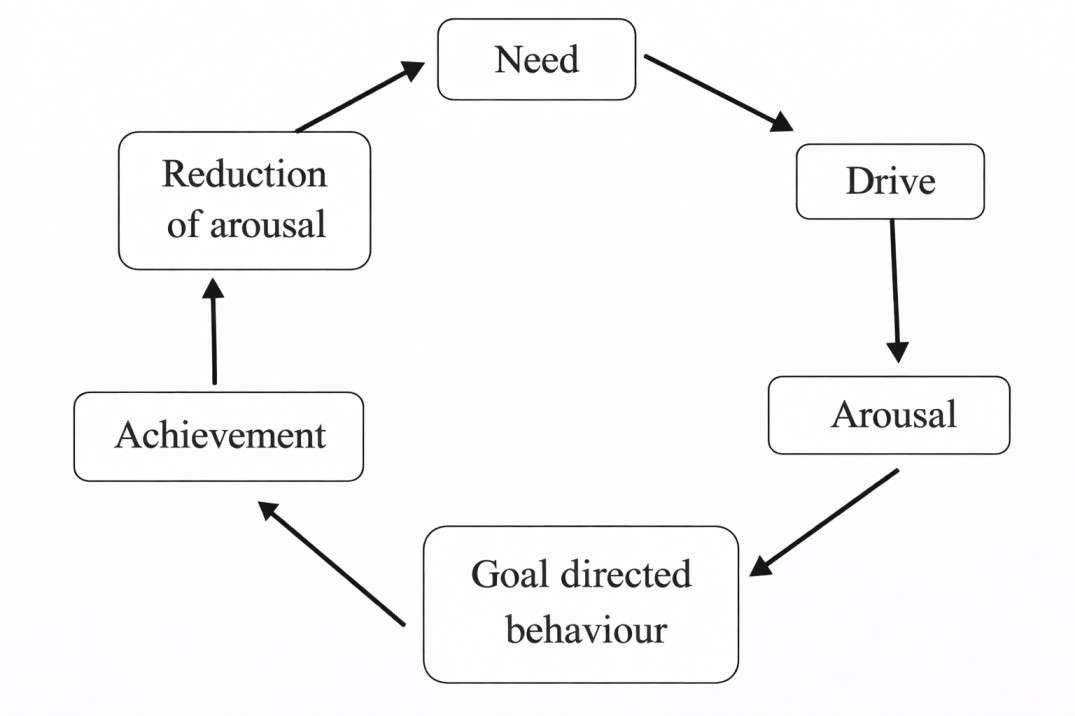
There is a motivational cycle that helps us to understand behavior (Morgan & King, 1979). This motivational cycle starts with a need, a state of lack or deficit of some necessity. The state of need leads to a driving state. Drives can be stimulated due to internal factors or external factors. Internal factors could be thoughts and memories, while external factors could be environmental influences. This driving state arouses you and pushes you to perform some goal-directed behaviour. For example, if we are thirsty, there is a need for water; this need will drive us towards attaining water, and once we have consumed water, the need is satisfied and the drive is reduced or diminished. So, once the performed behaviour leads to the achievement of the desired goal, it reduces the drive and the organism returns to a balanced state. The motivational cycle ends here and arises again when the need reappears.
Before describing further, let us discuss the four terms related to motivation: needs, drives, incentives, and motives.
Needs: These are related to the biological states of cellular or bodily deficiencies that lead to drives. For example, individuals need water, food, and oxygen to survive.
Drives: These are the states of tension that occur when our bodies are deficient in some need, creating an urge to relieve the tension. Thus, when an individual is hungry, she/he will seek food. The need leads to drive and motivates behaviour to reduce the deficiency.
Incentives: These are external factors or environmental stimuli that motivate behaviour. It could be an object or an event. For instance, a trophy won in a game can act as an incentive to perform well.
Motives: Often used interchangeably with motivation, but they differ. Motivation is a general process, whereas a motive is a specific force that drives an individual to take action.
Theories of Motivation
Instinct Theory Of Motivation
- The instinct theory explains motivation as stemming from inborn, biological drives and impulses. Motivated behavior arises to satisfy fundamental survival needs like hunger, thirst, sex, and rest. Instincts propel humans and animals to act in certain innate ways.
- Motivation is the pushing force behind all human action. Simply, without motivation, humans will cease doing anything.
- However, what is it that motivates behavior? Is the way we behave something innate in everyone since we were born, or does it develop as we age and due to our experiences? What evidence supports the basis of motivation?
- For this reason, the instinct theory of motivation is one of the most influential theories in psychology. The very term “instinct” dates back to the 1870s. As one of the very first theories in psychology to explain why humans are driven to do certain behaviors, it examines the forces that motivate people to act and how they influence behavior.
- Addressed by the instinct theory of motivation, all living things are born with innate biological tendencies that help them survive.
- The idea is that this approach finds parallels between biological instincts and motives. It declares that motives are natural forces found in all living creatures. Organisms rely on intuition to survive in a world of contradicting needs and drives.
- The instinct theory of motivation predicts that survival instinct is at the core of not only human behavior but the behavior of all creatures. The instincts depicted include behaviors for eating, forming relationships, procreating, and more.
- It is a shared belief that we are encouraged by what we want; therefore, we do certain actions because we desire to reach specific outcomes. At the heart of every human being is an internal drive that guides our thoughts, feelings, and behavior, and instinct theory is one of the most influential theories of motivation.
What are instincts?
Instincts are goal-directed and innate patterns of behavior that are not the result of education or experience. We are not necessarily conscious of the principle of all mental and bodily actions due to our mindful motives. It is a capability to achieve knowledge without learning or discovery inside the individual.
We tend to use our intellect to help us figure out in each setting how to be in line with expected instinctive behaviors for that setting. We are often guided and influenced heavily by our emotions in that process.
To create their steerage and achieve their goals, our instincts often trigger, activate, amplify, support, and reinforce specific feelings. Emotions often create evident functional behavioral steerage levels for our instincts.
In living creatures, instincts are inherent tendencies to engage spontaneously in a particular pattern of behavior.
Example of instincts in action:
A dog is shaking after it gets wet.
A sea turtle is seeking out the ocean after it hatches.
A bird is migrating before the winter.
Konrad Lorenz famously showed the influence of instincts when he got young geese to imprint on him. He noted that geese would become connected to the first moving thing they faced after they hatched, which in most circumstances would be their mothers.
However, by confirming that he was the first thing the geese discovered, they became attached or imprinted on him instead.
What is William McDougall’s Instinct Theory of Motivation?
Psychologist William McDougall was one of the foremost to report on the instinct theory of motivation. The definition of an “instinct” meant it needed to be:
Unlearned
Uniform in expression
Universal in species
He proposed that instinctive behavior was composed of three fundamental elements:
Perception
Behavior
Emotion
McDougall’s theory was based on much earlier research by Darwin, who presented that animals display behaviors similar to human psychological traits.
Animal instincts are observable behaviors passed down through generations, providing an evolutionary edge to survival. Many psychologists propose neurobiological explanations for humans’ evolved instincts, but this basis remains controversial.
McDougall also outlined 18 different instincts, which include:
Sex
Fear
Laughter
Parental
Submission
Curiosity
Escape
Reproduction
Repulsion
Jealousy
Self-assertiveness
Hunger
And so on…
From this list, we can think about why McDougall chose these instincts. We work to satisfy our hunger because, essentially, without food, we would die.
The second instinct is the sexual kind, as it assures the survival of another generation to continue our species. Finally, the third instinct is self-preservation. This includes worry and aggression – fear of bodily harm and attack to defend ourselves or ensure individual survival.
Sigmund Freud’s Instinct Theory of Aggression:
Sigmund Freud defined “instinct” as an involuntary stereotyped response to a distinct stimulus and is close to the English definition of reflex. According to Freud, an instinct is a basic, unlearned, pre-programmed pattern of behavior that is to be found in all individuals of every species.
To give an example of intuition, Freud could allude to the behavior of birds building a nest. However, it differs from the terms reflex or habit because it is not dependent on any previous experience, and its direction is not due to earlier actions. For example, if you touch a hot object, you immediately withdraw your hand.
Freud’s theory says that two powers drive human behavior. First, there are the life instincts (Eros), which cause us to seek pleasure. Second, there are the death instincts (Thanatos), where he theorized that these were indications of our impulses towards self-destruction or damage that we may be unaware of.
Eros or Life instincts
Includes: engaging in sex, eating, and other activities to sustain life
Thanatos or Death instincts
Includes: engaging in aggressive behaviors like fights, stunts, and not caring about survival
He explained that all animals, social or otherwise, have aggressive instincts, which drive them to be involved in contentious activities. These aggressive activities help unleash the instinctual energy called catharsis, the purification of guilt.
William James’ Instinct Theory:
William James was another American psychologist who is renowned for the theory that human thoughts, actions, and emotions are much more intricate than can be explained by simple human instincts.
He proposed that one could look at human actions as indications of instinctive behavior, similar to the involuntary activities of animals.
James grounds his research in evolutionary theory, arguing that all survival functions of human beings are driven by several instincts that lead to a series of behaviors.
In his theory, he outlined some instincts such as:
Anger
Fear
Shame
Love
Cleanliness
And so on…
William McDougall, Sigmund Freud, and James’ instinct theories were widely influential studies. Many other psychologists developed upon their work in the years that followed their original findings.
For example, Carl Jung proposed that certain behaviors were inspired by the inner desire to harmonize with one’s environment.
Example of Instinct Theory in Humans:
- In humans, many reflexes are examples of automatic behaviors. For instance, infants have an innate rooting reflex that helps them seek out a nipple and receive nourishment.
- This rooting reflex is an example of the suckling reflex or a reflex in which babies start sucking when a finger or nipple places pressure on the top of their mouth. This behavior does not need to be learned in order to be displayed.
- The Moro reflex is another reaction seen in babies under six months of age; essentially, they jump when startled. The Babkin reflex is when babies open their mouths and bend their arms in response to rubbing the palms of their hands.
- Infants exhibit these instinctive reactions when confronted by catalysts in their environment. For example, grazing an infant’s cheek will cause the child to turn their head and search for a nipple.
- Our biological instincts influence us. Just like animals are governed by their intuitions to do things such as migrate, create nests, mate, and defend territory, early researchers suggested that certain instincts may also control human beings.
Example of Instinct Theory in Animals:
Innate behaviors are well-known in many bird and insect species.
For example, chicks in numerous bird species instinctively open their mouths wide when their mother returns to the nest. To reply to this stimulus, the mother instinctively spits up nourishment to feed the chicks.
In certain further bird species, including the kelp gull, when a mother bird taps on the ground with her beak, her chicks instinctively peck at a red mark on her beak. In reaction to the pecking, the mother instinctively spits up food to nurture the chicks.
Another instance of ingrained behavior occurs in honeybees. A honeybee conducts a “dance” when it returns to the hive after locating a food source. The dance tells the additional bees where to find sustenance.
These innate behaviors in birds and honeybees benefit the animals’ survival and reproduction, so they are passed down to forthcoming generations.
Intrinsic behaviors occur in practically all species of animals. Generally, in species with lower tiers of intelligence, a more significant ratio of behaviors is natural. The subsequent behaviors are examples of innate behaviors:
Web making in spiders.
Fighting among male fish.
Swimming in dolphins and other aquatic species.
Nest building in birds.
Cocoon spinning in insects such as moths.
A well-studied instance of innate behavior occurs in ground-nesting water birds, such as geese. If one of their eggs rolls out of the nest, a female goose will instinctively use their bill to force the egg back into the nest. The mere sight of the egg outside the nest triggers the behavior. It involves a fixed action pattern.
Once a stimulus starts a specified action pattern, the series continues until completed, even if the trigger is no longer present.
For instance, if the goose’s egg rolls out of the nest and is picked up and carried away, the goose will continue pushing her head as though driving an imaginary egg. The goose will also try to shove any egg-shaped object, such as a golf ball, if placed near the nest. She will even push larger, egg-shaped objects, such as a volleyball. In fact, a bigger thing will trigger more significant movements in response.
Criticisms:
- The instinct theory of motivation states that particular behaviors are innately connected to specific drives. It is said that all living creatures have instinctual drives to reach certain goals.
- However, this theory has been proven to have its limitations, and it has been continuously criticized due to the fact that the theory cannot be adequately verified.
- Some psychologists believe that combining causes can ultimately explain every psychological phenomenon. However, there is no hard evidence to suggest an instinctual basis for human behaviors, and instinct does not mean that all people with the drive will carry out the behavior.
- One significant criticism is that instincts do not explain all behavior. For example, is laughing an instinct? Or do we giggle because we learned it from our parents as babies? Also, driving is not an instinct, as people need years of practice before learning to drive.
- If all human actions were determined by instincts alone, then the same behavior should result from the same set of circumstances every time. For instance, if we are hungry and see food, we will always consume that food. This is not the case, as many people resist eating some foods even when hungry.
- Likewise, certain behaviors, such as seeking new intellectual challenges, can be explained by combining social learning theory with reinforcement principles.
- A new challenge, such as taking a new job within an organization or learning a new skill at work, can provide positive reinforcement for new behavior that will lead to tremendous success at the particular job or task being performed.
- There is nothing inherent about seeking new intellectual challenges that makes it an instinct. It can be explained by the combination of two well-known psychological principles.
- Instincts are often used as a catch-all term for behaviors that seem to occur without much cognition behind them, but just because we have no idea why we behave the way we do, it does not mean there is no reason.
- Even if one tries to list thousands of different instincts that are innate to all humans, one is still going to find differences in inspiration.
- The manner one mother may care for her baby looks very distinct from the way another mother cares for her infant. The mother’s experiences, the information they have collected, and societal expectations all play a role in how a mother nurtures her child.
- Another criticism was that instincts cannot be readily observed or scientifically experimented with. As the human mind is so intricate and vast, it would be impossible to try or observe a person’s instinctual behaviors in a scientific environment.
- It is not easy to gather information supporting all of these different factors. Today, psychologists use data and research studies to test theories and form their own.
- Nevertheless, this was not precisely how James, McDougall, or Freud functioned back in their days. It is much easier to write about the intuitions humans have in their unconscious than to verify them through data and controlled studies.
- Scientists today tell us about animal instinct, but this is because animals are much easier to observe than humans.
Maslow’s Hierarchy of Needs
Introduction:
It was in 1943 a Psychologist Mr. Abraham Harold Maslow suggested his Theory of Human Motivation. His theory is one popular and extensively cited theory of motivation. Maslow’s theory is based on the Hierarchy of Human Needs. According to Maslow, human behavior is related to his needs. It is adjusted as per the nature of needs to be satisfied.
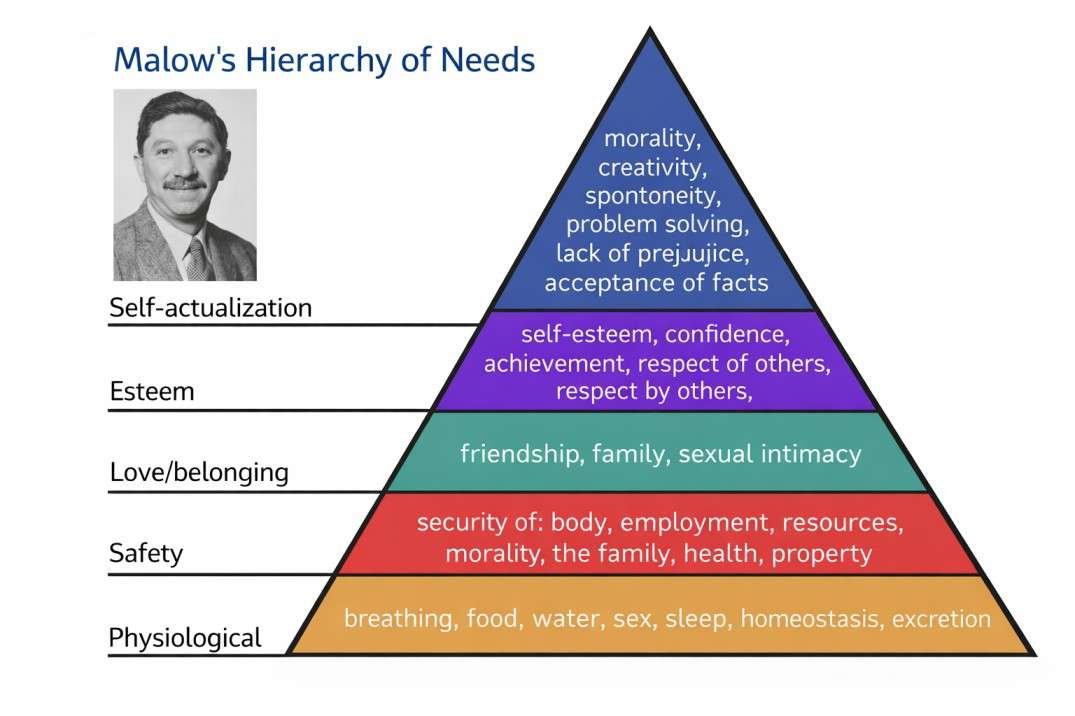
In hierarchy of needs theory, Maslow identified five types / sets of human need arranged in a hierarchy of their importance and priority. He concluded that when one set of needs is satisfied, it ceases to be a motivating factor. Thereafter, the next set of needs in the hierarchy order takes its place. These needs in hierarchy can be compared to a pyramid. At the lowest level, there will be first set of needs which can be described as basic needs and are universal in character. This will be followed by other sets of needs.
Maslow’s hierarchy of needs is often portrayed in the shape of a pyramid with the largest, most fundamental needs at the bottom and the need for self-actualization and transcendence at the top. In other words, the crux of the theory is that individuals’ most basic needs must be met before they become motivated to achieve higher level needs.
The most fundamental and basic four layers of the pyramid contain what Maslow called “deficiency needs” (d-needs): esteem, friendship and love, security, and physical needs. If these deficiency needs are not met – with the exception of the most fundamental (physiological) need – there may not be a physical indication, but the individual will feel anxious and tense. Maslow’s theory suggests that the most basic level of needs must be met before the individual will strongly desire (or focus motivation upon) the secondary or higher level needs.
Maslow also coined the term “metamotivation” to describe the motivation of people who go beyond the scope of the basic needs and strive for constant betterment.
The human brain is a complex system and has parallel processes running at the same time, thus many different motivations from various levels of Maslow’s hierarchy can occur at the same time. Maslow spoke clearly about these levels and their satisfaction in terms such as “relative”, “general”, and “primarily”. Instead of stating that the individual focuses on a certain need at any given time, Maslow stated that a certain need “dominates” the human organism. Thus Maslow acknowledged the likelihood that the different levels of motivation could occur at any time in the human mind, but he focused on identifying the basic types of motivation and the order in which they would tend to be met.
Assumptions in Hierarchy of Needs Theory:
Maslow’s Assumptions in Hierarchy of Needs Theory are:
Man is a wanting being, i.e. his wants are growing continuously even when some wants are satisfied.
Human needs are of varied and diversified nature. They can be arranged in a hierarchy of importance progressing from a lower to a higher order of needs.
Needs have a definite hierarchy of importance. As soon as needs on a lower level are fulfilled, those on the next level will emerge and demand satisfaction. This suggests that bread (food) is essential and is a primary need of every individual. According to Maslow, “Man lives by bread alone when there is no bread.” However, he feels the other needs when his physiological needs are fulfilled.
In brief, bread is important but man does not live by bread alone. There are other needs (security/safety, social, esteem, and self-actualisation) which influence behavior of people (employees) to work. This is the basic feature of Maslow’s need hierarchy.
Attention to all human needs is essential for motivation of employees. Attention to the provision of bread alone is not adequate for motivating employees. Bread can act as a motivating factor when there is no bread, but when it is available, its use as motivator comes to an end.
Here, other motivators (e.g. job security, social status, etc.) will have to be introduced for motivating employees. Attention to other needs such as security needs, social needs, esteem needs, and self-actualisation needs is equally important and essential for the motivation of different categories of employees.
Maslow, in his theory, has referred to different needs and suggested that attention needs to be given to all such needs, as attention to physiological needs alone is not adequate for motivating employees. According to Maslow, “Man does not live by bread alone”. This conclusion of Maslow is a practical reality and needs to be given adequate attention while motivating employees.
A satisfied need does not act as a motivator.
As one need is satisfied, another replaces it.
Maslow’s Pyramid of Human Needs:
Maslow’s Pyramid of Human Needs is shown in the following diagram.
1. Physiological Needs:
- Physiological needs are the basic needs for sustaining human life. These needs include food, shelter, clothing, rest, air, water, sleep, and sexual satisfaction. These basic human needs (also called biological needs) lie at the lowest level in the hierarchy of needs as they have priority over all other needs. These needs cannot be postponed for long.
- Unless and until these basic physiological needs are satisfied to the required extent, other needs do not motivate an employee. A hungry person, for example, is just not in a position to think of anything else except his hunger or food. According to Maslow, “man lives by bread alone” when there is no bread. The management attempts to meet such physiological needs through fair wages.
2. Security/Safety Needs:
- These are the needs connected with the psychological fear of loss of job, property, natural calamities, or hazards, etc. An employee wants protection from such types of fear. He prefers adequate safety or security, i.e., protection from physical danger, security of job, pension for old age, insurance cover for life, etc.
- The safety needs come after meeting the physiological needs. Such physiological needs lose their motivational potential when they are satisfied. As a result, safety needs replace them. They begin to manifest themselves and dominate human behavior. Safety needs act as motivational forces only if they are unsatisfied.
3. Social Needs:
- An employee, being a human being, is rightly treated as a social animal. He desires to stay in a group. He feels that he should belong to one or another group and that the members of the group should accept him with love and affection. Every person desires to be affiliated with such groups.
- This is treated as a basic social need of an individual. He also feels that he should be loved by other members. He needs friends and interaction with his friends and superiors of the group such as fellow employees or managers. Social needs occupy the third position in the hierarchy of needs.
4. Esteem Needs:
- This category of needs includes the need to be respected by others, need to be appreciated by others, need to have power, and finally a prestigious position. Once the previous needs are satisfied, a person feels the need to be held in esteem both by himself and by others.
- Thus, esteem needs are twofold in nature. Self-esteem needs include those for self-confidence, self-respect, competence, etc. The second group includes needs related to one’s status, reputation, recognition, and appreciation by others. This is a type of personal ego which needs to be satisfied.
- The organisation can satisfy this need by giving recognition to the good work of employees. Esteem needs do not assume motivational properties unless the previous needs are satisfied.
5. Self-actualisation Needs:
- This is the highest level among the needs in the hierarchy of needs advocated by Maslow. Self-actualisation is the desire to become what one is capable of becoming. It is a growth need.
- A worker must work efficiently if he is to be ultimately happy. Here, a person feels that he should accomplish something in his life. He wants to utilise his potential to the maximum extent and desires to become what he is capable of becoming. A person desires to have challenges and achieve something special in his life or in the area of his specialization.
- Though everyone is capable of self-actualisation, many do not reach this stage. This need is rarely fully satisfied.
Other Models of Needs
Murray’s Need:
Henry Murray, a psychologist, was active in developing a theory of motivation. He believed that a need is a potentiality or readiness to respond in a certain way under given circumstances. It is a noun which stands for the fact that a certain trend is apt to recur.
Murray identified needs as primary and secondary needs. Primary needs refer to those based upon biological demands, such as the need for oxygen, food, and water. Secondary needs are generally psychological needs, such as the need for nurturing, independence, and achievement.
Murray and his colleagues identified 24 needs, which they called psychogenic needs.
Psychogenic Needs:
The following is a partial list of 24 needs identified by Murray and his colleagues. According to Henry Murray, all people have these needs, but each individual tends to have a certain dominant level of each need.
1) Ambition Needs
Achievement: Success, accomplishment, and overcoming obstacles.
Exhibition: Shocking or thrilling other people.
Recognition: Displaying achievements and gaining social status.
2) Materialistic Needs
Acquisition: Obtaining things.
Construction: Creating things.
Order: Making things neat and organised.
Retention: Keeping things.
3) Power Needs
Abasement: Confessing and apologising.
Autonomy: Independence and resistance.
Aggression: Attacking or ridiculing others.
Blame Avoidance: Following the rules and avoiding blame.
Deference: Obeying and cooperating with others.
Dominance: Controlling others.
4) Affection Needs
Affiliation: Spending time with other people.
Nurturance: Taking care of another person.
Play: Having fun with others.
Rejection: Rejecting other people.
Succorance: Being helped or protected by others.
5) Information Needs
Cognizance: Seeking knowledge and asking questions.
Exposition: Educating others.
Influences of Psychogenic Needs: Each need is important in itself, but Murray also believed that needs can be interrelated, can support other needs, and can also conflict with one another. For example, the need for dominance may conflict with the need for affiliation when overly controlling behaviour drives away friends, family, and romantic partners.
Murray also believed that environmental factors play a role in how these needs are expressed in behaviour. He referred to these environmental forces as “presses.”
Kano’s Needs:
Japanese consultant Noriaki Kano has produced a simple diagram that was intended for use in understanding business customer needs, but is also applicable to general psychological situations.
1) Basic Needs: These are the things that we expect to get without having to ask for them. When they are being met, we hardly notice them. When we buy a second-hand car, we expect it to have five fully inflated tyres with a good amount of tread. If we got home and found the spare was bald and punctured, we would not be happy. These are called basic expectations.
2) Performance Needs: Performance needs are those things that are at the top of our consciousness and which we deliberately seek. If these are well met, we are happy; if they are not met, we become dissatisfied. In the example of buying a second-hand car, these are the features we ask about, such as traction control and modern styling.
Performance needs come from two sources. When basic needs have not been met before, they may escalate into performance needs. More commonly, they arise from expectations set by magazines, friends, or salespeople. For instance, a car salesperson may highlight a new safety system that many families now expect.
3) Excitement Needs: Beyond basic and performance needs, excitement needs are those unexpected extras that delight us. These are the features we did not anticipate but that create strong satisfaction. For example, a hands-free radio system or a soft, padded steering wheel may pleasantly surprise the buyer.
A simple equation that explains this concept is:
Delight = Expectation + 1
This means going slightly beyond performance needs. The essence of excitement lies in surprise, and the essence of surprise is unexpectedness. Surprise can be created either through gradual revelation or sudden appearance.
Glasser’s Five Needs:
William Glasser, in his Control Theory (later renamed as Choice Theory), detailed five needs that are quite close to Maslow’s Hierarchy, but with some interesting differences.
1) Survival: This is similar to Maslow’s physiological and safety needs. These are basic needs which are of little interest unless they are threatened.
2) Love and Belonging: This corresponds to Maslow’s belonging need and highlights how important it is for humans, as a social or tribal species, to be accepted by others.
3) Power or Recognition: This is somewhat related to Maslow’s esteem need. The power need focuses on our ability to achieve goals and gain recognition.
4) Freedom: This refers to the ability to make choices and act independently. It is linked with free choice and the idea of fairness or procedural justice.
5) Fun: This is an interesting ultimate goal. When other needs are satisfied, people simply want to enjoy life—this reflects the need for fun and enjoyment.
You can leverage these needs in two ways: stimulating or satisfying them.
Stimulate Needs: The simplest way to stimulate needs is to make them visible. Show people what they lack and what they could achieve in the future. If you have influence, you may even highlight or remove certain benefits to create awareness of unmet needs.
Satisfy Needs: When people have needs (especially those that have been stimulated), you can offer ways to fulfill them. This puts you in a position of negotiation and influence, as satisfying needs can guide behaviour.